
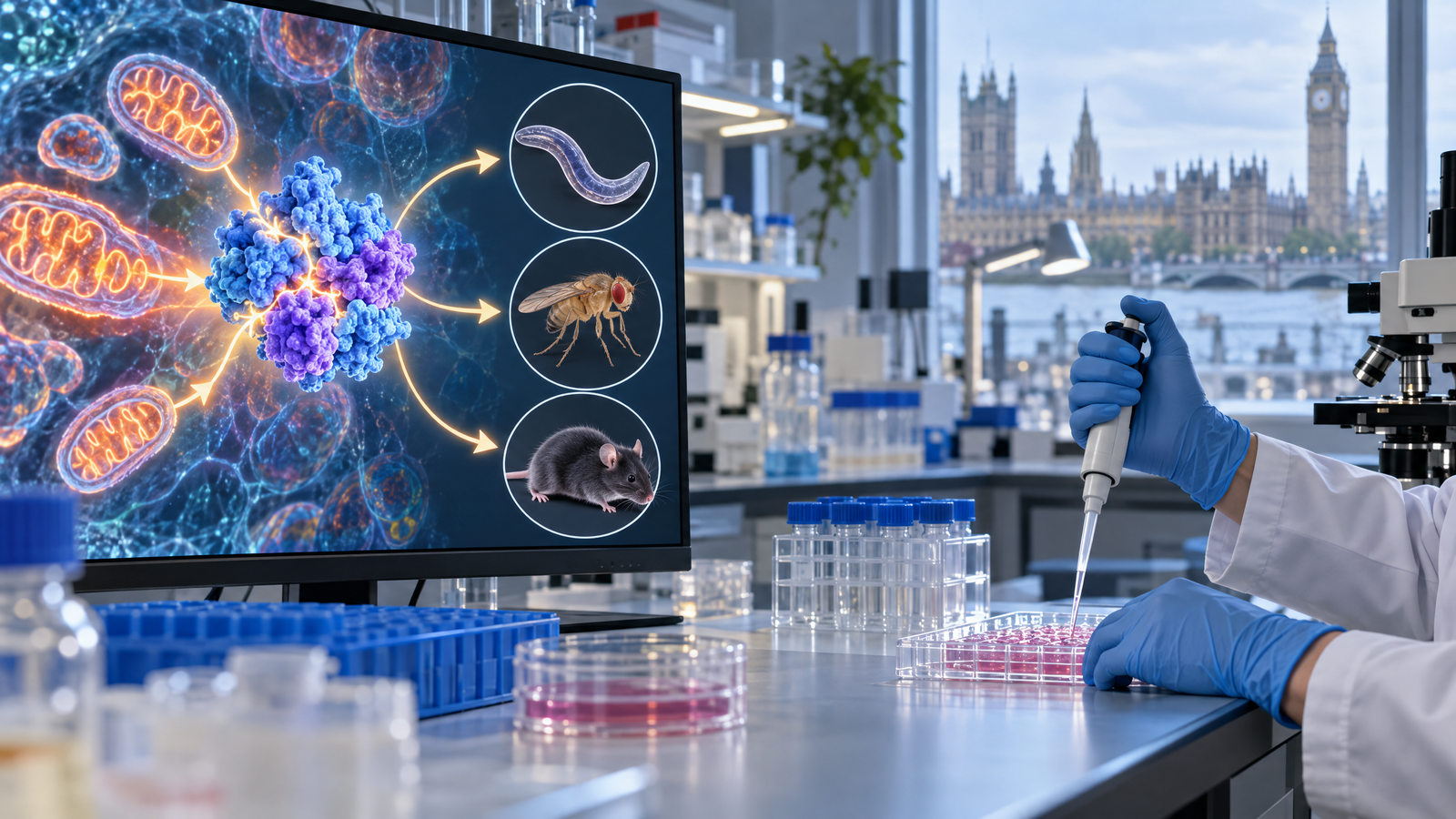

Research involving Queen Mary University of London has found that directly activating a cellular energy sensor extended lifespan in fission yeast, nematode worms and fruit flies, while also underlining that the work does not show a human anti-ageing treatment or a mammalian lifespan benefit.
The study examined a compound known as 991, which activates AMP-activated protein kinase, or AMPK. The enzyme helps cells respond when energy levels are low and has long been of interest to researchers studying metabolism, ageing and healthy lifespan. The findings add laboratory evidence that AMPK itself can influence longevity in several model organisms when switched on directly.
Direct test of a long-studied ageing pathway
AMPK is often described as a cellular fuel sensor because it helps cells adjust to energy shortage. When activated, it promotes processes linked to energy production and cellular recycling while reducing growth-related activity. Its role in ageing has been investigated for years, but separating AMPK’s effects from the wider effects of drugs and diet has been difficult.
The research, titled Direct Pharmacological Activation of AMPK Extends Lifespan in Yeast, Worms and Flies, used compound 991 to test the pathway more directly. Unlike drugs that may influence AMPK indirectly while also acting on other biological systems, 991 binds directly to AMPK and switches it on. That made it a useful tool for asking whether AMPK activation itself could alter lifespan in living organisms.
The work involved fission yeast, the nematode worm Caenorhabditis elegans and the fruit fly Drosophila melanogaster. These organisms are widely used in ageing biology because their lifespans are short, their genetics can be manipulated and many core cellular processes are shared across species.
Effect disappeared when AMPK was missing
In the lifespan experiments, 991 extended life in yeast, worms and flies under reported laboratory conditions. The study also found that the effect was absent in AMPK-deficient worms and yeast. That result supports the conclusion that the longevity effect depended on AMPK rather than on an unrelated action of the compound.
The cross-species result is notable because AMPK is evolutionarily conserved, meaning related versions of the enzyme are found across diverse organisms. The study first examined whether 991 could act on AMPK beyond mammalian systems, then used the compound in model organisms to test whether direct activation altered survival.
The work was carried out by researchers across several institutions, with Queen Mary affiliations listed for John-Patrick Alao and Charalampos Rallis. Rallis is identified by the university as a co-author and Reader in Genetics, Genomics and Fundamental Cell Biology. Collaborating London institutions included the MRC Laboratory of Medical Sciences, Imperial College London and the Francis Crick Institute.
Higher doses raised safety questions
The findings do not support a simple message that more AMPK activation is necessarily better. Higher doses of 991 shortened lifespan in some experiments. That dose-related harm signal is an important limit on how the results should be interpreted, because it suggests the pathway may need to be activated within a particular range and under particular nutritional or biological conditions.
The compound should not be presented as a supplement, medicine or practical anti-ageing intervention for people. The work was conducted in laboratory model organisms and in a short mouse experiment that examined molecular changes rather than lifespan. There is no evidence from this study that 991 extends human life, improves human healthspan or is suitable for self-administration.
Mouse work showed molecular changes, not longer life
The mouse component lasted three weeks and focused on molecular and liver-protein analysis. After treatment, researchers observed changes consistent with AMPK activation, including processes associated with ATP production and mitochondrial biogenesis, alongside suppression of the growth-promoting mTOR pathway.
Those results were molecular signatures only. The mouse work did not demonstrate lifespan extension, and longer-term studies would be needed to establish whether direct AMPK activation can improve lifespan or healthspan in mammals. The next research step is expected to involve testing health and lifespan effects in mice, but the field remains far from human anti-ageing clinical trials.
The study therefore places AMPK more firmly among the biological pathways that can be experimentally targeted in ageing research, while also showing why caution is needed. Direct activation of the pathway extended lifespan in three model organisms, but dose, context and species differences remain central unresolved questions before any relevance to mammalian ageing, let alone human health, can be established.







