
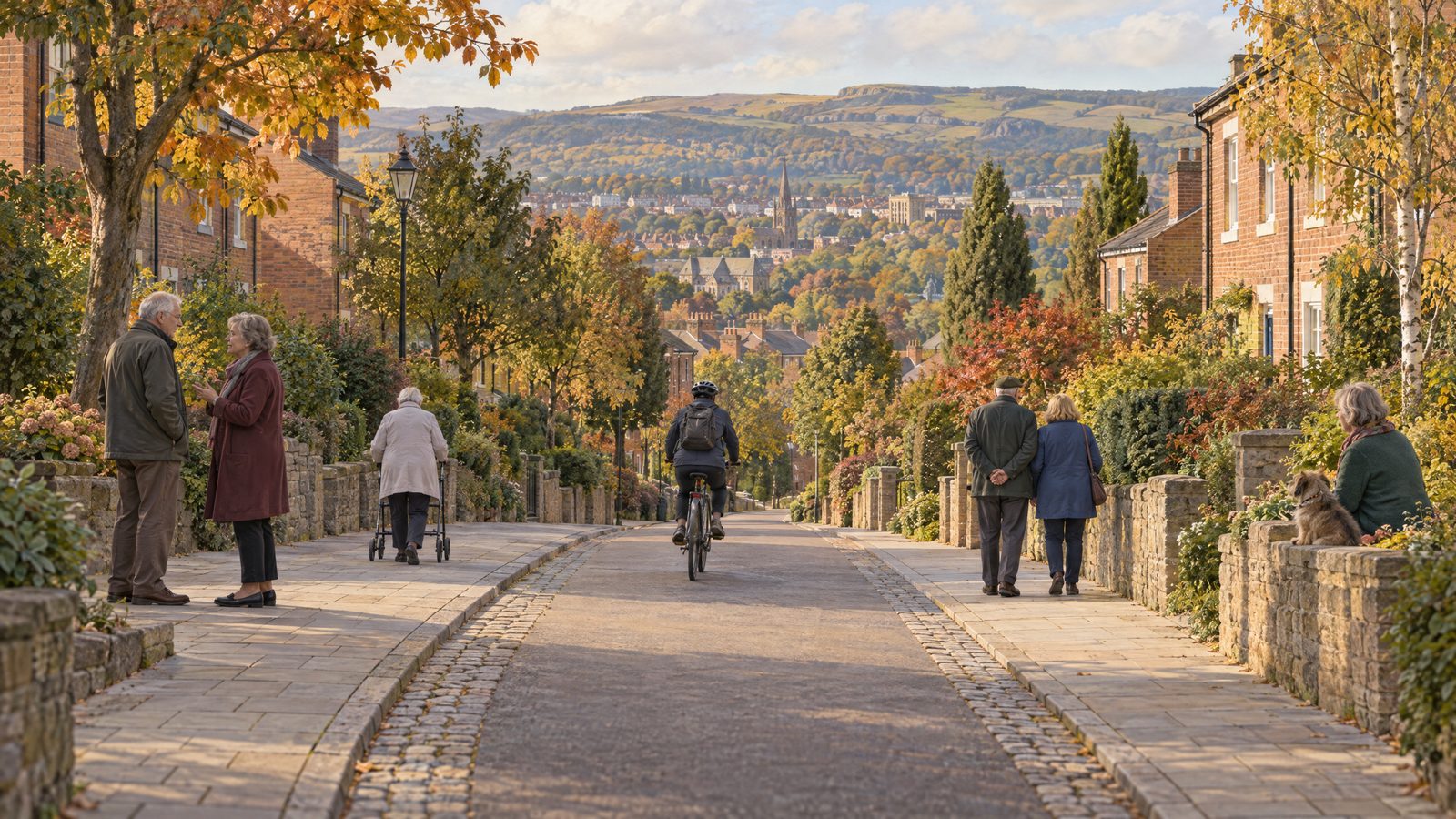

Sheffield residents are being asked whether the city should consider 20mph speed limits on more types of streets, as the council reviews a policy that has focused on residential areas since 2012. The engagement is part of a wider update to the Road Safety Delivery Plan. It does not propose an immediate change to the limit on any named road.
A review of where the policy applies
The Council is seeking views from people who live, work, study or travel in Sheffield, as well as businesses and visitors. It wants feedback on the kinds of streets that could be considered for 20mph limits in future. The issue is whether the city’s framework should continue to concentrate on residential streets or potentially include other street types. No list of roads is being put forward for a decision through this engagement.
The existing policy was approved in March 2012. The consultation material explains that it uses average vehicle speeds and national guidance when deciding which residential roads can be considered. Roads averaging 24mph or below are automatically considered for a 20mph limit. Where average speeds fall between 24mph and 27mph, a limit is assessed case by case using government guidelines. Roads averaging 27mph or more are considered only if funding can be identified for the traffic-calming measures needed to reduce speeds.
These thresholds describe the current residential policy, not a new citywide speed rule. The review is asking whether additional categories of streets should be included in a future approach. That distinction matters: asking about eligibility at policy level does not itself select roads, set new limits or determine what treatments a particular street would need.
Road safety is the stated rationale
The Council says around 300 people are killed or seriously injured on Sheffield roads each year. It presents safer and appropriate speeds as one part of reducing collision likelihood and severity, within a broader road-safety approach. Sheffield is a member of the South Yorkshire Safer Roads Partnership, whose stated Safe System principle is that no one should be killed or seriously injured in a road collision.
In explaining the case for reviewing its policy, the Council cites evidence that every 1mph reduction in average speed can result in a 5 per cent reduction in collision frequency. That is a general evidence claim, not a forecast that Sheffield’s annual toll would fall by a fixed amount if the policy changed. The council’s consultation material also notes evidence from Wales: during the first 18 months after 20mph limits were introduced in 2023, the number of people killed or seriously injured on 20mph and 30mph roads fell by 11 per cent. It is a separate Welsh experience and should not be read as a measured Sheffield outcome.
The same material recognises that journey times and air quality are common concerns. It summarises Welsh analysis of 60 journeys, which found an average increase of around eight seconds per mile where a 20mph limit applied, while journey-time reliability improved on 45 of the routes. It also cites a London evaluation that found no increase in vehicle exhaust emissions, with smoother driving involving fewer accelerations and decelerations. These examples offer context for the debate; they do not settle how any future Sheffield proposal would perform on a specific road.
Feedback comes before any road-level process
The online survey remains open until 11:59pm on Sunday 8 November 2026. Feedback will be analysed to inform a revised policy, which will then be presented to councillors for consideration and approval. Councillor Alexi Dimond, chair of the Transport, Regeneration and Climate Committee, said the council wants people across Sheffield to help shape its future approach.
If councillors approve an updated framework, proposals for individual streets or areas would still be considered separately and would be subject to statutory consultation. The present engagement is therefore an early policy stage, not a notice that a particular road will become 20mph. Its outcome will help define what kinds of locations might be assessed later; any eventual street-level decision would require its own process.
The council says it particularly wants to hear from a broad range of people, including parents, children, older residents and people who use mobility aids or encounter other accessibility barriers. That emphasis reflects how speed policy affects people using the same street in different ways. Residents, businesses, commuters, students and visitors can take part before the November deadline.







