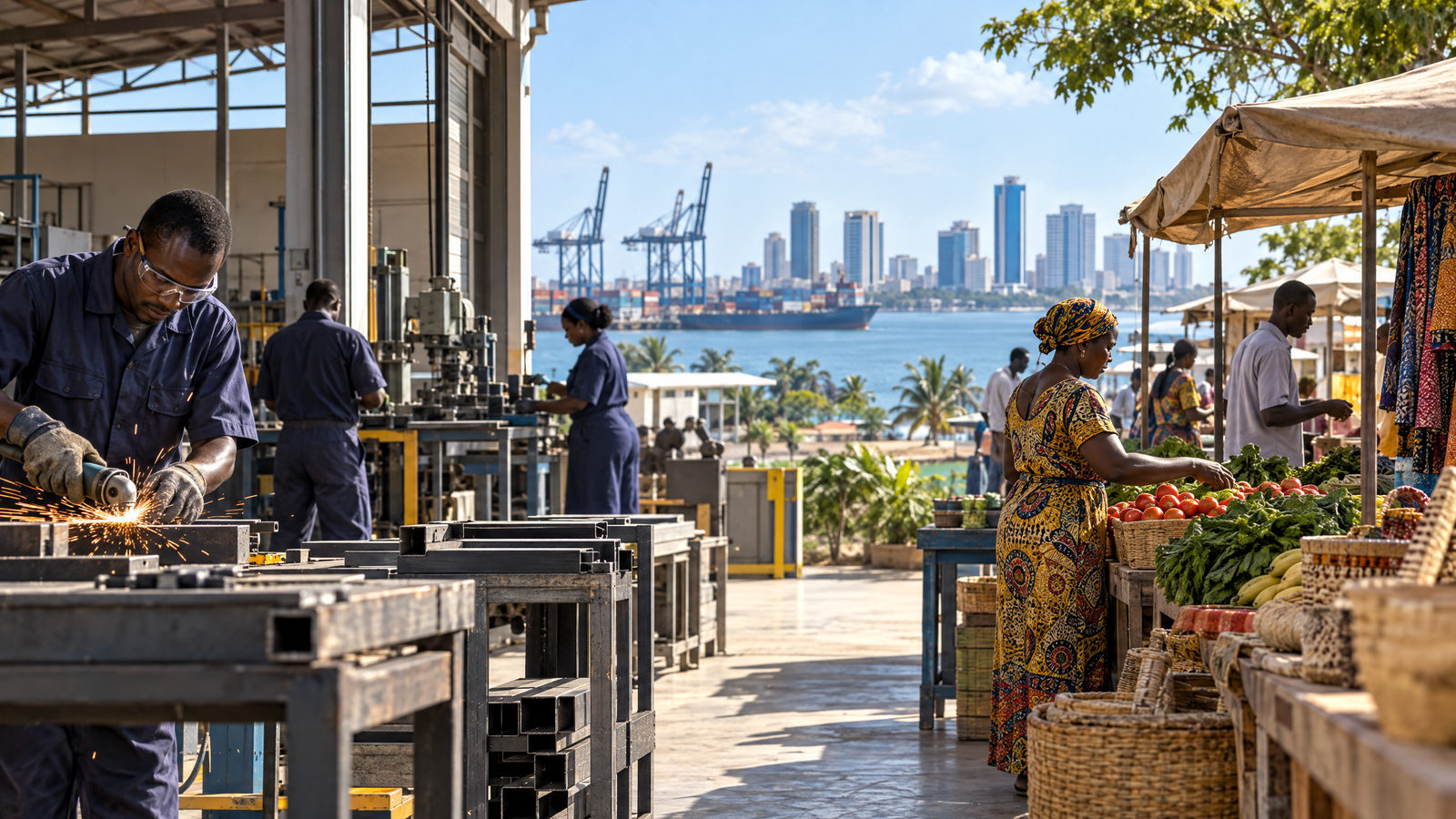

Tanzania is forecast to expand by 6.1% in 2026, with growth averaging 6.5% over the medium term, but the central economic test will be whether that momentum produces more secure and productive work. A newly released Tanzania Economic Update places job quality, rather than the raw number of jobs, at the centre of the country’s route towards lower poverty and higher living standards.
The outlook follows GDP growth of 5.9% in 2025 and is underpinned by increased private-sector activity. Finance, trade and transport have been major contributors to the recent expansion. Inflation has remained within the Bank of Tanzania’s 3% to 5% target band, while public debt stands at 49% of GDP. Revenue has exceeded target in the 2026 fiscal year, reflecting stronger domestic resource mobilisation.
Those figures offer a comparatively stable starting point, but they do not remove the risks facing the economy. Higher global energy prices and freight costs have widened the current-account deficit to 2.5% of GDP in 2026. Gold exports provide some protection, yet the country remains exposed to external shocks. The outlook also depends on maintaining growth-friendly fiscal consolidation and on continued reforms to improve the business environment.
The update makes a sharp distinction between employment and a livelihood that can reliably improve a household’s circumstances. Nearly 69% of working-age people are employed, but much of that work is in low-productivity agriculture or informal activity. Earnings can be insufficient, and workers can remain highly vulnerable to economic or climate-related shocks. In that setting, a high employment rate does not automatically translate into a secure route out of poverty.
Workforce barriers are part of the problem. Many people lack the foundational skills needed to move into more productive and better-paid roles. Women face additional obstacles through occupational segregation, caring responsibilities and limited access to training. Existing programmes intended to support poorer households are described as small and fragmented, with too few people able to use them to gain skills or move into stronger opportunities.
The challenge is also on the demand side of the labour market. Formal businesses are relatively few and are expanding slowly, limiting the supply of good jobs. Just 12% of registered firms are young, compared with 38% in Rwanda. Complex registration procedures, weak arrangements for resolving business failure, limited long-term credit and insecure land rights can all deter investment and expansion, particularly for smaller businesses.
The proposed response has two linked parts. One is to help productive firms invest and grow, including through digital business registration, a stronger legal framework, wider access to finance and digitally accessible land records. The other is to build a workforce better prepared to benefit from those openings. That includes skills development, social protection that helps people move into better work, recognition of skills gained in informal employment, and programmes designed around women’s needs, including childcare and flexible schedules.
Agriculture and industry remain important areas for potential productivity gains. Agriculture employs most Tanzanians but has been held back by inefficiencies in input markets, including fertiliser distribution. Mining has faced pressure from maturing mines and limited new investment. A broader export base beyond gold and tourism would also reduce exposure to external disruption.
The growth forecasts are projections rather than guarantees, and their achievement will depend on policy choices, business investment and conditions beyond Tanzania’s control. The more immediate message is that economic expansion alone will not settle the jobs question. Durable poverty reduction will require growth to be matched by firms able to create quality work and by workers able to take up those opportunities.