

Technology will not automatically solve all compliance problems. Good data quality, competent investigators, and strong cooperation with regulators are also key to effective risk management. High-quality data ensures that advanced systems generate reliable insights. Professionally trained analysts are still required to make decisions and interpret complex cases.
Financial institutions are also finding that they can collaborate more closely with regulatory bodies through the implementation of new technologies. Early engagement helps build trust and ensures that new solutions are developed in line with regulatory requirements.
The future of financial crime compliance is not just about adopting new tools. It represents a shift toward intelligence-led risk management, where technology, data, and human expertise are integrated. As one financial crime expert notes, “Financial crime is no longer about isolated events; it is about connected patterns that require equally connected systems to detect and prevent.”
Why Traditional Sanctions Screening Is Struggling
Name matching with official sanctions lists has long been a sensitive area of sanctions compliance. As soon as a customer name was similar to a name on a sanctions list, an alert was triggered and analysts would then investigate the case. This is a workable solution; however, it leaves much to be desired, particularly when compared with more sophisticated approaches that use data-driven and behaviour-based detection systems rather than simple name matching.
One of the biggest problems with basic name-matching systems is the high number of false positives. Compliance departments tend to waste enormous amounts of resources processing cases that ultimately prove to be legitimate. This inefficiency can cause investigators to lose focus on actual threats.
The behaviour of sanctioned individuals and organisations presents another challenge. Once they are identified, they can quickly alter their methods. They may do this through intermediaries, the creation of shell companies, or by transferring transactions across different jurisdictions. Such tactics make the screening process more complex, to the point where it becomes difficult to determine suspicious behaviour using simple screening systems. The real risk is often not a direct name match, but patterns and signals within financial transactions. Traditional screening systems struggle to detect these hidden patterns.
Technology as a Turning Point
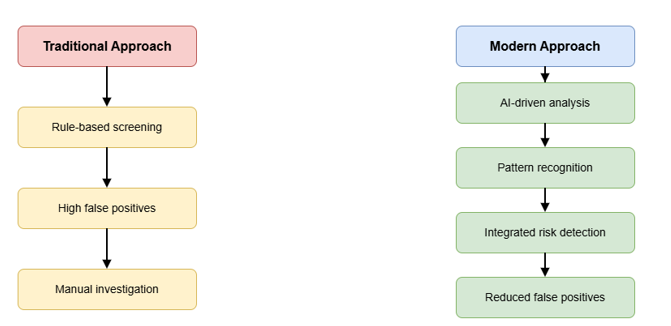
Banks are resorting to the use of sophisticated technologies to manage these issues. Machine learning and artificial intelligence have begun to transform the way risks are identified and potential financial crimes are investigated. Contemporary systems do not merely rely on rule-based approaches but instead analyse vast amounts of data and identify unusual patterns of behaviour.
This figure illustrates the shift from reactive rule-based systems to integrated, intelligence-driven financial crime detection.
These systems are able to trace transactions, establish links between clients, and identify abnormal behaviour in comparison to normal activity. They can uncover complex networks that would otherwise remain concealed through continuous data analysis. This enables compliance teams to move beyond simple list checks and gain a clearer understanding of financial activity.
Another benefit of intelligent systems is the reduction of unnecessary alerts. The models can be trained using historical data and user feedback to better distinguish between risky and legitimate transactions. This can significantly reduce the workload of analysts and improve the overall quality of investigations.
The Growing Role of Context and Information
Financial crime rarely exists in isolation. Critical leads are often found in news stories, official documentation, and other unstructured data. With the emergence of advanced technologies, analysing these sources is now feasible, enabling deeper insights into customers and organisations.
Articles, reports, and other external sources allow modern systems to identify relationships that are not apparent from transaction data alone. For example, connections between companies, reputational concerns, or emerging geopolitical risks can be revealed through the use of external information. This approach enables compliance teams to develop a more comprehensive understanding of potential risks. This shift represents a move from reactive compliance to proactive intelligence gathering, where situational awareness is as important as transactional analysis.
The integration of internal transaction data with external intelligence is emerging as a powerful tool in combating financial crime. It helps institutions detect risks earlier and respond more effectively when suspicious activity arises.
Breaking Down Compliance Silos
Other significant changes include advancements in compliance programs. In many institutions, these functions-sanctions compliance, anti-money laundering monitoring, and customer due diligence—are carried out in separate departments. Each function gathers its own data and provides its own analysis. While this may have worked in the past, it now creates potential gaps, especially when compared to institutions that have begun integrating sanctions, AML, and customer data into unified systems to gain a more comprehensive view of risk.
Financial crime activities often blur the boundaries between these areas. Money laundering practices can resemble sanctions evasion schemes, and information collected during customer onboarding may contain valuable insights for transaction monitoring. These connections can easily be overlooked when teams and systems operate in isolation.
The new generation of risk management focuses on unifying these functions into a single system. When institutions integrate sanctions data, customer information, and transaction monitoring outcomes, they can develop a more comprehensive and dynamic understanding of risk. This integrated perspective enhances the ability to detect complex schemes that might otherwise remain hidden.
Building a Smarter Compliance Future
Technology will not automatically solve all compliance problems. Good data quality, competent investigators, and strong cooperation with regulators are also key to effective risk management. High-quality data ensures that advanced systems generate reliable insights. Professionally trained analysts are still required to make decisions and interpret complex cases.
Financial institutions are also finding that they can collaborate more closely with regulatory bodies through the implementation of new technologies. Early engagement helps build trust and ensures that new solutions are developed in line with regulatory requirements.
The future of financial crime compliance is not just about adopting new tools. It represents a shift toward intelligence-led risk management, where technology, data, and human expertise are integrated. As financial crime continues to evolve rapidly, institutions that remain agile and adaptable will be better positioned to detect threats, protect their customers, and maintain the integrity of the global financial system, enabling a more dynamic and intelligence-driven response to emerging risks.