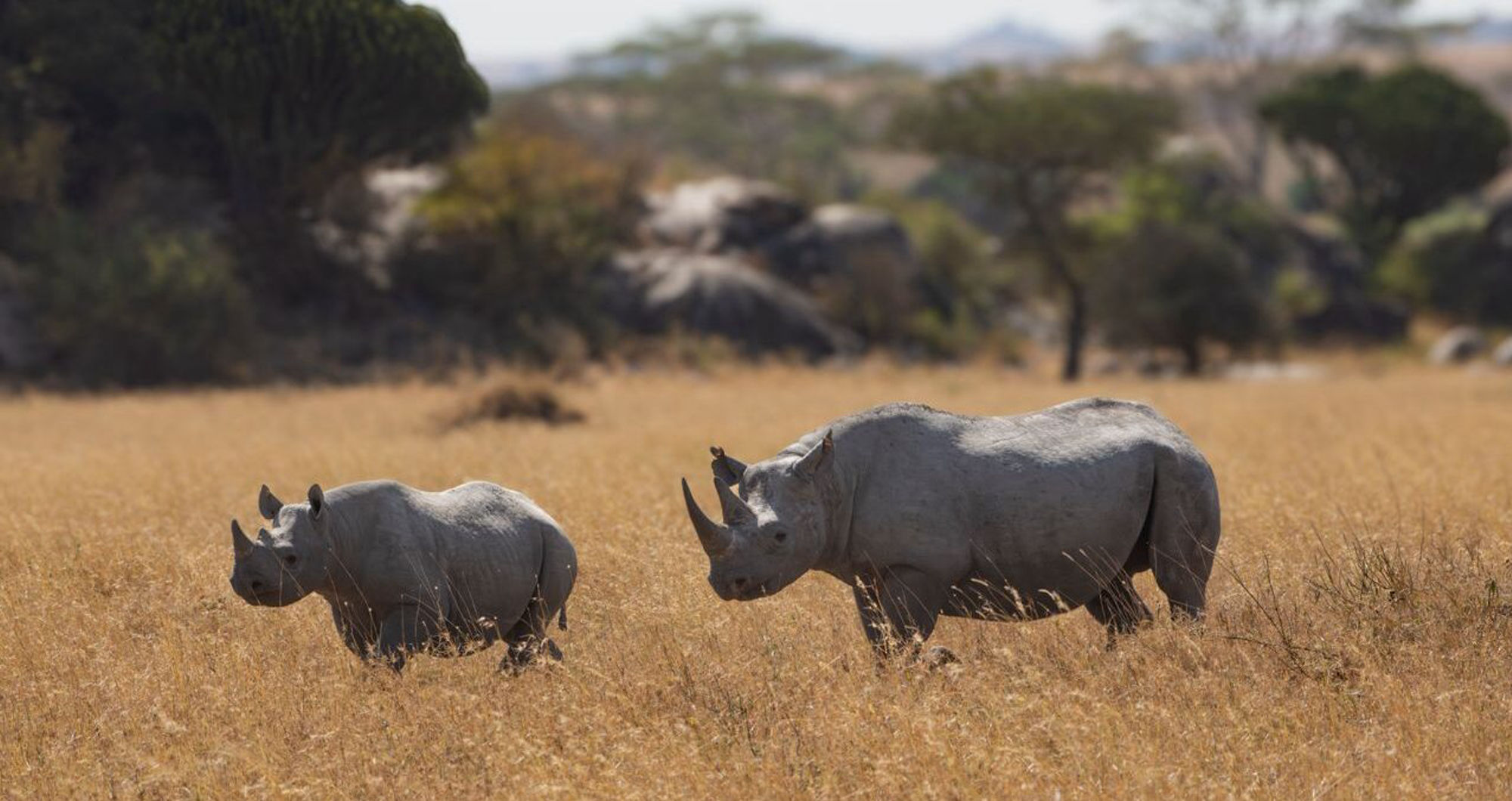

For many British travellers planning an African safari, the shortlist often includes South Africa, Tanzania or Botswana. Northern Kenya rarely makes the first draft of the itinerary. Yet in the remote Sera Conservancy, deep within the Samburu region, visitors can experience something that remains exceptionally rare: tracking critically endangered black rhinos on foot alongside the community helping to bring them back.
The heat in the Sera Conservancy feels like a physical weight. It presses against the temples and vibrates off the rust-coloured earth of northern Kenya in a shimmering haze. Here, in this arid landscape, the air carries the scent of wild sage and dry, peppery soil that has gone months without rain.
Deep inside a dry riverbed, the sand shifts beneath your boots, revealing a footprint that, only a few decades ago, should not have existed. You are following the tracks of a black rhino on foot—an experience that has become one of Kenya’s most distinctive wildlife encounters.
A Species That Almost Disappeared
For decades, black rhinos were effectively absent from this part of Kenya. Poaching devastated populations across East Africa during the late twentieth century, and by the 1990s, sightings in Samburu had become little more than memories shared by local elders.
Today, those memories are becoming reality once again.
The black rhino has returned to Sera, protected not only by conservation organisations but also by the Samburu community itself, whose long-term commitment has helped restore a species that had almost disappeared from the landscape.
A Different Kind of Safari
Many UK visitors are familiar with traditional game drives, where wildlife is viewed from the safety of a 4×4 vehicle. Rhino tracking in Sera offers something entirely different.
No vehicle doors are separating you from the wilderness. Instead, every step is guided by experienced Samburu trackers who read the landscape in remarkable detail. A faint footprint, disturbed sand, or fresh dung becomes evidence of an animal that may have passed only minutes earlier.
Suddenly, every thorn bush and acacia tree takes on new significance.
Unlike the more placid white rhino, black rhinos are known for their unpredictable temperament. They browse through dense vegetation and can react quickly when surprised. That is why every movement is carefully managed by experienced local guides, who understand both the terrain and the behaviour of the animals.
Conservation Led by the Community
One of the most remarkable aspects of Sera Rhino Sanctuary is its ownership.
It is the first community-owned and managed black rhino sanctuary in East Africa. Rather than conservation being directed from outside the region, the sanctuary is managed by the Samburu people themselves.
Since the first ten rhinos were reintroduced in 2015, the population has continued to grow.
The sanctuary also protects a broader ecosystem where wildlife, livestock and local traditions continue to coexist. Nearby are the famous Singing Wells, where Samburu herders still sing traditional songs while drawing water for their cattle—a practice that has continued for generations.
For local communities, the return of the rhino represents far more than successful wildlife conservation. It marks the recovery of a landscape that holds both ecological and cultural significance.
Meeting a Black Rhino on Foot
Rhinos are often found near dense Commiphora thickets.
Eventually, through the branches, a charcoal-grey shape comes into view. Standing quietly at a safe distance, guided entirely by the wind direction and the trackers’ instructions, visitors watch as the animal feeds, almost unaware of their presence.
The silence is broken only by the steady crunch of branches.
In that moment, the comforts of the safari lodge fade into the background. The focus narrows entirely to the rhino, whose powerful sense of smell constantly tests the air for danger.
After a few moments, it turns, slips back into the thorn scrub and disappears almost as quietly as it arrived.
A Journey Worth Considering
As more British travellers look beyond traditional safari routes, northern Kenya offers an experience that combines wildlife, conservation and community in equal measure.
Tracking black rhinos on foot is not simply another safari activity. It provides an opportunity to witness one of Africa’s most successful conservation stories while supporting a model in which local communities play the leading role.
For UK visitors seeking an alternative to more familiar safari destinations, Sera Conservancy demonstrates that some of East Africa’s most memorable wildlife experiences are found far from the busiest tourist routes.