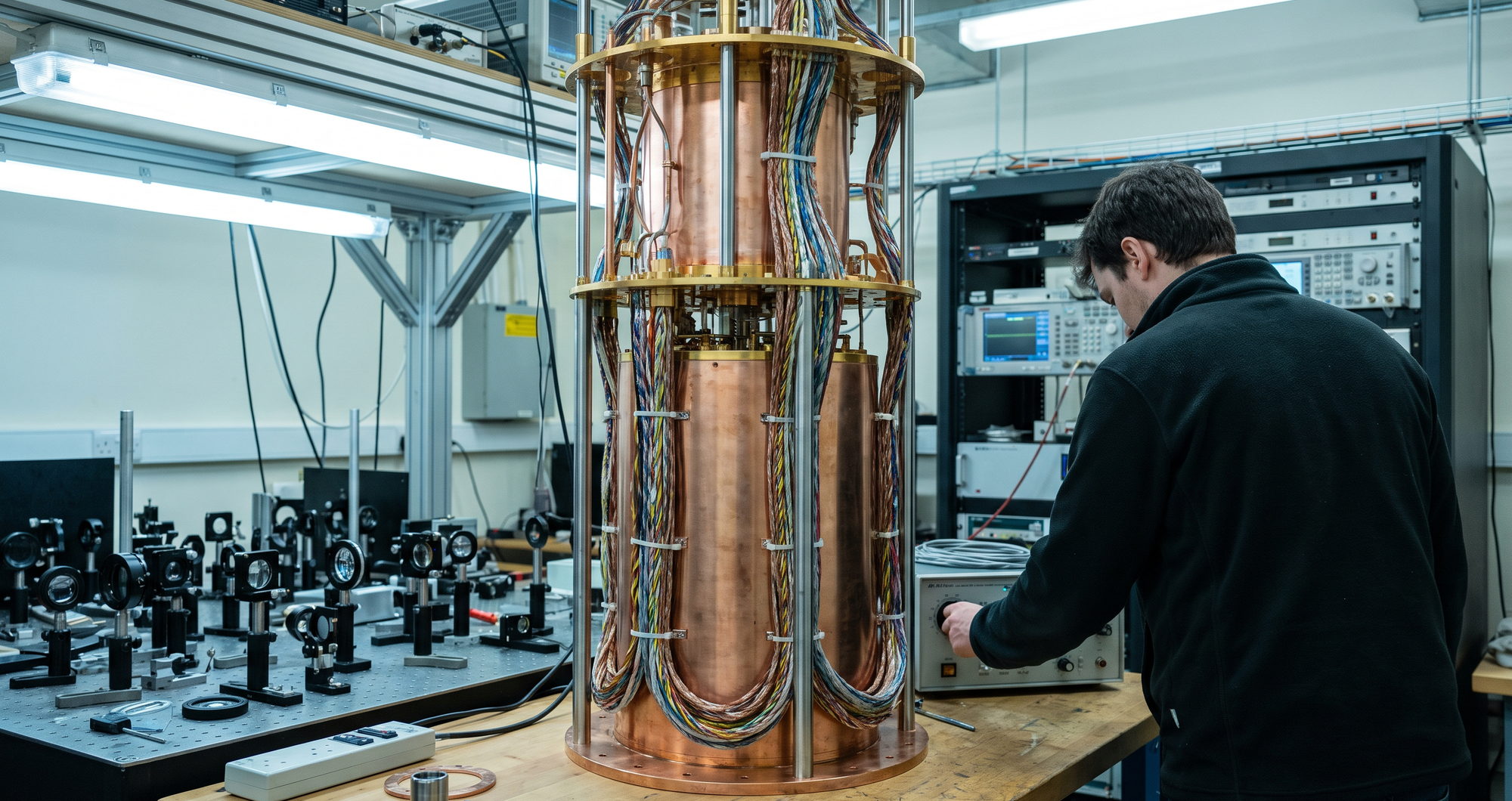

The National Quantum Computing Centre and the Science and Technology Facilities Council named 13 winning projects on 6 November in this year’s SparQ cross-cluster proof-of-concept call. The programme pairs organisations with a defined business problem against developers of quantum hardware and software. The centre is based at the council’s Harwell campus.
Selection was split across two tracks: the standard proof-of-concept call and a strand labelled POC+ in the announcement. Each winning project must bring together an end-user organisation and a quantum technology provider, so the awards fund collaborations rather than single teams working alone.
Two tracks, thirteen projects
The first project named in the announcement is QuIP’D, a collaboration built around quantum-inspired optimisation. Optimisation, sensing and quantum-inspired methods are the areas the selected work covers.
Pairing is the substantive part of the design. A hardware developer working alone can demonstrate an advantage on a problem of its own choosing. An end user arrives with a problem that has a cost, a deadline and a reason to care whether the answer is right. The awards are meant to put those two parties in the same project.
No headline funding total was disclosed, so the size of the individual awards is not public. That omission limits how much can be read into the announcement: 13 projects is a count of activity, not a measure of money committed or of results expected, and the round cannot be compared with earlier funding announcements on value, only on scope. It also means the round cannot be weighed against the sums attached to earlier state quantum programmes.
What the awards test
SparQ is the centre’s access programme, which gives UK teams time on quantum computers along with technical support. The proof-of-concept round sits on top of that access, and its stated purpose is to build evidence of commercial usefulness ahead of the wider national quantum strategy’s milestones.
Evidence of that kind is a specific thing. It means a result on a real dataset, set against the best conventional method available, at a cost and within a time that an organisation could live with. None of it has been produced yet, and the round exists to find out whether it can be.
That framing is deliberately modest. A proof of concept tests whether an approach works on a real problem with real data. It is not a statement that a product exists, that a method beats a conventional one on cost or speed, or that the work is ready for market, and the announcement makes no such claim for any of the 13.
What happens next
The projects will now run, with each partnership expected to produce evidence about whether its chosen problem is tractable on current hardware. The announcement did not set completion dates, and no results have been published.
For the funders, the value of the round lies in what it reveals about which sectors are willing to commit staff time to quantum experimentation, and whether the answers justify the next round of spending. For the companies involved, the calculation is narrower: whether a method that works in a demonstration can be made to work on their own data, inside their own constraints, before the hardware changes underneath them.
What the round will not settle is whether quantum computing is useful to these organisations at all. That question is for the years after the evidence is in, and it will be answered project by project rather than in a single announcement.