
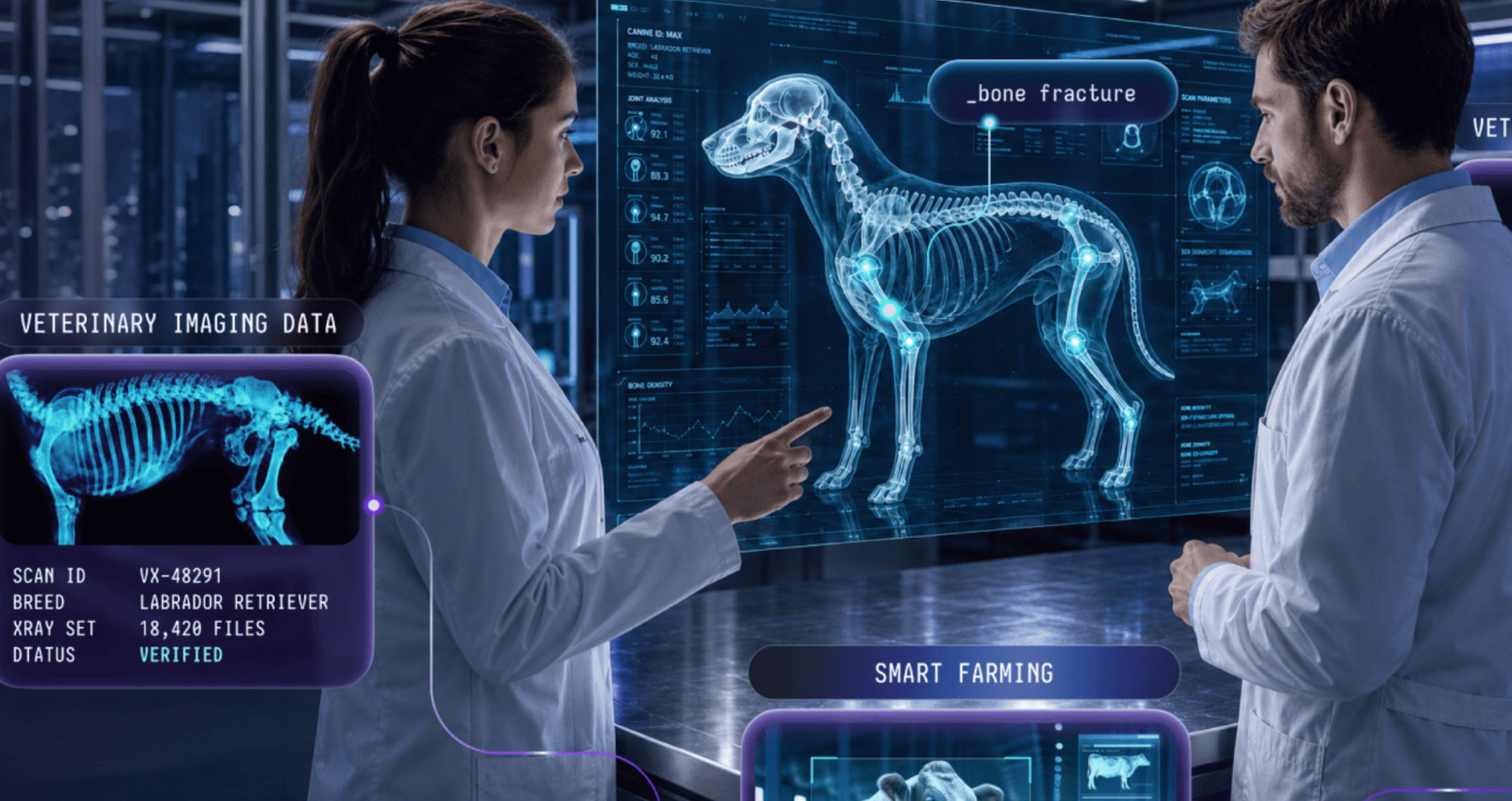

AI is transforming veterinary medicine and animal agriculture in ways that would have sounded far-fetched a decade ago — models that flag abnormalities on a dog’s X-ray, systems that monitor thousands of livestock for early signs of illness, sensors that track herd behaviour across an entire farm. None of this works without carefully labelled training data, which is exactly the gap that specialised veterinary AI data annotation services are built to fill.
A Different Kind of Complexity Than Human Medical AI
At first glance, veterinary annotation might seem like a simple variation of medical data annotation for humans — same imaging modalities, similar techniques, different subject. In practice, it’s a distinct discipline with its own set of challenges.
Anatomy varies dramatically across species. A radiograph annotation protocol built for canine chest X-rays doesn’t transfer cleanly to equine, feline, or livestock imaging. Behavioural datasets for livestock monitoring involve tracking dozens of animals simultaneously, often closely grouped together in a single frame, moving unpredictably, and requiring the annotator to distinguish between individuals that look nearly identical. This is a fundamentally different annotation problem than labelling a single, cooperative human patient in a controlled clinical setting.
Where Veterinary AI Annotation Is Actually Being Used
The applications span a wider range than most people expect:
Veterinary diagnostic imaging — annotating radiographs, dental X-rays, and abdominal scans to train AI systems that help veterinarians catch abnormalities faster and more consistently.
Livestock monitoring and behaviour tracking — labelling animal positions (standing, sitting, lying down, feeding) and movement patterns across large groups, supporting AI systems used in modern farm management.
Animal health and welfare datasets — building training data for models that flag early signs of illness, distress, or injury in production animal environments.
Keypoint and pose annotation — marking specific body parts on animals to support movement analysis, gait assessment, and physical health monitoring.
Each of these use cases demands a slightly different annotation approach, and the datasets involved can get complicated fast — some livestock monitoring projects involve annotating 20 to 35 closely grouped animals within a single frame, which requires real precision to avoid mislabeling or losing track of individual subjects as they move and overlap.
Why Domain Expertise Matters More Than It Might Seem
Diagnosing abnormalities on a veterinary radiograph is not something a general-purpose annotator can pick up casually. It requires familiarity with species-specific anatomy and an understanding of what a genuine pathology looks like versus normal anatomical variation. This is why serious veterinary annotation work increasingly involves annotators with actual veterinary training — including licensed veterinarians and veterinary radiologists — rather than generalist labellers applying techniques learned on human medical imaging or everyday object detection.
The same principle applies on the agricultural side. Recognising subtle behavioural cues that indicate illness or distress in livestock takes a different kind of domain familiarity than labelling bounding boxes around cars or pedestrians. Annotators need context about normal versus abnormal animal behaviour to label datasets that actually teach a model something useful.
Techniques Commonly Applied in Veterinary and Livestock Projects
- Bounding boxes and keypoint annotation — locating and tracking individual animals or specific body parts across frames.
- Position and behaviour classification — labelling actions like standing, lying, feeding, or moving for behavioural analysis models.
- Radiographic annotation — identifying and labelling abnormalities in X-rays and other diagnostic imaging specific to veterinary anatomy.
- Quality assurance review — verifying the accuracy and consistency of pathology annotations, often by comparing against expert assessment.
Why This Work Tends to Get Outsourced
Veterinary AI is a relatively young and fast-growing niche, which means most companies building products in this space are startups or specialised teams without the resources to build an entire annotation function from scratch — let alone one that spans multiple species and use cases.
Outsourcing to a partner with existing veterinary and agricultural annotation experience solves a few practical problems at once:
Access to specialised annotators. Rather than spending months trying to recruit veterinary radiologists or animal behaviour experts internally, companies can plug into an existing network of professionals who already understand the domain.
Scalability for large agricultural datasets. Livestock monitoring projects often involve massive volumes of footage across many animals and locations, requiring a workforce that can flex up quickly without sacrificing labelling consistency.
Established QA processes. Multi-step review, including verification against expert assessment, catches errors before they compound across a training dataset — particularly important in diagnostic applications where a missed abnormality has real consequences.
Data security for sensitive projects. Some veterinary and agricultural datasets involve proprietary farm operations data or client-sensitive information, which requires the same rigour around confidentiality and secure handling found in other regulated annotation work.
What Good Results Look Like
Companies working in this space have used properly annotated behavioural datasets to build models capable of accurately classifying animal positions and movement patterns across large, closely grouped populations — the kind of result that would be extremely difficult to achieve with inconsistent or poorly supervised labelling. The difference between a usable veterinary AI model and one that fails in the field often comes down to exactly this: whether the training data was labelled by people who actually understood what they were looking at.
Final Thoughts
Veterinary and agricultural AI is still an emerging category, but it’s growing quickly, and the annotation work behind it deserves the same rigour applied to any other high-stakes vertical. Getting it right means working with annotators who understand species-specific anatomy, animal behaviour, and the practical realities of livestock and clinical veterinary environments — not simply repurposing generic image labelling workflows and hoping they translate. As more AI companies enter this space, partnering with a team that already has this specialised experience tends to save significant time and prevent costly mistakes down the line.







