
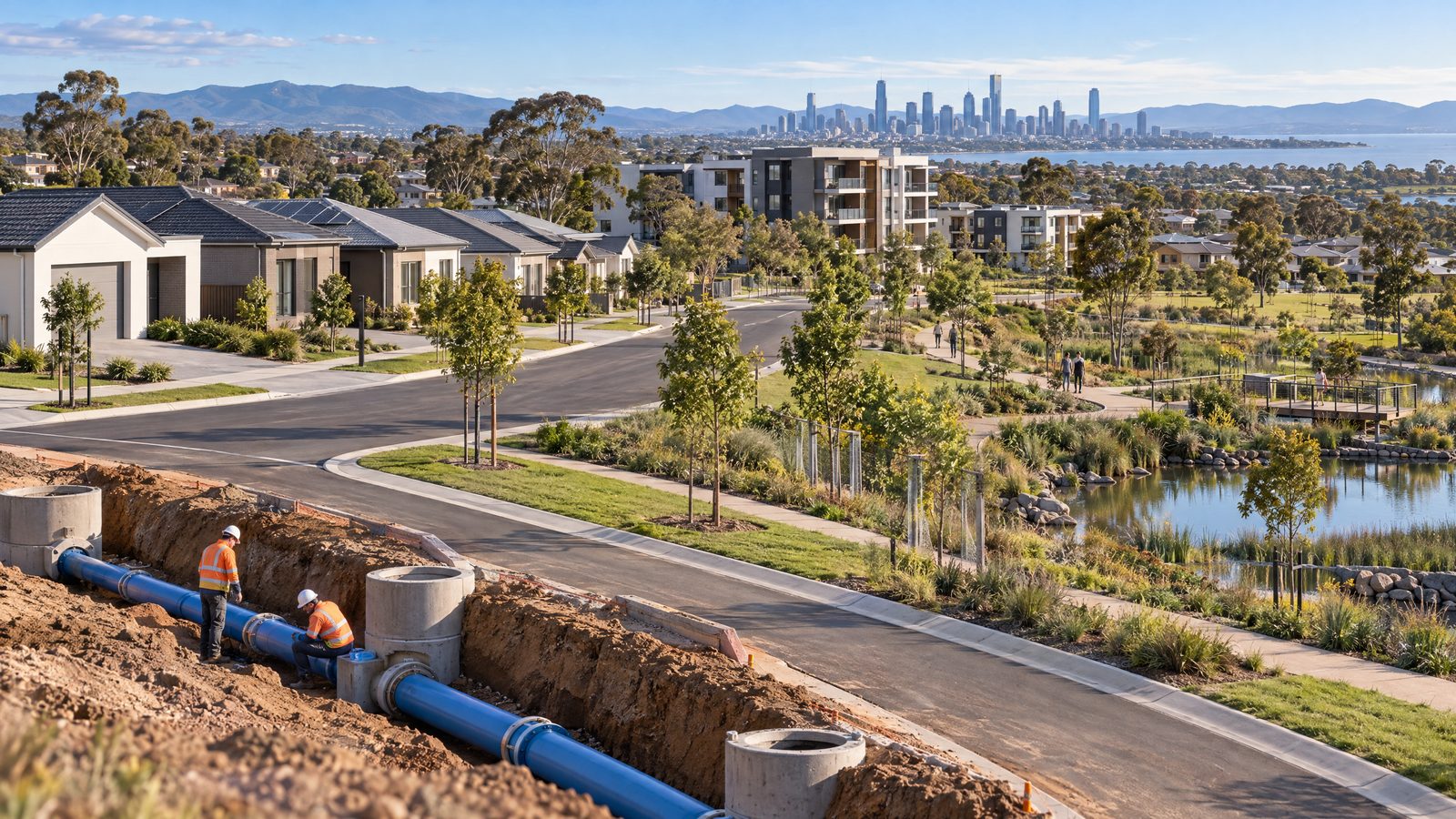

Victoria has signed an agreement with the federal government intended to unlock more than 66,000 homes, including more than 25,000 reserved for first-home buyers. The deal also commits billions of dollars in federal infrastructure finance and requires a substantial state contribution, setting out a much larger package than the earlier announcement of a prospective housing bonus.
The agreement, dated 21 October, makes Victoria the first state to sign up to the New Homes Bonus. It combines the bonus mechanism, which rewards progress towards national housing targets, with funding for infrastructure needed to open land for development. The homes are planned or enabled, not completed: the release says first-home buyers are expected to begin moving into homes from 2027–28.
Infrastructure package spans Melbourne and regional areas
The Commonwealth is providing $2.5 billion, made up of $2 billion in concession loans and $499 million in grants. Victoria is to provide a matching contribution of at least $499 million. The stated purpose is to address infrastructure bottlenecks that can prevent housing construction, including roads, water and sewerage services.
The published allocations include $698 million for enabling infrastructure across greater Melbourne, associated with more than 47,000 homes, of which 11,923 are reserved for first-home buyers. A further $91 million is allocated to infrastructure in regional Victoria to support 5,800 homes, including 1,900 for first-home buyers. Another $82 million is linked to 474 first-home-buyer homes through infrastructure investment and construction in inner Melbourne.
A separate $55 million allocation is described as supporting 2,040 homes through enabling infrastructure and direct construction under a Peri Urban and Regional Infrastructure Fund and a Rent to Buy pilot for First Peoples. These figures describe different allocations and groups of homes in the release; they should not be read as evidence that construction has already taken place.
The agreement’s headline figure combines more than 25,000 homes reserved for first-home buyers with around 41,000 additional homes intended to expand supply. The distinction matters: the programme sets aside a portion for eligible buyers while also seeking to increase the overall number of dwellings. The government says further projects will be announced in coming months.
A bonus alongside the detailed deal
Prime Minister Anthony Albanese had announced Victoria’s sign-up in a speech on 20 October, describing the state as on track to receive an additional $350 million through the New Homes Bonus. That money, he said, could be reinvested in local infrastructure in growing suburbs and regional centres. The next day’s agreement supplies a separate, fuller account of the planned housing-enabling package, including the loan, grant and matching-contribution components.
The bonus is framed as part of a national effort linked to the National Housing Accord target of 1.2 million homes. Victoria’s agreement builds on arrangements with South Australia, the Australian Capital Territory, Tasmania, Western Australia and Queensland. The combined arrangements are described as covering around 180,000 homes, including more than 67,000 reserved for first-home buyers.
Earlier coverage of the bonus announcement noted that projections anticipated an acceleration in Victorian construction, with a five-year total of 287,000 homes by 1 July 2029. That was a forecast, not a delivery tally. The new agreement likewise sets out intended homes and funding commitments; its success will depend on infrastructure projects being delivered and housing actually being built.
The policy makes the connection between housing supply and enabling works explicit. Roads, water and sewerage do not themselves create finished homes, but they can allow development to proceed where essential services are missing. The package therefore marks a funding and partnership decision, while its ultimate effect on affordability and the number of homes available will only become clearer as individual projects advance.







