
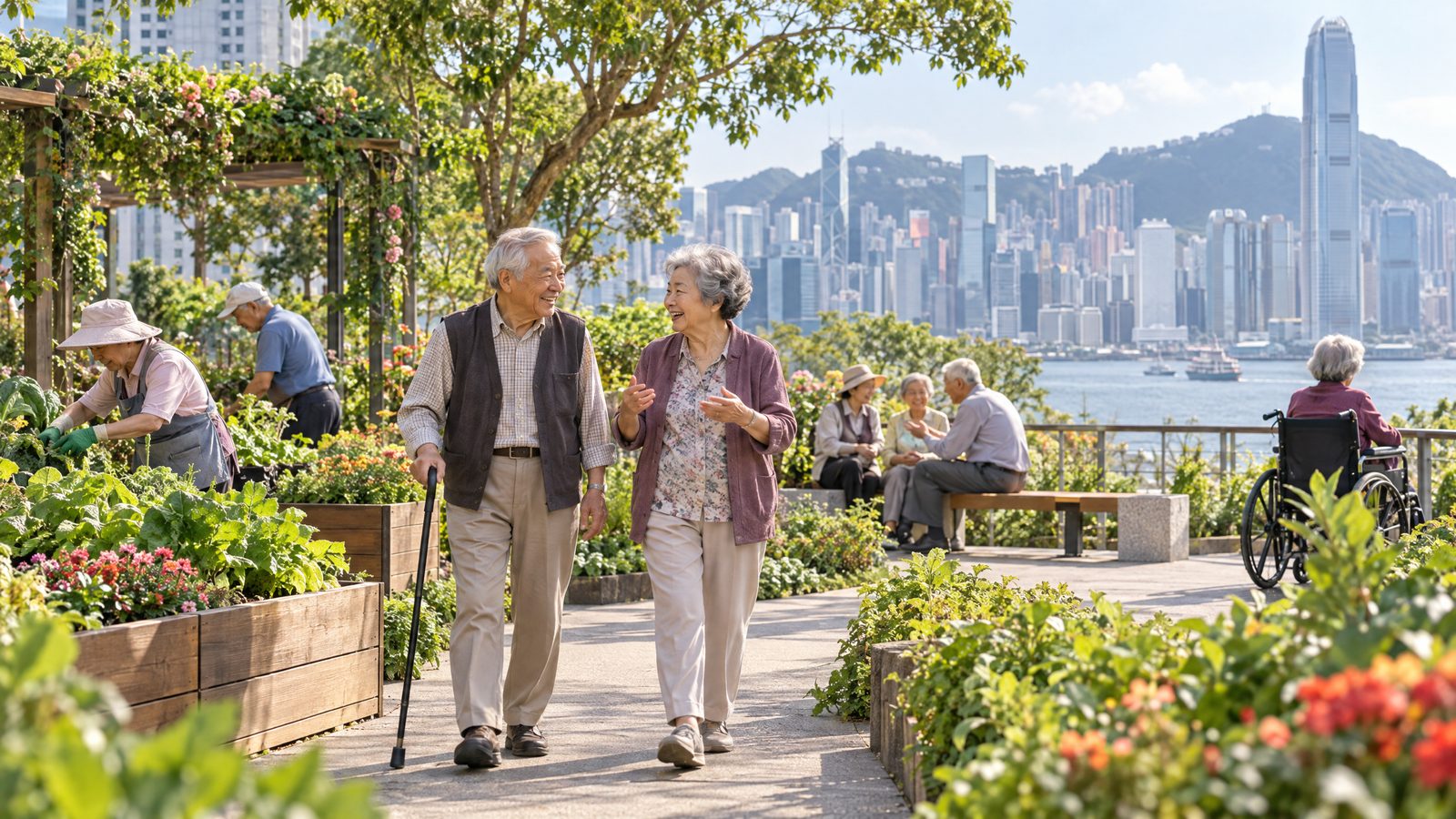

A four-year programme to develop and test approaches to healthy ageing in Hong Kong and support adaptation across the Western Pacific is due to begin in 2027, following a partnership announcement by the World Health Organization’s regional office, the Institute of Philanthropy, The Chinese University of Hong Kong and The Hong Kong Jockey Club Charities Trust.
The initiative is supported by a contribution of approximately US$7 million from the Institute and the Charities Trust. The amount is a stated commitment supporting the initiative; it should not be read as a report of money already disbursed or of services already delivered.
Two linked strands
In Hong Kong SAR, the university will work with the regional health body to develop and test what the announcement calls a Multi-component Healthy Ageing Package, with support from the Charities Trust. The announcement does not set out the package’s individual interventions, a trial design, participant numbers, locations, budget split or measurable targets. Those details remain to be specified, so the planned testing should not be mistaken for evidence that the package has already improved health or independence.
A second, regional strand, supported by the Institute, is intended to turn the Hong Kong experience into adaptable guidance and practical tools. The partners say they will work with interested member states on adapting the material to country contexts and on demonstrations. They also plan to strengthen regional learning and evidence generation. The stated purpose is not simply to export one fixed model: adaptation and learning across different settings are explicit parts of the design.
Work is scheduled to start in 2027. The partnership is connected to the UN Decade of Healthy Ageing, which runs from 2021 to 2030, and to the regional action plan on ageing endorsed in 2020. The new programme therefore arrives in the second half of that decade, with a stated emphasis on translating existing commitments and evidence into approaches that countries can apply. No detailed annual timetable or list of participating countries has yet been announced.
Why the regional focus matters
The regional office says more than 245 million people in the Western Pacific are aged 65 or older and projects that this number will double by 2050. It also reports that the gap between life expectancy and healthy life expectancy widened from 9.1 years in 2000 to 10.0 years in 2023. These are regional figures, not estimates for Hong Kong alone, and they describe the scale of the challenge rather than an effect of the new initiative.
The underlying policy framework centres on maintaining functional ability: the capacity to do the things a person values, and to live well in their community. Its broad areas include prevention and health promotion, primary care, integrated health and social care, community support and environments that enable participation. In practice, those priorities point beyond treatment in clinics alone, while the announcement leaves the specific package components for development and testing.
The partnership was introduced at a technical meeting in Manila held alongside the 77th session of the regional committee. Delegations from Australia, China, the Cook Islands, Indonesia, Japan, Malaysia, the Philippines and Singapore attended, with health and community organisations also represented. Participants discussed prevention, primary care, integrated and community-based care, workforce needs and links between health and social support. The meeting offered a setting for exchange; it was not itself evidence that the new programme has been implemented.
The Trust brings prior local experience to the work. It says it has supported more than 60 healthy-ageing-related projects and approved nearly HK$4 billion in funding since the late 1990s. Examples shared at the meeting included community care and age-friendly-city programmes developed with the university. Those earlier activities are distinct from the newly announced four-year initiative, though the partners say the new work will build on lessons from Hong Kong and the regional meeting.
The central test will come after the programme begins: whether the package can generate credible evidence, and whether guidance can be adapted usefully across settings with different health systems and community needs. The announcement establishes a funded partnership and a work plan, not proven outcomes. Its success will depend on the details of the testing, the quality of evidence produced and how countries choose to apply what is learned.







