

An interview with London’s fresh face of fashion, Victoria Harman
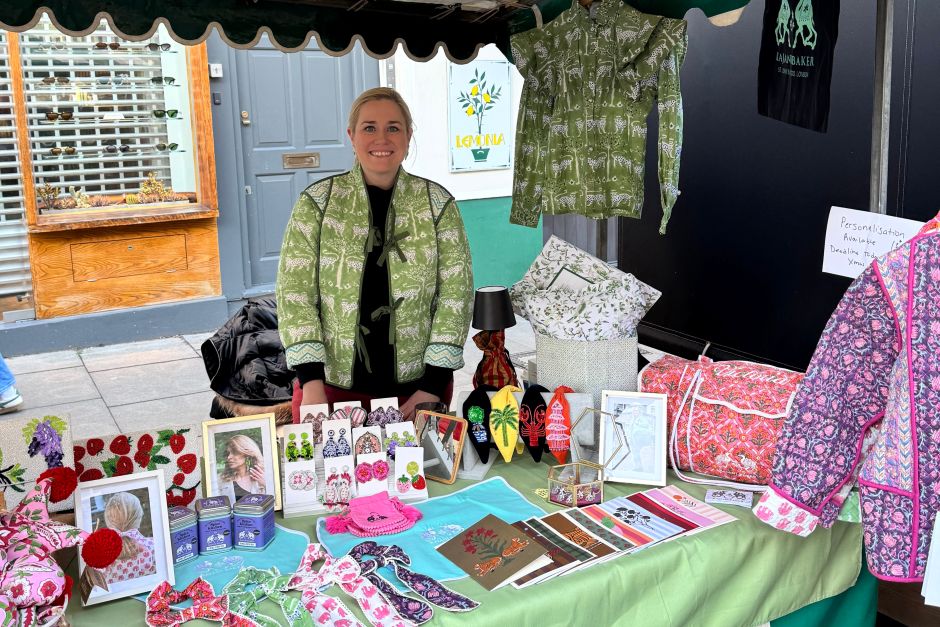
Victoria Harman, of Rajani Baker fashion and accessories
Victoria Harman is the founder of Rajani Baker, a London-based lifestyle brand that merges British elegance with Indian craftsmanship, a vision shaped by her five-year tenure as Vice Consul for the UK’s Department for International Trade in New York. After building a high-level corporate career at global giants like TikTok and ASOS, she pivoted to her creative roots by studying technical pattern-making at the prestigious Central Saint Martins. This career shift was catalysed by a life-altering diagnosis of Reversible Cerebral Vasoconstriction Syndrome (RCVS) in 2023, which prompted her to trade ‘hustle culture’ for a more mindful, flexible approach to entrepreneurship. Her brand celebrates cultural fusion through co-designed partnerships with artisans in Jaipur and Delhi, focusing on traditional techniques like hand-block printing and hand-beading. Victoria is dedicated to ethical, slow-fashion growth, recently earning a Top 50 recognition at the UK Small Business Awards for her commitment to community-driven storytelling and artisanal integrity.
Your career began in a very structured environment at the British Embassy, helping British brands navigate the complexities of the US market. How did that experience in vendor relations and international expansion provide the blueprint for the operational side of Rajani Baker?
I am tremendously grateful for the five years I had as Vice Consul, Retail & Luxury for North America at the UK’s Department for International Trade (now Department for Business & Trade) based in the British Consulate in New York City. Through that role, I interacted with thousands of UK businesses looking to enter or expand in the US market and vice versa. Most importantly, when the companies initially came to me, I got to learn quite a bit about what they’d tried that succeeded and what they’d tried that failed. Hearing their first-hand experiences was invaluable. As you can imagine, you can give businesses as much advice as you’d like, but things don’t always work out in implementation the same way they look on paper. That experience definitely taught me to start out a business by thinking about very specific markets – narrowing down targets to an initial region or even neighbourhood and catering toward those customers before zooming out to build a brand with a larger presence. Since Rajani Baker was founded in St. John’s Wood, London, we were so thrilled to recently take part in the Primrose Hill Christmas Festival because we could narrow in on our local community and get more of a sense of what products resonated with them. It was our most successful event to date.
My experiences also kept the idea of international expansion, even at an early stage in the business, close to mind. Being American, naturally, I have thought about expansion to the US and developing products and pricing that would be attractive to both the British and American customer – something that can prove quite challenging given different tastes and very different economic environments.
You’ve mentioned that your fashion credentials began at the prestigious Central Saint Martins. After years in the corporate world, how did it feel to return to those creative roots and apply technical pattern-making skills to your own brand?
Before I moved to London, I had the opportunity to work at some amazing fashion and jewellery brands like Betsey Johnson, ASOS, Erwin Pearl, Levi’s, and Vineyard Vines. However, those roles were always more on the marketing, operations, and strategy side of the business. Studying at Central St. Martin’s gave me exposure to the technical/design side of the business. My classes at Central St. Martin’s gave me just the knowledge I needed to be able to fill in the knowledge gaps between my creative product ideas and the technical requirements of the in-house designers at the various artisanal production houses I work with in India. Through the experience, I gained a tremendous appreciation for people who’ve completed their undergraduate degrees at schools like Central St. Martin’s – even my short course was a very rigorous programme that required study and repetition until perfection! I definitely still have a lot to learn and a strong desire to do so. In doing this, I really identified an exciting piece of my career journey that had been missing – exposure to the product development, design, and sourcing side of the business, which I now find the most interesting!
In May 2023, you were diagnosed with Reversible Cerebral Vasoconstriction Syndrome (RCVS) after experiencing thunderclap headaches. You’ve described the moment as your body simply saying “enough.” Looking back, how did that medical forced-pause change your perspective on the momentum you once prized in your corporate career?
I think it’s really easy to get caught up in an idea that there’s just one path to a particular career goal – be it getting a job at a particular prestigious company, climbing a corporate job ladder, or getting a certain level of recognition from your peers. However, I think what I’ve learned through this experience is that there are many different ways to achieve your dreams. They can all look a little different, and that’s ok. You can always get another job. You can always earn more money. One thing you cannot ever get back is your health. I always took my health for granted before that point. However, it is really one necessary element to keep anyone moving forward in their career.
Leaving a senior role at a global giant like TikTok is a massive leap. Was there a specific moment during your recovery when the fear of leaving stability was outweighed by the clarity that you needed to build something of your own?
I was a little over 3 years out of my MBA, which was a major investment in myself and my career, and fairly fresh out of Covid. It was definitely a difficult time to imagine leaving something stable. In this case, I didn’t have much of a choice as my role was made redundant whilst I was on sick leave. However, I think the active decision to move forward with the idea of building something on my own was a very conscious one. I was still recovering from my illness and was aware that it might prove challenging when requirements to rest or attend doctors’ appointments might conflict with a regular 9-to-5 schedule. I had also entered my MBA programme with the intention to start my own business upon graduation. I even worked actively on a business idea whilst I was there. Unfortunately, upon graduating in Spring 2020, I was flung into a huge market of uncertainty and instability amidst Covid and the time just didn’t feel right to launch an international e-commerce brand then. Realising the fragility of life after what I’d been through, I started to ask myself, “If not now, when?”. It was then that I decided to take that leap of faith.
The name Rajani Baker is a beautiful homage to two iconic detectives: Sherlock Holmes (Baker Street, London) and Satyajit Ray’s Feluda (Rajani Sen Road, Kolkata). Why was it important for you to weave these literary and cultural addresses into the very identity of the brand?
I have always been a huge fan of cinema. Since my business was founded in St. John’s Wood, near Baker Street, I thought combining the historic addresses of these two literary detectives that are so emblematic of the cultures of both nations was a fitting way to create a fictional home where both cultures could flourish. That theme runs throughout the brand, I think – the desire to combine the best of both worlds, giving a nod to traditions and heritage with a thoughtful, modern twist.

Sherlock’s Holmes’ home address of Baker Street was an inspiration for the name Rajani Baker
Rajani Baker is deeply committed to supporting artisan craftspeople, particularly in Jaipur and Delhi. How do you ensure that the partnership remains a bridge between cultures rather than just a transaction, especially when working with traditional techniques like block printing and hand-beading?
I would describe everything I do as “co-designed”. I dream up all the concepts, but I always introduce those to the creative leads at each of the workshops I work with in India with an open mind and listen to their feedback, so that I can best showcase their expertise and creative flair. I do not like to take any shortcuts that would undermine their traditional methods of production. The fabrics are all made-to-order to minimise waste materials, and the “scraps” from the clothing pattern designs are used to make other items like the lovely potli bag-inspired reusable packaging for our candles. No large machinery is used, and everything is made completely by hand to every extent possible.
It is important to me that we are an inclusive brand, from both a supplier and customer perspective. I am very proud that many of my suppliers are global majority women-led businesses and that my suppliers and creative teams are inclusive of a diverse spectrum of Indian communities, including artists from the Muslim and Dalit communities, for example. I source amazing products from inspiring Indian founders representing the diaspora in Spain, the USA, and the UK – including some incredible makers from the LGBTQ+ community.
From our collection of beaded accessories, my favourite items to point out to customers are our clutch bags. Each bag is absolutely covered with beads, and every bead of every design is hand sewn. Additionally, everything with a scalloped edge requires extra attention and is hand-cut. So, the amount of human effort required to create each piece is tremendous. I think a lot of the value of these pieces gets lost when they are mass-produced and seen on shelves or in markets. Not all beaded and blockprinted items you see in the UK market are made using these traditional methods, and it’s really a shame to see this artisanal work be overlooked or devalued by machine-made imitations from other countries. So, it’s also really important to give credit where it is due and to highlight the handmade element and the people behind the products. It is a piece of their cultures and communities, requiring skills handed down for generations, and that should get the platform it deserves on the global stage.
You operate as a businesswoman in London, but your brand’s DNA spans the US, Europe, and Asia. What are the unique challenges – and advantages – of bringing three continents together in a single supply chain?
I think one interesting perception people have about the West is that fashion is more muted and colour palettes tend to be more neutral than the vibrant colours of the East, especially South Asia. I lived a large portion of my life in New York City and I do not disagree that black is the prevailing fashion colour choice of my old hometown. However, I lived a small portion of childhood in the American South, and I also have had the wonderful opportunity to vacation in many historic and beautiful places in New England. When you look at Southern style and even the more classic “preppy” New England style, you’ll find that American fashion is just full of colour. I think that intrinsic love of colour and print that has always been so integral to my personal style is something that really drew me to Indian textiles and fashion.
I have loved building up the brand’s presence in the UK market. There is something so special about how vibrant the Indian community is in the UK and how much enthusiasm there is around Indian culture across the board. You only need to look at the UK’s top restaurants, the numerous incredible museum exhibits focused on Indian works in the past year, and the Diwali festivities that aim to rival even those back in India to understand the wonderful contribution the Indian community has made to Britain. It is something to be shared and celebrated, and I encourage not only members of the diaspora community but anyone else who has a platform to help get cultural stories out there and lift up others to do so.
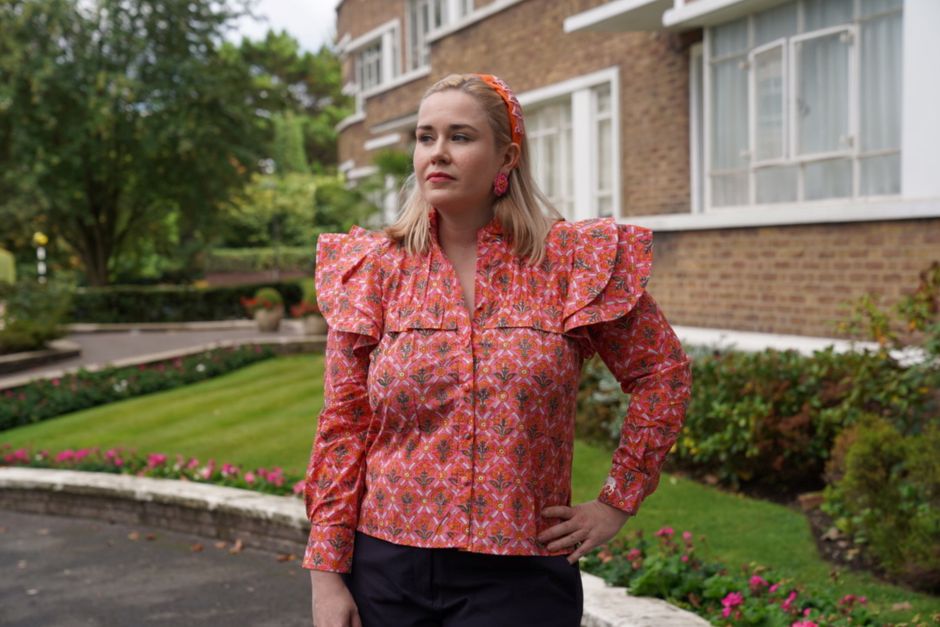
Victoria Harman models one of her own designs, available to buy on the Rajani Baker website
Your logo features a camel inspired by a Rajasthani silk painting, combined with the floral elegance of William Morris. How does this visual fusion represent your personal philosophy of “British elegance meets Indian craftsmanship”?
There is such a beautiful history of print and design across both cultures. Many people don’t realise that the origin of a lot of historic “British” pieces actually sits in India – the cumberbund, madras, seersucker, and chintz, serving as just a few examples. These are stories that need to be told, and that also sartorially link the two cultures throughout history.
In creating a brand that emphasises the idea of “East meets West”, there is a lot of room left open for interpretation. That really fuels my creativity. I love taking traditional Indian textiles and handicrafts and figuring out how to translate them to more Western silhouettes and styles. Rather than focusing on ethnic wear or just the traditional kurta pyjama styles, I love thinking about how these beautiful textiles could more seamlessly integrate into everyone’s daily wardrobe by taking influences from Western workwear and formal attire, such as tailored cuffed sleeves, ruffles, and crisp minimalist embroidery, alongside Eastern design influences. I hope that in doing this, it can raise the visibility of these beautiful crafts.
Rajani Baker was recently recognised in the UK Small Business Awards. As you look toward the future, what does meaningful growth look like to you now – not just for the brand’s bottom line, but for the artisans and the community you’ve built?
It was a challenging category to be in as it spanned all industries, so it was a real honour to be recognised in our first year of trading. For me, meaningful growth does not come at the expense of sacrificing respect for the cultures and traditions that created the craft. There have been many opportunities to improve my brand’s bottom line by purchasing ready-made block print fabrics with other brands’ prints on them, or moving production of fabrics or beaded accessories to China, or substituting natural materials for synthetic ones, or generally taking design decisions that reduce the quality of the finished goods. These are not ethical sacrifices I’m willing to make for the sake of an increased margin. Meaningful growth to me will largely equate to discovering new customer segments and developing new products to appeal to them, so that I can increase my order sizes and bring more financial success back to my suppliers in India. At the end of the day, the best way I can support their craft is by increasing order size and continuing to build an appetite for and curiosity around their handiwork, which will require further time, creativity, and investment in marketing, collaborations, and storytelling.







