
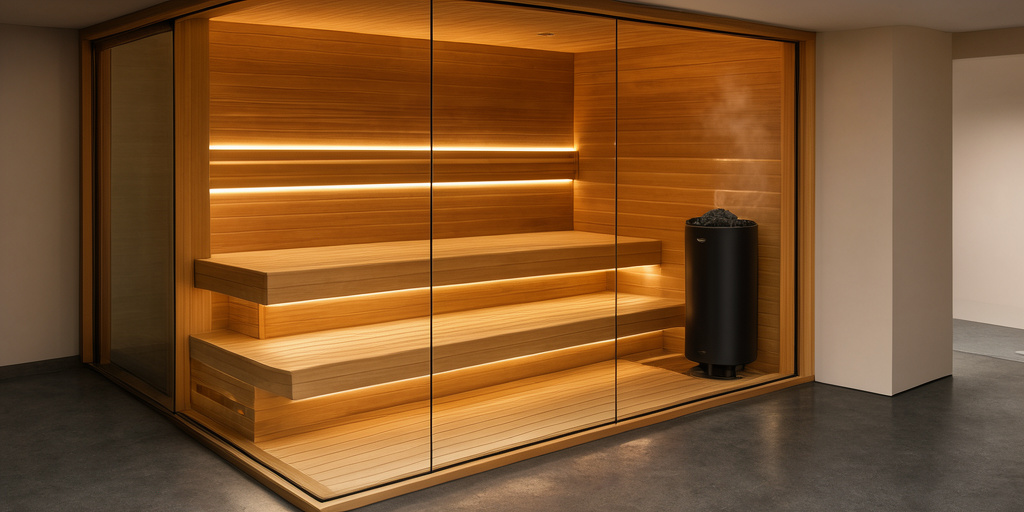

The home sauna has moved a long way from the gym changing room and the Scandinavian cabin. It now appears in London basement conversions, garden rooms, and ensuite bathrooms, sold as a wellness investment rather than a luxury. The question is no longer whether a home sauna is possible. It is whether one makes sense for your home, your habits, and your budget.
The answer depends less on space than on how you live. A sauna that is used three times a week justifies itself quickly. One that is used twice a year becomes an expensive cupboard.
Why Interest Has Grown
Several factors have pushed the sauna into domestic design.
Wellness has become a mainstream concern, and the documented benefits of heat therapy—muscle recovery, circulation, stress reduction, and improved sleep—are widely known. The infrastructure of public bathing has also weakened, with gyms and leisure centres reducing their sauna provision or closing altogether. For anyone who relied on those facilities, a home version is the obvious replacement.
Remote working has compounded this. A sauna fitted into a garden room or a converted garage can be used during the day, when public facilities are closed or inconvenient. The ritual fits neatly into a working week that no longer involves a commute.
The Space Question
The first practical consideration is where a sauna can go.
Inside the house, the natural locations are a basement, a spare room, a large bathroom, or an underused corner of a utility area. A small two-person sauna can fit into a footprint of around two square metres, though three to four square metres is more comfortable.
Outside, a garden room or a dedicated cabin offers more flexibility. It avoids the disruption of internal work and can be sited away from the house, but it requires insulation, power, and a path that can be used in winter.
The constraints are consistent. A sauna needs a level base, ventilation, a power supply, and drainage or a suitable floor covering. Heat and moisture must be managed carefully, particularly in a basement, where ventilation is often the limiting factor.
The Types Available
The market offers three broad options, each with different costs and demands.
Traditional Finnish saunas use a heater to warm the room to between 70°C and 90°C, often with a stone basket for pouring water. They are the most authentic and the most intense, and they require proper timber cladding and ventilation.
Infrared cabins use panels that emit radiant heat directly onto the body at lower temperatures, typically 40°C to 60°C. They are cheaper to buy, easier to install, and can be plugged into a standard socket in some cases. The experience is different—gentler, more like a warm wrap than a proper sweat—and purists are dismissive, but many users find them pleasant and convenient.
Barrel and pod saunas are outdoor structures, usually timber, that can be installed in a garden without building work. They are popular in smaller gardens and can be moved if necessary.
The Costs
A home sauna is not a cheap addition, and the figures vary widely.
Purchase costs range from around £2,000 for a basic infrared cabin to £10,000 or more for a bespoke traditional sauna with a quality heater and custom timber. Barrel saunas typically fall in the middle of that range.
Installation costs add significantly. A traditional sauna requires electrical work, insulation, timber cladding, and ventilation. A garden installation may need a base, a power supply, and a structure. Budget several thousand pounds on top of the cabin itself.
Running costs depend on the type. A traditional electric heater draws around 6–9 kW and takes thirty to forty-five minutes to heat up. Used three times a week for an hour, the electricity cost is meaningful but manageable. Infrared cabins draw less power and heat faster, which reduces running costs considerably.
The Practical Requirements
A sauna is a wet, hot environment, and the building must be able to cope.
Ventilation is essential. Moisture must be able to escape, or it will condense inside the structure and cause rot. In a basement, mechanical ventilation is usually required. In a garden room, vents and a breathable construction are needed.
Insulation matters for efficiency, particularly in an outdoor sauna, where heat loss to the cold air is considerable.
Flooring must be suitable for wet conditions—tiles, concrete, or a duckboard arrangement over a drained base.
Electrical work must be carried out by a qualified electrician, and the heater must be on a suitably rated circuit.
The Health and Safety Caveats
Saunas carry genuine risks, and these deserve a fair hearing.
Prolonged exposure to high heat can cause dehydration, dizziness, and fainting. Alcohol and sauna use do not mix. Anyone with cardiovascular conditions, low blood pressure, or pregnancy should consult a doctor before using a sauna regularly. Children should be supervised and should use lower temperatures for shorter periods.
A sauna should never be installed without proper ventilation, and the heater should never be left unattended. These are basic precautions, and they are not difficult to observe.
The Return on Investment
A sauna is unlikely to pay for itself in resale value alone. It is a niche feature, and buyers may view it as a novelty or a maintenance liability rather than an asset.
Where it adds value is in daily use. A household that uses the sauna regularly gains genuine benefit—recovery, relaxation, and a ritual that supports wellbeing. That benefit is not measured in property prices, but it is real.
The calculation is therefore personal rather than financial. If you will use it, it is worth the investment. If you will not, it is not.
In Conclusion
A home sauna is a significant commitment of space, money, and installation effort. It is not for everyone, and it does not suit every property.
For the right household—one with the space, the budget, and the habits to use it regularly—it offers something that few other home improvements can match. A daily ritual of heat, rest, and recovery, available without leaving the house.
Would you consider a home sauna? If you have the space and will use it, yes. If not, the local gym remains a perfectly good alternative.







