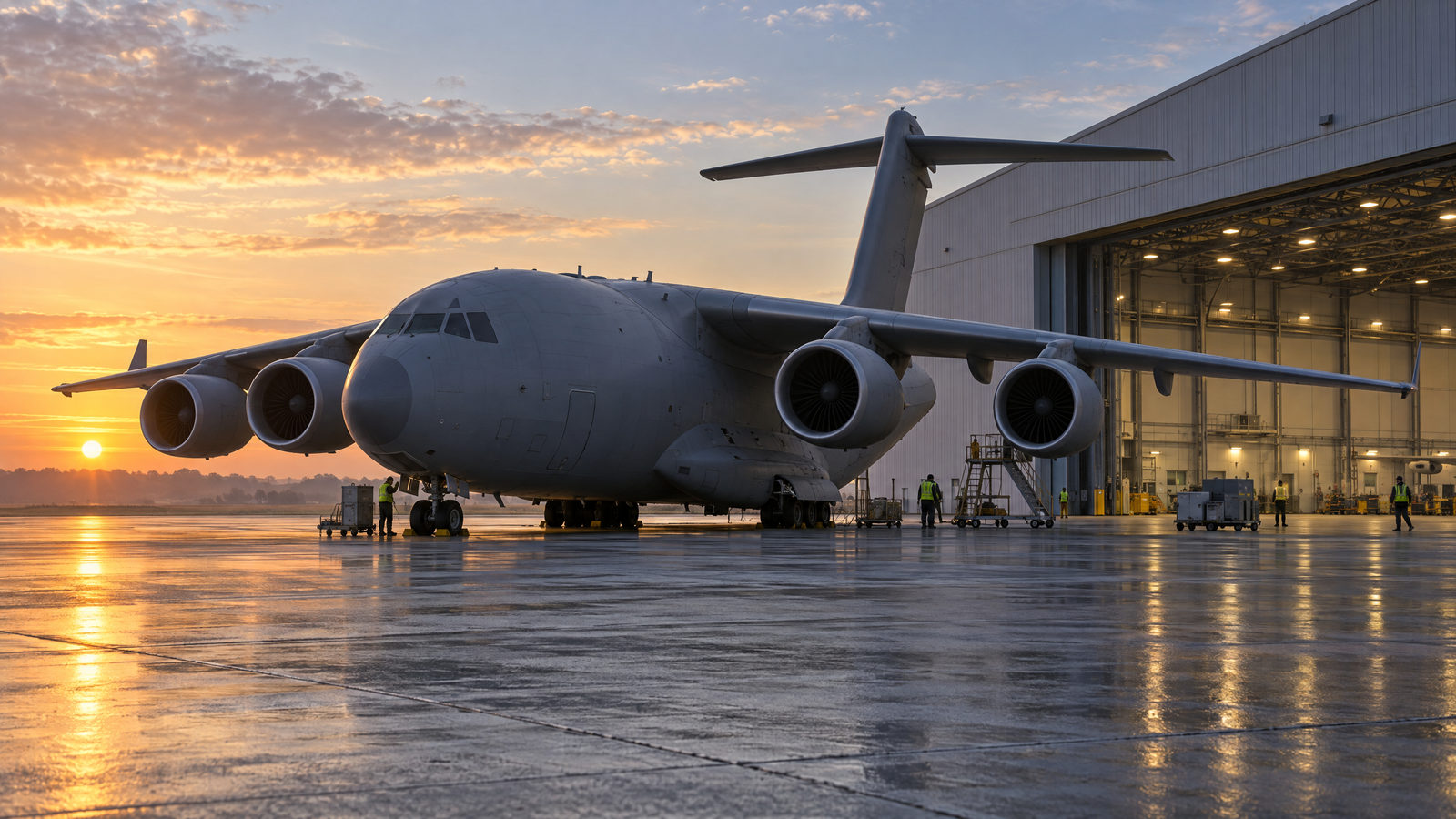

Support extension begins
A £190 million support extension for the RAF’s A400M Atlas fleet has begun, with the aim of increasing the number of fully mission-capable aircraft available on a typical day from 10 to 13 by the end of 2027. The target represents a 30% rise in availability, but it is a planned outcome rather than an immediate addition of three aircraft.
The 31-month arrangement keeps maintenance, repair and support work in place until April 2029. It is a continuation of an existing support contract, not an order for new airframes. The aircraft will continue to be supported from the UK centre at RAF Brize Norton, the principal hub for the fleet’s operational support.
Readiness is the central measure
The important number in the agreement is not the fleet’s total size but the number that can be classed as fully mission-capable on a given day. Raising that figure from 10 to 13 would give commanders a larger pool of aircraft that can be assigned to tasks without waiting for planned maintenance or repair work to be completed.
Atlas aircraft are used for both tactical and strategic airlift. They can move personnel, equipment and supplies over long distances, while also operating from shorter or unpaved strips when conditions permit. That combination makes availability significant for routine transport as well as for rapid deployments, humanitarian relief and allied commitments.
What the contract covers
The support package covers national in-service work on the airframe. Its stated scope includes base maintenance, line and line-support services, and continuing airworthiness management. Those functions cover the practical work of keeping aircraft serviceable, dealing with faults close to operations and ensuring that maintenance is managed within the applicable airworthiness framework.
The published procurement record gives the contract a precise value of £189,823,013 and lists a start date of 1 October 2026. It also allows for a possible additional 12 months, which could take support through to April 2030 if used. That option is not a commitment to spend or extend further; it is a provision within the award.
Why the work was directly awarded
The arrangement was made by direct award rather than through an open competition. The procurement documentation says the aircraft’s original manufacturer and design authority holds the technical knowledge, programme access and approvals needed to provide the national service alongside the multinational support system.
It also cites the requirements that apply to organisations maintaining or repairing UK military-registered aircraft. The published reasoning says transferring the work to another operator could create risks around regulatory compliance, interoperability, safety and readiness while the aircraft continues to receive upgrades and retrofits. This is the authority’s justification for its procurement route, rather than a finding about every possible future support arrangement.
Workforce at Brize Norton and Carterton
More than 350 UK jobs are expected to be sustained by the extension. The workforce figure includes more than 240 staff employed by Airbus and more than 110 people working for primary subcontractors. The announcement concerns the continuation of existing roles and support activity; it does not say that all of those posts are newly created.
For the RAF, the test of the deal will be whether the planned availability improvement is delivered by the end of 2027. The current agreement sets the support framework to April 2029, while the separate extension option leaves room for further continuity if it is required.