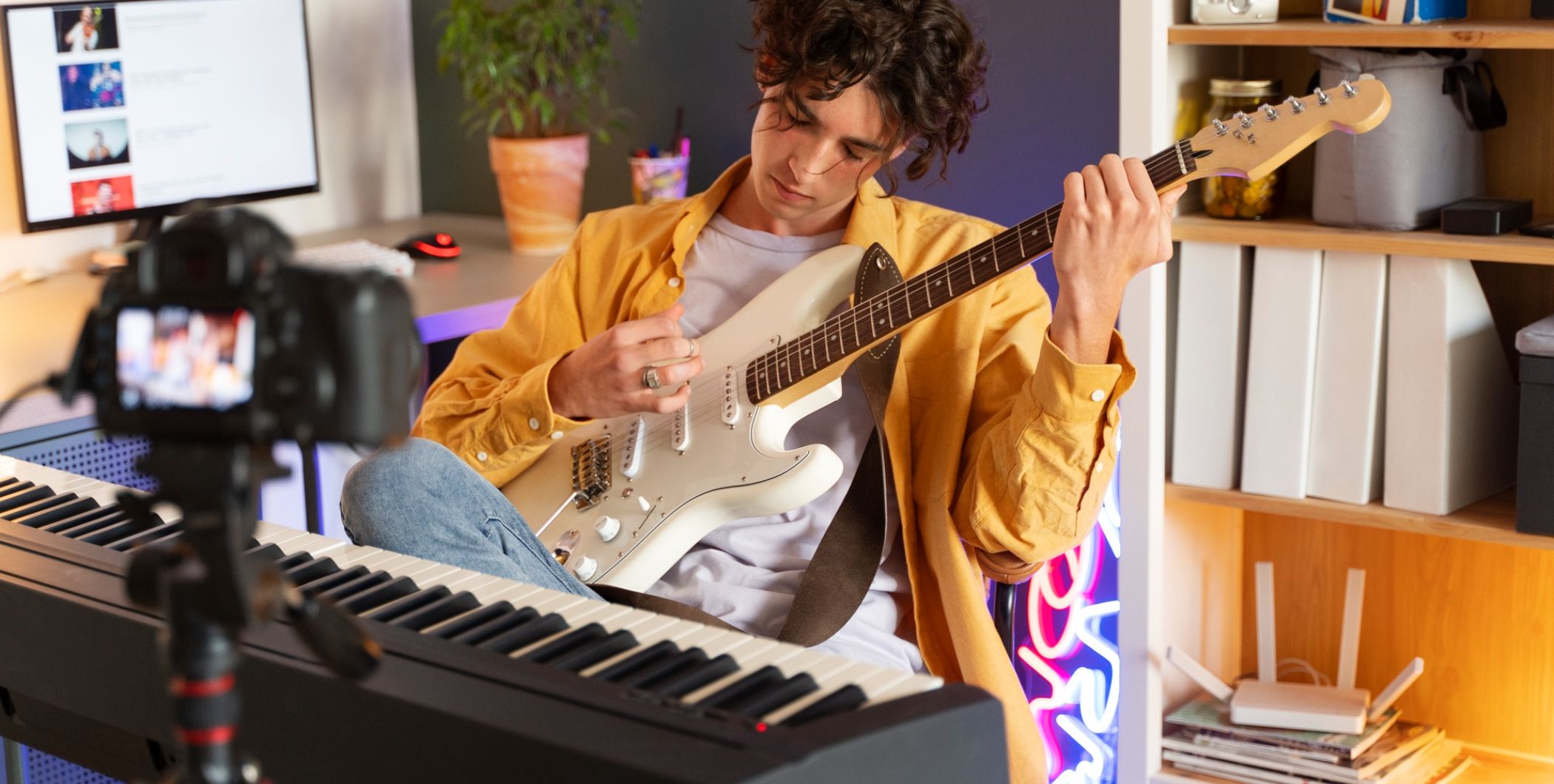

The music industry has undergone a noticeable shift in how visual content is conceptualised and produced, largely due to advances in generative systems. For both independent artists and established studios, traditional music video production often involves significant budgets, long timelines, and complex coordination between production teams. In contrast, modern AI music video generator platforms now offer a faster alternative by translating audio inputs into structured visual narratives or abstract motion designs.
This shift is especially relevant in an era dominated by short-form video platforms such as TikTok, Instagram Reels, and YouTube Shorts. Visual output is no longer occasional but continuous, requiring creators to maintain a steady stream of content. The tools examined below represent some of the most widely adopted solutions in this space, each offering different strengths in realism, stylisation, and production workflow.
1. Pollo AI: Multi-Model Creative System
Pollo AI music video generator is often positioned as a flexible production environment rather than a single-function tool. It brings together multiple video generation models within one interface, allowing users to switch between different visual styles without changing platforms. This makes it particularly useful for creators who work across different genres, where visual identity may vary significantly from track to track.
From a workflow perspective, Pollo AI is structured around prompt-based direction combined with timing and motion controls. Users can align visual changes with beats or lyrical cues, which helps maintain rhythm consistency throughout the generated output. The system also places emphasis on temporal stability, reducing flickering or visual drift that can occur in longer sequences.
Why It Is Often Considered a Leading Option
A key advantage of Pollo AI lies in its consolidation of multiple generation models into a single environment. Instead of relying on separate tools for different styles, creators can access a range of outputs—from realistic environments to stylised animation—within one workflow. This reduces production fragmentation and simplifies experimentation during early creative stages.
It also includes structured templates for lyric-driven visuals, automated motion graphics, and end-sequence formats commonly used for branding and YouTube outro content creation, which can reduce the manual editing typically required in post-production software. For many users, this combination of flexibility and workflow efficiency is what makes it a central option in this category.
2. Runway: Cinematic-Level Video Generation System
Runway has established itself as one of the more advanced platforms in the generative video space, particularly for users who require a higher degree of cinematic control. Its latest generation models are designed with an emphasis on motion consistency, lighting realism, and spatial accuracy, making it suitable for more narrative-driven visual work.
Unlike simpler systems, Runway provides tools that allow direct manipulation of camera movement and scene composition. This gives users more influence over how a visual sequence unfolds, which is particularly relevant for music-driven storytelling where pacing and atmosphere play a critical role.
Technical Depth and Creative Control
Runway is frequently used in projects that require atmospheric or mood-heavy visuals. It handles complex lighting scenarios and environmental effects with a high level of consistency, which makes it suitable for genres that rely heavily on tone and ambience.
In addition to generation features, the platform includes editing functions such as background removal, object replacement, and motion tracking. This allows users to refine generated clips rather than treating them as final outputs, making it closer to a full production suite than a standalone generator.
3. HeyGen: Performance-Focused Music Video Generator
HeyGen takes a more focused approach by concentrating on human-centred video output, particularly avatar-based performance. In the context of music video creation, it is often used to simulate vocal delivery or front-facing performance without requiring a physical shoot.
The system maps audio inputs to facial movement and expression, creating synchronised digital performances. This is especially relevant for artists who want to maintain a consistent on-screen persona or explore virtual identity without traditional filming constraints.
Use in Music and Localisation Workflows
One of HeyGen’s more practical applications is content localisation. By supporting multilingual voice and lip-sync adaptation, it allows a single performance to be distributed across different language markets without reshooting.
Its “digital avatar” capability also enables variations of a performer to be generated under different visual settings. This reduces production time while maintaining a consistent character identity, which is increasingly relevant for digital-first artists.
4. Kaiber: Stylised Visual Transformation Engine
Kaiber is widely recognised for its focus on visual transformation rather than photorealistic output. It is commonly used to convert existing footage or images into stylised sequences that resemble animated artwork or abstract motion design.
Instead of prioritising realism, Kaiber emphasises visual interpretation of sound. Users can guide how different elements respond to audio layers such as bass, rhythm, or melody, allowing the visual composition to evolve alongside the track.
Emphasis on Audio-Responsive Design
The platform’s audio-reactive system allows for structured visual changes throughout a track. For example, intensity can be adjusted during chorus sections, while calmer visuals can be maintained during verses. This creates a dynamic relationship between sound and imagery.
Kaiber is often selected by artists who prefer a more expressive or artistic interpretation of their music videos rather than a live-action simulation style.
5. Luma Dream Machine: Spatial Motion and Realism System
Luma Dream Machine is known for producing visually fluid sequences with strong spatial awareness. It tends to generate scenes with more natural movement and environmental depth compared to many earlier generation systems.
Its strength lies in simulating camera motion and object interaction in a way that feels physically coherent. This makes it particularly effective for cinematic shots, looping visuals, and atmospheric sequences that require continuity across frames.
Strength in Continuity and Scene Expansion
One of its more notable capabilities is extending static images into moving environments. A single frame, such as album artwork, can be expanded into a short animated sequence that suggests depth beyond the original composition.
This feature is frequently used for promotional visuals, looping backgrounds, and teaser content, where short but visually consistent clips are required.
Conclusion
The development of AI-driven music video generation tools has introduced a significant shift in how visual content is produced and distributed within the music industry. While each platform approaches the problem differently, the overall trend is clear: production is becoming faster, more iterative, and less dependent on traditional filming infrastructure.
Pollo AI offers a consolidated workflow with multiple generation styles, making it suitable for flexible production needs. Runway provides deeper cinematic control for more structured storytelling. HeyGen focuses on performance-driven avatar content, while Kaiber leans toward artistic transformation. Luma Dream Machine, on the other hand, emphasises spatial realism and motion continuity.
Rather than replacing traditional creative processes, these systems are increasingly functioning as extensions of them—tools that assist in ideation, prototyping, and rapid visual iteration. As capabilities continue to evolve, the distinction between pre-production, animation, and final output is likely to become even less defined.