
There was a time when laser engraving was something most people associated with professional workshops and industrial production. Machines were large, expensive, and operated by trained technicians. Today, that picture is changing. More compact equipment, simpler design software and fully enclosed designs have made laser engraving accessible to hobbyists, makers, artists and small business owners across the UK.
As a result, the desktop laser engraver is finding a place in spare rooms, garages, garden studios and home workshops. Enclosed models that once seemed out of reach are now sold by UK retailers, with entry-level machines priced at a few hundred pounds. For many users, a home engraver is not simply a smaller version of industrial equipment. It is a practical tool for turning digital ideas into physical products.
Smaller Machines, More Possibilities
Space is one of the biggest advantages of modern engraving equipment. A traditional industrial laser system may need a dedicated production area, while a compact machine can sit on a desk or workbench. In homes where space is tight, that difference matters.
This makes a desktop machine appealing to people who want to experiment without setting up a full workshop. Depending on the laser type and power, users may work with materials such as wood, leather, cardboard, coloured or opaque acrylic, and certain coated metals.
Material compatibility varies with laser type, colour, composition, thickness and surface coating, so it is always worth checking the manufacturer’s specifications before starting a project.
A Typical Home Laser Engraving Workflow
One of the easiest ways to understand how these machines fit into everyday life is to look at a typical project:
Create a design → Choose a material → Test the settings → Position the material → Engrave or cut → Finish the project
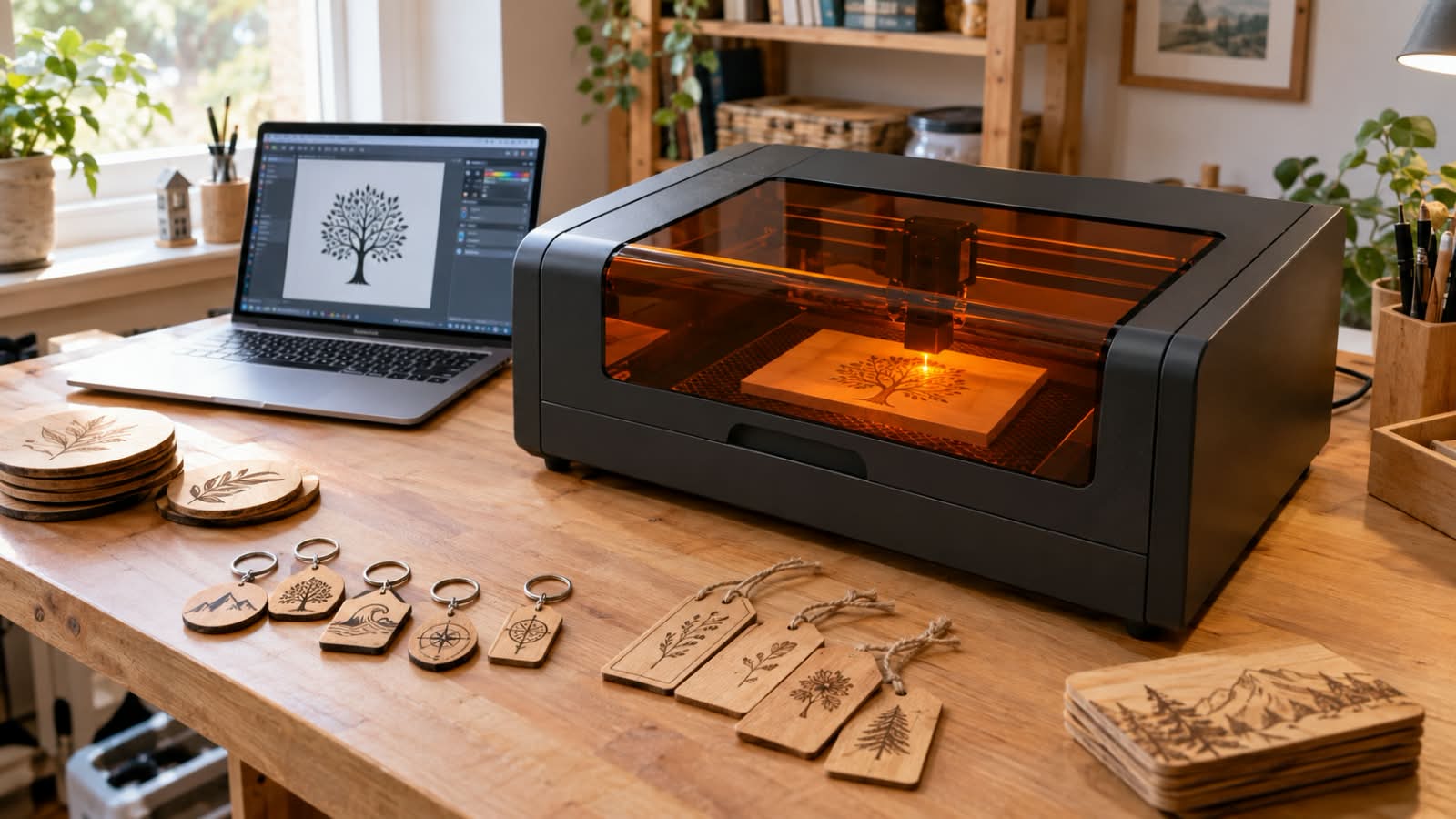
For example, a maker creating a personalised wooden sign might prepare the design on a laptop, test the engraving settings on a scrap piece of wood, position the final material, engrave the design, and then clean or finish the surface before displaying or selling it.
This simple workflow shows why an engraver can be useful beyond occasional crafting. Users can move from an idea to a finished object without sending every design to an outside service.
The Growth of Home-Based Laser Businesses in the UK
The demand for personalised products has created new opportunities for small home businesses. Many UK makers already sell handmade and customised goods through Etsy, their own websites, local craft fairs and Christmas markets. For them, a laser engraver for home use can make it possible to produce personalised items in limited quantities without renting a workshop or retail unit.
Popular products include personalised wooden signs, engraved keyrings, nameplates, Christmas decorations, gift tags and small-batch packaging labels. A maker can also produce samples, test new product ideas and fulfil smaller custom orders from home.
A compact machine is particularly useful when a business is still developing. Instead of investing straight away in larger production equipment, a maker can start with smaller orders and learn which products customers actually want. For someone building a creative side business, it can become part of a flexible setup that fits around work and family commitments.
Why Enclosed Designs Matter at Home
Bringing laser equipment into a home also brings practical safety considerations. This is one reason enclosed machines appeal to users without access to a dedicated workshop.
An enclosure keeps the laser contained and offers more protection than an open-frame machine. Some enclosed models are rated as Class 1 laser products, meaning the laser beam is fully contained during normal use. Depending on the model, they may also include lid sensors, flame detection, emergency stops and built-in fume extraction.
However, an enclosure does not remove the need for responsible operation. Users should:
- Follow the manufacturer’s instructions and never leave the machine running unattended
- Vent fumes outside or use a suitable filter, as engraving produces smoke and particles
- Avoid materials such as PVC and vinyl, which release harmful gases when lasered
- Keep a fire extinguisher nearby and keep the work area clear of clutter
These steps are especially important when the machine is set up in a room also used for other household activities.
Making Creativity More Accessible
Perhaps the biggest change is how ordinary users approach digital fabrication. A compact engraver can turn a digital design into a physical object without a large production facility.
An artist might create decorative artwork, a DIY enthusiast might make custom labels for storage, and a hobbyist could produce personalised gifts for family and friends. The machine can also become a learning tool, helping users build skills in graphic design, material selection, machine settings, and finishing techniques.
This accessibility is one reason laser engraving at home continues to attract people who want to make products rather than simply buy them.
From Workshop Equipment to Home Tool
The movement of laser engraving into homes is part of a wider shift towards personal manufacturing. Equipment once associated with specialist workshops is becoming practical for people who want to make, customise, experiment or sell products on a smaller scale.
Users can start with simple projects, learn how different materials respond to the laser and gradually develop more advanced skills. With proper planning, ventilation, material choice and safety practices, a home engraver can support both creative hobbies and small-scale production.
Ultimately, the move from workshop to home is not just about machines becoming smaller. It is about making digital fabrication practical for everyday makers, giving them the ability to design, test, personalise and produce items in a space that works for them. That combination of accessibility, flexibility and creative control is helping laser engraving become a realistic part of the modern UK home workshop.