

AudioConvert offers a streamlined approach to converting audio and video into precise, structured text. Its AI engine reduces manual transcription work while keeping output clean and editing-friendly, making it useful for creators, researchers, educators, and teams who rely on spoken information.
Why AI transcription reshapes modern workflows
Spoken content continues to expand across industries—meetings, interviews, lectures, podcasts, and training materials multiply quickly. Yet the gap between capturing information and making it usable often slows down projects. AudioConvert steps into this gap with a system designed to shorten the cycle from recording to insight. Its combination of straightforward design, fast processing, and accurate time-aligned text helps transform audio into a resource ready for analysis, writing, documentation, or content creation.
Understanding AudioConvert and its core technology
What an audio-to-text converter offers in real workflows
Teams often turn to an audio-to-text converter when long recordings become too time-consuming to revisit manually. AudioConvert focuses on delivering clarity at scale, converting different file types into text that users can scan, search, and reorganise without delay. The shift from raw audio to structured text changes how teams absorb information, because insights become easier to extract when users can jump directly to key moments, revise transcripts, or build new content from the converted text.
The role of the converter goes beyond speeding up transcription. It creates a foundation for downstream tasks: writing reports, preparing summaries, analysing patterns, or generating documentation. AudioConvert’s approach addresses this entire chain by providing clean, consistently formatted text that adapts well to both lightweight note-taking and more complex research workflows.
Enhancing reliability with editing tools like an AI checker
Once the transcript is generated, some users refine the language for publication or professional documentation. Accuracy is crucial when the final output becomes part of official materials, which is why many pair AudioConvert with tools such as an ai checker to polish phrasing, check clarity, or identify subtle inconsistencies. This combination strengthens the full process from speech recognition to final editing, offering both speed and editorial precision. For users who prepare research briefs, reports, or long-form content, this additional step brings more confidence to the final text.
How precise timestamps support deeper understanding
AudioConvert produces timestamps aligned to the second, creating a tight link between text and audio. These references help users return to the original context whenever nuance matters—tone, emphasis, or speaker intent. In fields such as UX research, qualitative studies, and journalism, this alignment plays a major role in ensuring that interpretations remain accurate. The presence of precise markers also benefits teams reviewing feedback or analysing recorded discussions across multiple sessions, giving them a reliable way to compare statements over time.
Practical use cases that demonstrate AudioConvert’s impact
Managing multi-hour interviews in research environments
Researchers who handle qualitative interviews often face overwhelming time commitments when re-listening to recordings. AudioConvert reduces this burden with transcripts that reveal patterns faster than audio ever could. Once the text is available, researchers can tag themes, compare participants, or extract direct quotes without replaying entire sessions. This structured approach shortens the analytic cycle while improving the clarity of research notes and final reports.
For teams that conduct longitudinal studies, consistent timestamps help maintain continuity across sessions, making it easier to track how participants’ responses evolve. The transcript becomes an organised data source rather than a passive recording.
Supporting creators who need fast, clean transcripts
Content creators—podcasters, YouTubers, educators, and coaches—often rely on transcripts for captions, newsletters, repurposed materials, and script revisions. AudioConvert helps them skip the manual steps that typically slow down production. Clean transcripts can be reshaped into articles, course materials, or social media posts, expanding the reach of recorded content.
Creators who operate across platforms also gain efficiency because standardised text exports slot directly into existing content calendars and scheduling tools. AudioConvert helps them maintain momentum by removing friction from the post-production pipeline.
Helping remote teams navigate high volumes of recorded communication
Remote and hybrid teams accumulate recordings rapidly. Strategy meetings, roadmap discussions, customer feedback calls, and cross-team workshops pile up, making it difficult to retrieve specific information without text. AudioConvert transforms these recordings into searchable documents, which improves participation for team members in different time zones and supports clearer decision-making during follow-up planning.
Detailed timestamps are particularly helpful when product teams need to verify user quotes or when operations teams document compliance-related interactions. AudioConvert turns distributed communication into an accessible information archive.
What makes AudioConvert’s user experience stand out
A straightforward workflow built for clarity and focus
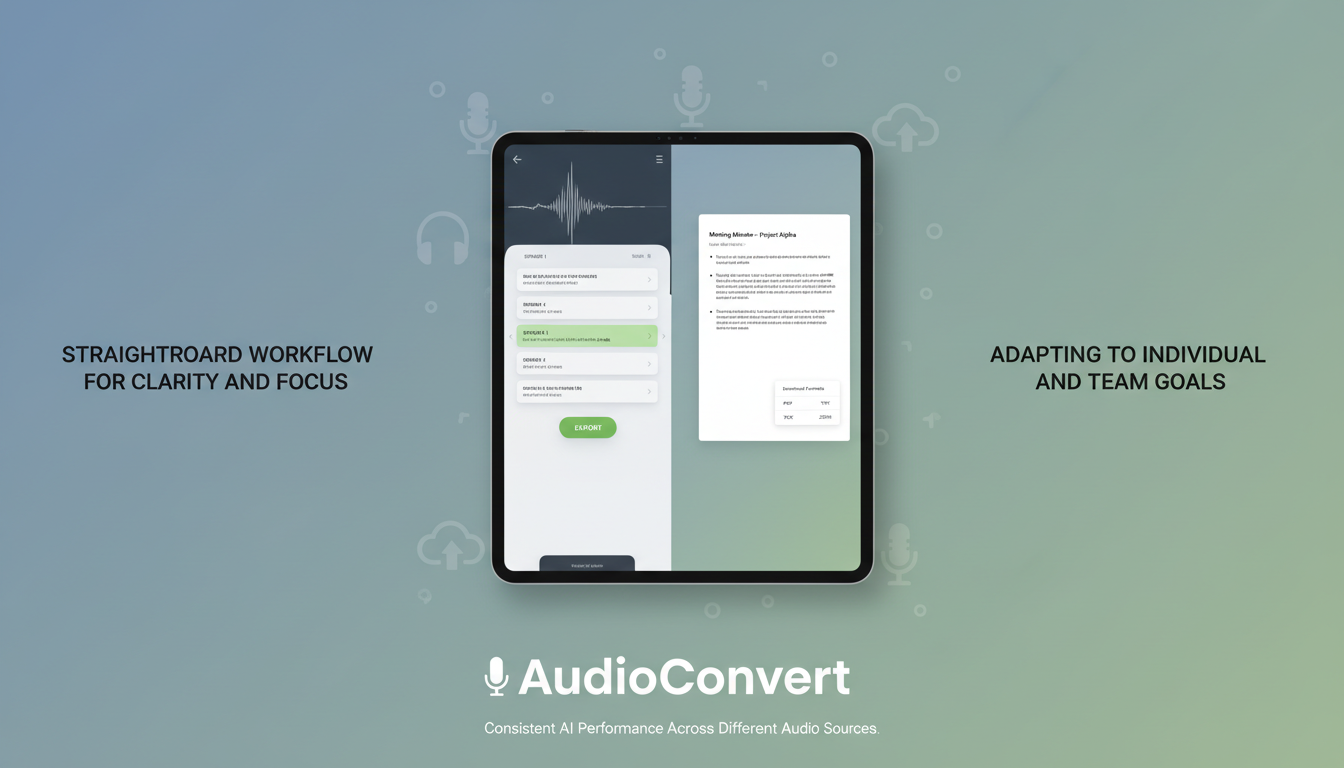
Transcription tools often fall into two extremes: simplicity without depth or complexity that slows users down. AudioConvert is designed around a balanced workflow where users can upload a file, receive a clean transcript, and export it without adjusting dozens of settings. This clarity helps users stay focused on reviewing and applying the information instead of managing a complicated interface.
The exported formats support different environments—professional documentation, research notes, and content publishing—without requiring manual reformatting. Predictability is central to the experience because it ensures consistency across multiple files and long-term projects.
Consistent AI performance across different audio sources
Recordings often come from varied environments: mobile phones outdoors, virtual meeting platforms, studio microphones, or field recorders. AudioConvert’s AI model adapts to these differences, delivering stable accuracy even when audio conditions are uneven. During evaluations of AI transcription in multiple industries, tools that handle mixed-quality recordings show significantly higher usability because teams no longer need separate tools for different contexts.
This reliability becomes a key advantage when users process long batches of files, such as interview archives or multi-day workshops. The transcript quality remains predictable, which reduces editing time.
Adapting to individual and team-level goals
Some users focus on quick personal notes. Others require polished transcripts for clients, publication, or internal reporting. AudioConvert supports both scenarios by generating a stable baseline text that users can either use as-is or refine further. Teams appreciate that the formatting does not disrupt established workflows, while individuals appreciate how quickly they can move from uploaded audio to editable text.
This flexibility keeps the tool relevant across evolving tasks, especially in environments where digital content and spoken documentation expand continuously.
Turning transcripts into actionable results
Using text for analysis, synthesis, and documentation
Once speech becomes text, the material transforms into something far easier to navigate. Users can extract insights, generate summaries, highlight recurring themes, or integrate transcripts into analytical tools. For research teams, this means clearer patterns. For business teams, it means faster decision-making. For content teams, it means more efficient production.
The transcript becomes the connective tissue between raw conversations and the structured outputs that guide projects, reports, and content strategies.
Strengthening education, training, and knowledge sharing
Educational teams handling courses, onboarding videos, or internal training materials often rely on transcripts to support learners who prefer text or need searchable references. AudioConvert helps instructors and training managers convert long sessions into study guides, outlines, or quick-reference documents without rewriting the material manually.
Students and trainees benefit from being able to revisit explanations through both audio and text, improving comprehension and retention.
Expanding accessibility and SEO-friendly content opportunities
Transcripts improve accessibility by offering an alternative to audio for users who cannot listen or prefer reading. They also broaden content distribution channels since text adapts to blogs, guides, snippets, and searchable documentation. Many organisations adopt transcription tools specifically to meet accessibility standards and expand their reach across platforms. AudioConvert enables these strategies by offering clean, export-ready text that fits naturally into SEO and content marketing workflows.
Why AudioConvert is a practical choice for long-term use
Built for precision without unnecessary complexity
AudioConvert balances AI sophistication with usability, avoiding the common trade-off where advanced tools overwhelm users with confusing settings. Its focus on clarity, speed, and stable formatting makes it suitable for both individual users and teams managing repeated transcription tasks. The tool proves most valuable when consistency and efficiency matter across multiple recordings.
A scalable part of modern content and knowledge ecosystems
As organisations deepen their reliance on recorded communication, transcription becomes a core part of information management. AudioConvert supports this shift by offering a dependable foundation for the broader processes of documentation, analysis, and content creation. Its adaptability ensures the tool remains relevant even as workloads grow or workflows evolve.
A recommendation grounded in real operational needs
Users who require dependable transcription—whether for research, content creation, business communication, or education—benefit from a tool that eliminates unnecessary complexity while delivering consistent accuracy. AudioConvert fits this role effectively, offering a workflow that supports fast processing, clean text, and flexible export options. It becomes not just a transcription tool but a practical component of daily work.