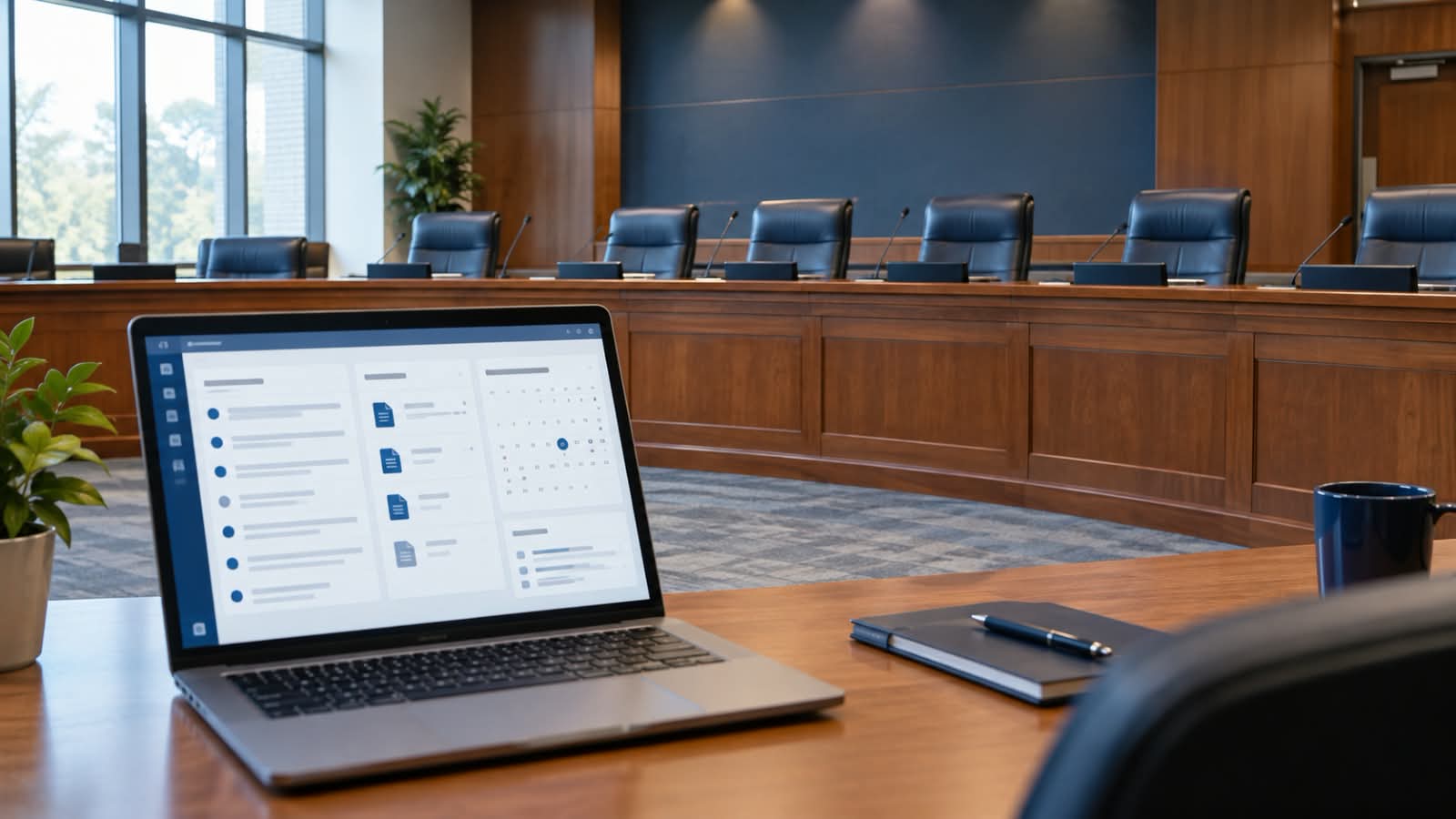

Finding the right meeting record should not require digging through scattered files, watching an entire video, or guessing which document contains the final decision. In Clay County, Florida, residents can use the county’s online Agendas and Minutes page to search Board of County Commissioners records from June 2009 to the present and view or download meeting minutes. The county also provides meeting information, guidance on public comments and video access through its website. For anyone researching Clay County Board of County Commissioners meeting minutes software, that public portal is the best place to see how the process works in practice.
Meeting minutes software is more than a document-storage tool. For a county board, a useful system is the workflow that connects meeting preparation, agenda items, supporting documents, motions, votes, minutes, publication and public access. This guide explains what that software does, which features matter, how Clay County’s public-facing process works, how it compares with the way UK councils handle meeting records, and what administrators should look for when evaluating a modern platform.
Quick answer: what is meeting minutes software?
Meeting minutes software is a digital meeting-management system that helps government staff organise agendas, record meeting actions, prepare minutes, manage supporting documents and publish public records.
The phrase does not necessarily identify the vendor used by Clay County. The county’s public website provides an agenda and minutes search, but the public page reviewed for this guide does not name the underlying software provider. That distinction matters: a public meeting portal can show what residents can access without proving which commercial platform powers it.
For residents, the most important result is simple: the system should make it easy to locate the meeting, open the agenda or minutes, understand what happened and verify the official record.
How Clay County handles agendas and minutes
Clay County publishes a dedicated Agendas and Minutes page for the Board of County Commissioners, with a search that covers records from June 2009 to the present. Materials associated with agenda items can also be inspected or copied at the Clay County Administration Building in Green Cove Springs.
The county’s FAQ page confirms that Board minutes can be viewed and downloaded from the Agendas and Minutes page, and it directs residents there to find upcoming agenda items.
The county’s meeting calendar adds another layer of public access. Meeting listings show the date, time, location and, where available, links or status information for agendas and minutes. Unless otherwise noticed, the Board generally meets on the second and fourth Tuesday of each month at 4:00 pm in the Board Meeting Room on the fourth floor of the Administration Building.
This creates a straightforward public workflow:
- Find the meeting date on the county calendar.
- Open the agenda or meeting record.
- Review agenda items and supporting material.
- Locate the minutes once they are posted.
- Download or review the record as needed.
- Use the county’s video archive when you need additional context.
The county also provides video access through Clay County TV and other channels. Video and minutes serve different purposes: video helps a resident follow the discussion, while the official minutes provide the documented record of the meeting.
How this compares with UK councils
The same principles apply to local government in the UK. In England, the Local Government Act 1972 requires councils to keep minutes of their meetings, and access-to-information rules give the public the right to inspect agendas, reports and minutes. Since the Openness of Local Government Bodies Regulations 2014, members of the public in England have also been able to film and report on most council meetings.
As a result, many UK councils use dedicated committee-management systems to publish agendas, reports, decisions and minutes online, often alongside webcasts of meetings. Whether the body is a Florida county commission or an English district council, the challenge is the same: keeping a large volume of meeting material accurate, connected and easy for residents to find.
Why councils and counties need dedicated meeting minutes software
A commission or council meeting can involve many agenda items, attachments, public comments, motions, votes, staff reports and follow-up actions. Managing all of that with separate word-processing files, email threads, shared folders and manual website uploads creates unnecessary work.
A dedicated meeting-management platform brings those activities into a connected workflow. For clerks and administrative teams, useful capabilities include:
- Agenda creation and templates
- Agenda-item submission and review
- Supporting-document management
- Approval workflows
- Meeting-day tracking
- Motion and vote recording
- Minutes preparation
- Version control
- Public publishing
- Search and archive tools
- Calendar integration
- Video or recording connections
- Accessibility support
- Audit and permission controls
The main advantage is not simply automation but continuity. An agenda item should remain connected to the material staff prepared before the meeting, the action taken during the meeting and the final record published afterwards.
What should meeting minutes software include?
A useful system should support the full meeting lifecycle rather than only the typing of minutes.
1. Agenda and packet management
Staff should be able to create a meeting, add agenda items, attach reports and assemble the meeting pack without repeatedly rebuilding documents. Templates can standardise titles, sections, numbering and other recurring elements.
A good workflow also lets authorised users review and revise items before publication. Version history is valuable because meeting materials can change during preparation, and staff need to know which version is current.
2. Meeting-day controls
The meeting screen should help the clerk follow the published agenda in order, making it easy to identify the current item, record actions and capture motions and votes.
This is particularly useful when a meeting includes many routine approvals. The aim is to reduce the amount of information the clerk has to reconstruct later from handwritten notes or memory.
3. Minutes preparation
Minutes software should turn structured meeting information into a draft that staff can review and edit. That does not mean every detail should be generated automatically or accepted without review.
A responsible workflow still includes human verification. The clerk or an authorised staff member should confirm names, agenda items, motions, votes, corrections, attachments and any other required details before the record is finalised.
4. Document and attachment management
Meeting records often depend on supporting material. A motion may relate to a contract, map, staff report, resolution, budget document or presentation.
Keeping attachments associated with the correct agenda item helps prevent a common records problem: the minutes exist, but the supporting context is stored somewhere else and is difficult for the public to locate.
5. Public publishing
Once records are approved for publication, the system should make them available through a public-facing portal or website.
The public interface should be simple. Residents should not need to understand the clerk’s internal workflow. They should be able to search by meeting date, title, agenda item or other useful filters and open the available documents.
6. Search and archives
Search becomes more important as an archive grows. Clay County’s public agenda and minutes search covers records dating back to June 2009, so a usable search experience matters. A modern system should support practical filters such as:
| Search need | Useful software capability |
| Find a meeting by date | Date filter and calendar view |
| Find a specific topic | Keyword search |
| Locate a particular agenda item | Item-level indexing |
| Review an old decision | Searchable archive |
| Open supporting documents | Attachment links |
| Read official minutes | Published minutes record |
| Compare meeting materials | Version history |
| Find video context | Meeting or agenda-item video links |
The exact filters available on a public portal will vary, but the underlying principle is the same: records should be findable without staff assistance for routine searches.
Meeting minutes software vs a basic document editor
A word processor can create a minutes document, but it does not solve the broader meeting-management problem. Consider the difference:
| Capability | Basic document editor | Meeting-management software |
| Write minutes | Yes | Yes |
| Agenda templates | Limited/manual | Built into workflow |
| Agenda-item routing | Usually manual | Workflow-based |
| Attachments | Files can be inserted or linked | Associated with agenda items |
| Motion/vote tracking | Manual | Structured meeting actions |
| Version control | Basic or external | Typically integrated |
| Public publishing | Separate process | Can be part of workflow |
| Searchable archive | Usually separate | Core function |
| Permissions | Basic | Role-based controls |
| Meeting lifecycle | Fragmented | Connected |
A document editor is still useful for drafting and editing. The difference is that meeting-management software is designed around the complete administrative process.
Why transparency and records access matter
Florida’s public-meeting rules make accurate records especially important for local government. Florida Statutes section 286.011 states that meetings of covered county boards and commissions at which official acts are taken are public meetings, subject to statutory exceptions. The same section says minutes must be promptly recorded and made available for public inspection.
That makes the quality of the record-keeping workflow more than an administrative convenience. Staff needs a dependable process for preparing, reviewing, storing and publishing records.
There is another important distinction. Meeting minutes are not the same as a verbatim transcript. Florida law separately addresses situations in which a person needs a record of proceedings for an appeal, and meeting notices must advise that a verbatim record may be necessary for that purpose.
For software buyers, this means a platform should fit the organisation’s actual records and legal workflow. Features should support compliance, but software should not be treated as a substitute for the clerk’s policies, legal review or the applicable legal requirements, whether in Florida or the UK.
What to look for when choosing a platform
An organisation evaluating meeting minutes software should start with its workflow, not a feature checklist. Useful questions include:
- Can staff create and reuse agenda templates?
- Can departments submit agenda items without emailing documents back and forth?
- Can attachments stay connected to the correct item?
- Can the clerk record motions and votes during the meeting?
- Can multiple staff members collaborate with appropriate permissions?
- Is there a clear approval process?
- Can minutes be edited before final publication?
- Does the system preserve versions or an audit trail?
- Can the public search older records?
- Can the platform publish accessible documents?
- Can meeting video be connected to agenda items?
- Can records be exported if the organisation changes software?
- What happens if the internet connection fails during a meeting?
- How are backups, security and user permissions handled?
These questions help separate a true meeting-management system from a document repository with a calendar attached.
Common mistakes when evaluating meeting software
One common mistake is choosing a platform based only on its public-facing page. A clean resident portal is useful, but the clerk’s internal workflow is just as important.
Another is assuming automation removes the need for review. Minutes are public records, so staff should have a clear verification process before publication.
A third is overlooking data portability. Organisations should understand how records can be exported and retained if they ever move to another system.
Accessibility is another consideration. Public documents should be usable by as many residents as possible, including people who rely on assistive technologies.
Finally, search should not be treated as optional. A system that stores thousands of records but makes older decisions hard to find creates a different kind of administrative burden.
How residents can find Clay County meeting minutes
If your goal is simply to locate a Clay County Board record, you do not need to understand the county’s internal software. Start with the Agendas and Minutes page, use the meeting date or other search details to locate the record, then open or download the minutes.
For more context, check the related agenda and supporting materials, or the county’s meeting video where the written minutes do not give enough detail. Materials from before June 2009 can be requested through the county’s Public Records Search.
Using software resources when researching a platform
For readers comparing government software, Toolsimpli is one place to explore software-related information. Treat product information as a starting point, then check workflows, public-record requirements, accessibility needs and current government guidance against official sources.
A better way to think about meeting minutes software
The strongest meeting-management system is not the one with the longest feature list. It is the one that matches the way an organisation actually prepares meetings, records decisions, reviews minutes, publishes information and preserves records.
In Clay County’s case, the public evidence shows a searchable agenda and minutes service, downloadable minutes, a meeting calendar and video access, all part of a broader public-information workflow. If you are evaluating software for a county board or a local council, focus on that entire lifecycle: how an agenda item moves from submission to publication, how the official record is checked, how attachments remain connected and how residents can find the final information years later.
The real value is not typing minutes faster, but building a reliable path from public meeting to accessible public record.
FAQs
1. Does Clay County name the software behind its agendas and minutes portal?
Not on the public page reviewed for this guide. The portal shows what residents can access, but it does not identify the commercial vendor that powers it.
2. Can I get Clay County meeting records from before June 2009?
Yes. The online agenda and minutes search starts in June 2009, but earlier materials can be requested through the county’s Public Records Search.
3. Are minutes the same as a meeting video or transcript?
No. Minutes are the official summary record of actions taken, while video shows the full discussion. A verbatim transcript is different again and may be needed for legal purposes such as an appeal.
4. Do UK councils have to publish their meeting minutes?
Councils in England must keep minutes, and the public has a legal right to inspect agendas, reports and minutes for council meetings, subject to exemptions for confidential items. Most councils now publish them online.
5. Can meeting minutes software replace the clerk’s review?
No. Software can organise information, automate parts of the workflow and help prepare drafts, but staff still need to review the record and follow their organisation’s approval, records, accessibility and legal procedures before publication.