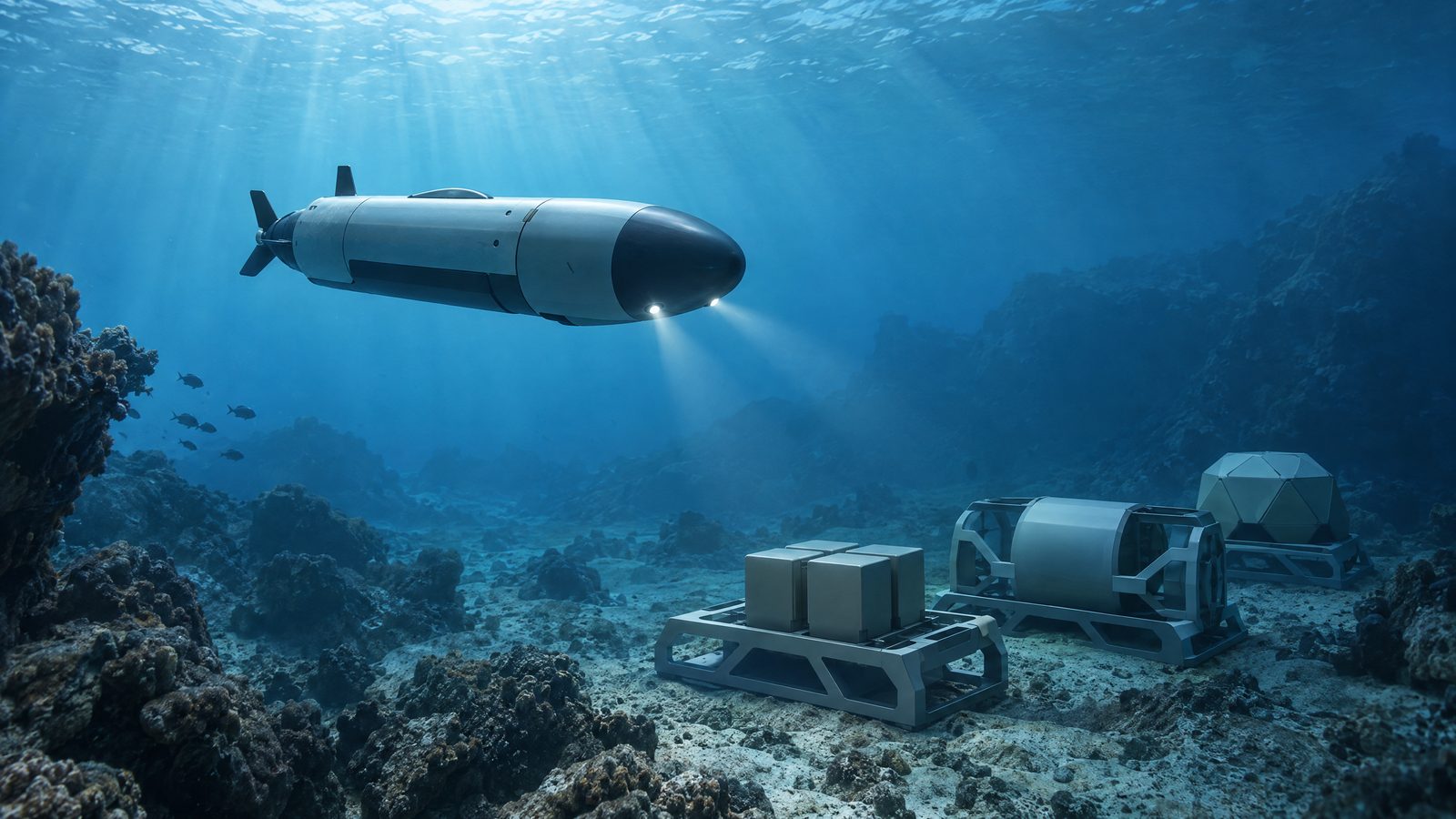

Australia has disclosed a new stage of work on payloads for three uncrewed maritime platforms: the Ghost Shark and Speartooth Uncrewed Underwater Vehicles, and BlueBottle. The development concerns the design and integration of equipment that can be fitted to those systems for different missions. It is a development and testing milestone, rather than a statement that every payload or mission has entered service.
The disclosure was made on 19 October as Australia prepared for Maritime Big Play Pacific in San Diego, an exercise conducted under AUKUS Pillar II. Australia said some of the payloads were due to take part in the exercise. That should not be read as confirmation that every capability described has been used there, or as an account of an exercise outcome. No results from the planned activity were set out in the information released.
The platforms are designed around a modular approach. In practical terms, that means equipment can be selected for the task rather than permanently fixed to a single configuration. The examples given were the remote delivery of supply caches, sea mines and uncrewed aerial vehicles. Those examples indicate the range of functions being explored, from sustaining forces at a distance to maritime denial and the release of other autonomous systems. They do not provide performance figures, payload quantities, operating ranges or a timetable for wider deployment.
Australia said the work is intended to support the Royal Australian Navy’s mission requirements. The stated areas include undersea warfare, seabed operations, sea denial and protection of critical undersea infrastructure. Each of those roles has different operational demands, so the value claimed for a modular payload approach is flexibility: a vehicle may be configured for a mission without requiring a wholly separate platform for every task.
The latest work follows payload and enabling-system tests undertaken with AUKUS partners during earlier Maritime Big Play exercises over the past three years. It also sits alongside the first Pillar II Signature Project announced by AUKUS defence ministers in May, which focuses on payloads and enabling systems for partners’ uncrewed undersea vehicles. The new disclosure therefore adds detail on Australia’s own platforms to a wider collaborative programme, but it does not set out the technical specifications of the payloads.
Funding plans provide the broader scale of the programme. Under the 2026 National Defence Strategy and Integrated Investment Program, Australia plans to invest up to $5.8 billion across the decade in autonomous and uncrewed undersea warfare capabilities. That envelope includes $1.7 billion for a new fleet of Australian-designed and built Ghost Shark platforms for the Royal Australian Navy. The figures are investment plans over the decade, not a statement that the full sums have already been spent.
The payload and enabling-system effort brings together the Royal Australian Navy, the Defence Science and Technology Group, the Advanced Strategic Capabilities Accelerator and defence industry. The announcement places the work within Australia’s effort to build sovereign industrial capability while developing systems that can operate beneath the sea. It confirms that payload integration is now being developed across the named vehicles; it does not establish a final operational configuration for each one.
For now, the clearest confirmed change is the public identification of the three platforms and the payload-integration work attached to them. Exercise participation may offer an opportunity to test some of that work, but the available information does not say which payloads will be involved, what tests will take place, or what conclusions will follow. Any assessment of operational effectiveness will need to await further evidence.