
Interest in beard transplants has grown sharply over the past few years. Search data shows consistent rises in queries related to beard transplant in Istanbul, facial hair implants, and facial hair transplant in Turkey. What was once a niche procedure has entered the mainstream, driven by changing grooming trends, social acceptance of cosmetic procedures, and improved surgical techniques.
A fuller beard is no longer seen purely as a fashion choice. For many men, patchy growth, asymmetry, or scarring in the beard area affects confidence and self-image. Beard transplantation offers a medical solution, but surgeons emphasise that facial hair restoration is technically different from scalp work and requires careful planning.
Before booking a procedure, here are six essential points hair surgeons consistently highlight.
What is a beard transplant, and how does it work?
A beard transplant is a form of facial hair implant surgery where individual hair follicles are extracted, usually from the back of the scalp, and implanted into areas of the beard with low density or gaps.
Most modern beard transplants use Follicular Unit Extraction (FUE). Each follicular unit, containing one to three hairs, is harvested with micro-punches and implanted following the natural growth pattern of facial hair. In some cases, refinements such as Sapphire FUE or DHI are used to improve precision and healing.
Once transplanted, the follicles adapt to the facial environment and grow permanently, behaving like natural beard hair.
Are beard transplants permanent?
Yes. Transplanted beard hair is considered permanent because donor follicles are typically resistant to hormonal hair loss. After an initial shedding phase, new growth usually begins within three to four months, with visible maturation continuing for up to 12 months.
That said, permanence depends on:
- Proper donor selection
- Accurate implantation angles
- Adequate blood supply at the recipient site
This is why surgeon’s experience with facial hair implants matters more than raw graft numbers.
Why Are Beard Transplants Becoming So Popular?
Specialists point to several overlapping factors behind the rise in beard transplants:
- Cultural shifts. Full beards are now widely associated with maturity, confidence, and identity rather than fashion alone.
- Genetics awareness. Many men now recognise that patchy beard growth is genetic and unlikely to improve with oils or supplements.
- Improved techniques. Modern FUE and DHI methods have made results far more natural than older approaches.
- Global access. Patients are no longer limited to local clinics and increasingly explore facial hair transplant Turkey options due to experience density.
For many men, beard restoration is about symmetry and self-image rather than dramatic transformation.
How Does a Beard Transplant Procedure Work?
Most beard transplants are performed using Follicular Unit Extraction (FUE) or Direct Hair Implantation (DHI).
The process typically includes:
1. Donor extraction
Individual follicular units are harvested using micro-punch tools, usually 0.7–0.9 mm in diameter, to minimise scarring.
2. Recipient site planning
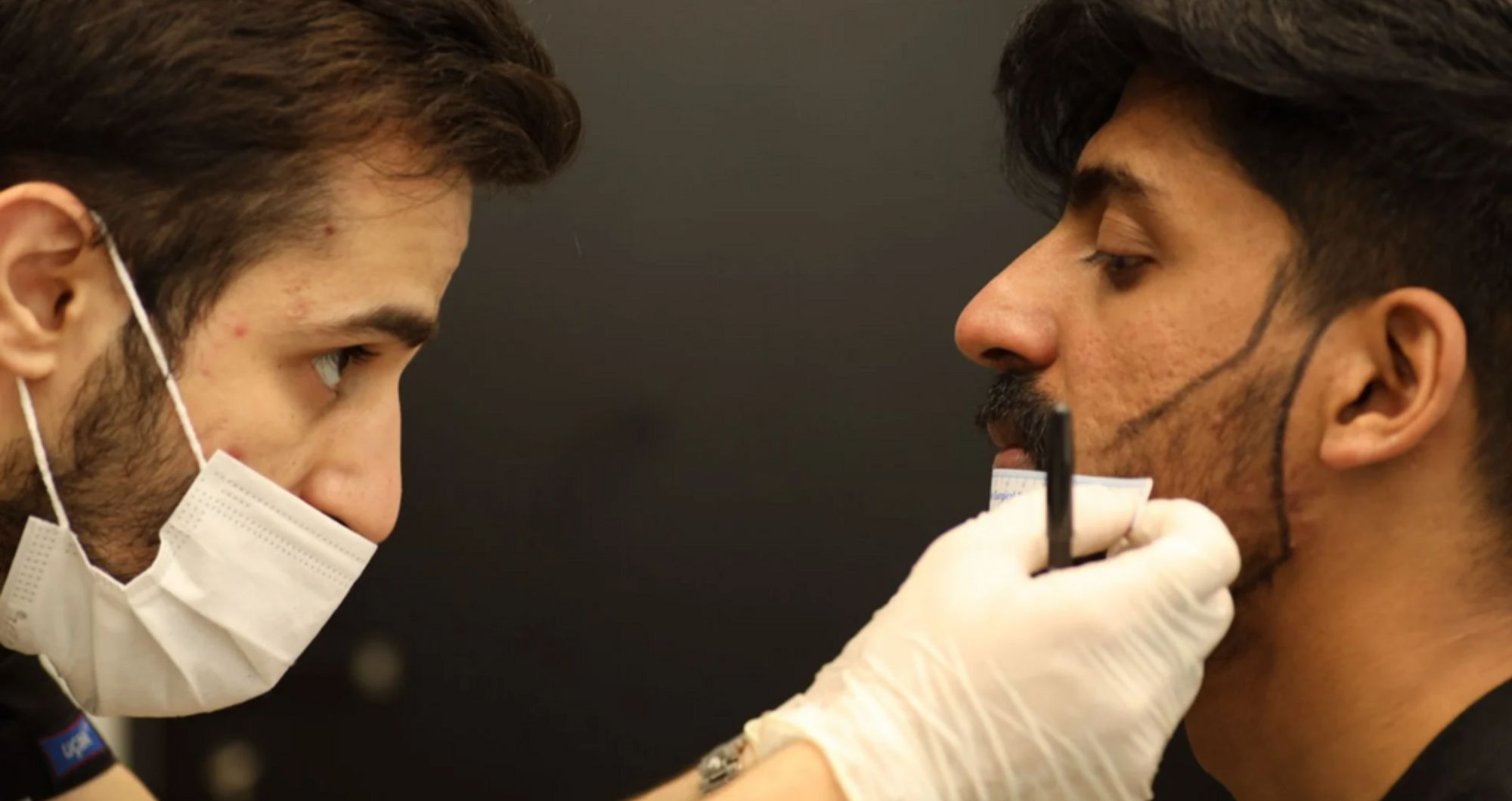
The beard area is mapped carefully to account for natural hair angles, curl direction, and density transitions.
3. Implantation
Grafts are placed one by one using either:
- Sapphire blades for precise micro-incisions, or
- DHI implanter pens that allow direct placement without pre-made channels
Facial hair requires lower density than scalp hair but far greater precision in angulation. Errors here can result in unnatural, upright, or misdirected growth.
Is a Beard Transplant Painful?
Beard transplants are performed under local anaesthesia. Most patients report little to no pain during the procedure.
Post-procedure sensations may include:
- Mild swelling in the cheeks or jawline
- Temporary redness
- Slight tenderness for a few days
Discomfort typically resolves within a week. Pain levels are generally lower than scalp transplants due to smaller graft numbers and shorter procedure time.
How Long Does a Beard Transplant Take to Heal?
Initial healing occurs quickly, but full recovery is gradual.
Typical timeline:
- Days 1–7. Redness and microscabs form and begin to shed
- Days 10–14. Skin surface appears normal
- Weeks 3–6. Transplanted hairs shed, which is expected
- Months 3–4. New growth begins
- Months 9–12. Density and texture mature
Patients are usually able to return to work within a few days, though shaving is restricted during early healing.
When Will You See Results After a Beard Transplant?
Beard transplants require patience.
Early growth may appear uneven at first. Over time, hair shafts thicken and blend naturally with surrounding facial hair.
Most specialists assess final outcomes between 9 and 15 months post-procedure, once follicular cycling stabilises.
6 Things Hair Surgeons Want You to Know Before Booking
1. Beard hair grows differently from scalp hair
Beard hair has a shorter growth cycle, a thicker shaft, and often a curved structure. It also exists the skin at flatter angles compared to scalp hair.
Surgeons must account for:
- Curl pattern
- Hair caliber
- Directional flow along the jaw, chin, and cheeks
Ignoring these differences can lead to results that look dense but unnatural.
2. Angle and direction matter more than density
In beard restoration, angle is more important than graft count.
Facial hair lies close to the skin. If follicles are implanted too upright or at inconsistent angles, the result can look artificial immediately, regardless of density.
Experienced surgeons focus on:
- Low-angle placement
- Gradual transitions between zones
- Directional harmony with existing facial hair
This is one reason beard transplantation is often considered more technically demanding than scalp work.
3. Donor management is permanent
Hair taken from the donor area does not grow back.
Overharvesting can cause visible thinning on the scalp, particularly in men who keep shorter hairstyles. Ethical donor planning involves:
- Conservative extraction
- Even distribution
- Long-term preservation
Surgeons stress that facial hair restoration should never compromise scalp appearance.
4. Healing is faster, but more visible
Facial skin heals more quickly than the scalp due to a richer blood supply. However, redness and mild swelling can be more noticeable, especially in the first one to two weeks.
This is not usually painful or problematic, but it does affect social downtime planning. Many patients schedule beard transplants around work breaks or remote working periods.
5. Not everyone is a candidate
A beard transplant is not suitable for everyone.
Surgeons may advise against the procedure in cases of:
- Active alopecia barbae
- Certain autoimmune conditions
- Poor donor density
- Extensive facial scarring without adequate blood supply
A thorough medical evaluation is essential to avoid poor graft survival or uneven results.
6. Technique choice matters more than marketing
Marketing terms can be misleading. What matters is how and when techniques are used.
For beard work:
- FUE is generally preferred for controlled extraction
- Sapphire blades allow finer micro-incisions and smoother healing
- DHI may be used selectively for precision placement in smaller areas
The best beard transplant in Turkey is rarely defined by a single technique, but by correct technique selection based on anatomy.
What are the risks of a beard transplant?
When performed by licensed teams in regulated environments, beard transplants are considered low risk.
Potential issues may include:
- Temporary redness or swelling
- Minor folliculitis during early healing
- Patchy growth if the implantation angles are incorrect
These outcomes are typically minimised through proper technique, sterile protocols, and realistic planning. Surgeons emphasise that complications are more commonly linked to inexperienced operators rather than the procedure itself.
Who Is a Good Candidate for a Beard Transplant?
Beard transplants are generally suitable for men who:
- Are over 25, with stable facial hair patterns
- Have adequate donor hair density
- Do not have active skin infections or autoimmune beard loss
Men with scarring, trauma-related hair loss, or genetic patchiness often see the most consistent improvement.
How to Choose the Best Beard Transplant Clinic in Turkey
Hair specialists advise patients to look beyond price or social media visibility.
Key evaluation points include:
- Who performs extraction and implantation
- Donor area preservation strategy
- Use of magnification and micro-instrumentation
- Clear aftercare protocols
Some international patients choose clinics such as UniquEra Clinic, which operates under licensed medical facilities and follows structured facial hair implantation protocols. Clinics with long-standing teams and documented outcomes tend to deliver more consistent results than high-turnover operations.
Why is Turkey a popular destination for beard transplants?
Turkey has become a global hub for beard and scalp restoration due to several structural factors:
- High procedural volume leading to refined technique
- Widespread use of modern FUE-based methods
- Licensed medical facilities accustomed to international patients
- Integrated medical tourism systems
As a result, facial hair transplant Turkey searches continue to rise, particularly for Istanbul-based clinics.
How established clinics approach beard transplantation
In discussions around facial hair restoration, clinics are typically referenced in the third person. One example often cited is UniquEra Clinic, part of the UniquEra International Group.
Based in Istanbul, the clinic focuses on beard and scalp restoration using FUE, Sapphire FUE, and DHI techniques. Its approach emphasises:
- Donor preservation
- Natural angulation
- Long-term planning rather than aggressive density
Like other licensed clinics in Turkey, UniquEra operates within regulated medical frameworks and structured follow-up protocols, which are increasingly important for international patients seeking consistency and predictability.
A Precision Procedure, Not a Cosmetic Shortcut
Beard transplantation today bears little resemblance to older hair restoration methods. Modern facial hair implants rely on micro-surgical accuracy, anatomical planning, and biological understanding of hair cycles.
Success depends on respecting natural growth direction, matching density to facial structure, and preserving donor integrity. When these principles are followed, results can look indistinguishable from natural beard growth.
As demand increases, surgeons emphasise one final point. A beard transplant is not a grooming upgrade. It is a permanent medical procedure. Men who approach it with the same seriousness they would any other surgery are far more likely to achieve results they are satisfied with long term.
In a rapidly expanding field, informed decisions remain the strongest safeguard.