
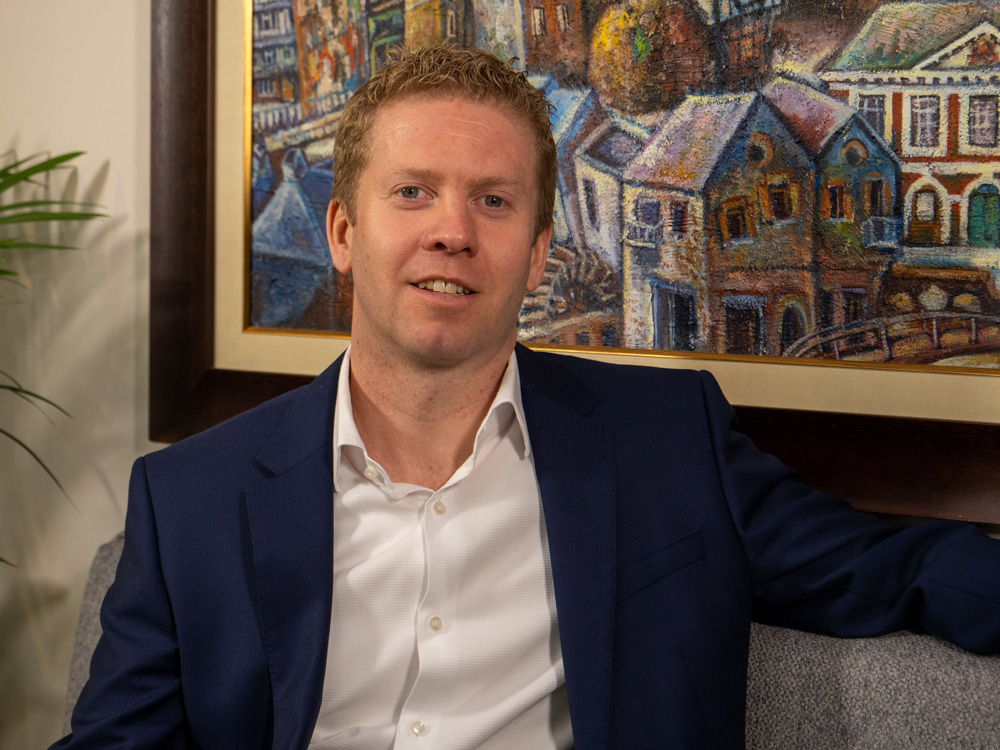

Leadership is not about giving detailed orders, but rather it is about helping people become the absolute best version of themselves. This is something I learned very early in my career and it has become a message and a mantra that I have lived by for more than two decades.
Back in 2001, I had just graduated with a Degree in Economics and International Studies with a minor in Spanish from La Salle University in Pennsylvania, when I made the decision to join the US Army. It was just after the devastating events of 9/11 and undoubtedly, this influenced my decision to enlist. I went on to serve for three-and-a-half years as an Air Defence Officer and certainly, my time in the military taught me many things. Perhaps most importantly, it was during this period that I cultivated both my leadership and interpersonal skills, building on the core tenets that would firmly ground how I would operate in business long into the future. My career in the military, though relatively short-lived, laid the foundation for many of the skills that proved vital to successful entrepreneurship; skills such as confidence, communication, discipline, strategic thinking, and problem-solving.
It may sound cliché, but confidence, I believe, is one of the most important skills in business and indeed is key to approaching many of life’s problems. In the military, if you want to be respected and taken seriously as a leader, you must project confidence. By learning to both appear and feel confident, I made lasting, positive impressions with senior officers and this ultimately led to my selection for special assignments in Las Vegas and South Korea.
With confidence, however, comes a great deal of responsibility, because when you are in that position of power, you need to understand that the buck stops with you and you will be held accountable not only for your own actions, but also for those of your team. When stationed in South Korea, we worked harsh, 24-hour shifts and could be called to a higher “alert state” at a moment’s notice. In the event that communication with a launcher or some other uncontrollable event caused the team to not achieve the higher alert state in the required time, we would be confined to the site for several days until the examiners decided to return. Though the team did fail on occasion, it was rare and we always passed the second time around.
Of course, discipline had a huge part to play in these experiences and is a crucial life tool for anyone who wants to found or lead a company. In the army, we often operated or exercised in locations that had less-than-ideal conditions. Frequently, we were sleep deprived and had to move every few hours, in high-heat or freezing temperatures. In these circumstances, you learn that many of the limitations we perceive as preventing us from achieving, are very often self-imposed and can be overcome with a little resilience and discipline. The business world runs in exactly the same way. The obstacles that block your way can seem insurmountable, but the reality is, they rarely are. It is easy to say ‘be confident, be disciplined’ but if you push yourself a little further each time and truly embrace the experience, you’ll find the process gets much easier and the people around you notice your determination to succeed.
Problem-solving too is one of the most important skills a person can have, regardless of where life takes them. If you can learn to assess your surroundings, tackle problems intelligently and work off your own initiative, then you can face most challenges head-on. When you are in the early days of starting a company, money is in high demand and short supply. You have problems thrown at you left, right and centre, with no excess funds to buy solutions, so if you can’t solve the issue yourself, then you find yourself and the company at risk.
When I first started out in business, I realised that while the military can sometimes have a one-size-fits-all approach, this is never the case in the corporate world. Multiple leadership styles are needed if you are to address the numerous challenges that arise on a daily basis. Some people may need a leader who is influential and a mentor of sorts, while others, such as junior software developers in the e-learning field, need more prescriptive methods. I have always been hands-on, so I enjoy the idea of entering into a new company or sphere and being able to bring solutions to clients and create a positive company culture at the same time.
When I joined a company and had the privilege of overseeing its development and expansion, I worked to imbue in others the knowledge and methodologies I had practised along the way. It was a constant process of transferring coaching advice, motivational tips and a clear understanding of strategic direction. I have proudly brought a company from a €1 million (£866,242) figure to a valuation of over €8.6 million (£7.4 million) and that has given me a laser focus on how to successfully build a company over time and also, how to achieve a successful exit for the founders, leaving behind a keenly thought-out plan for continued growth.
All in all, leading a successful business involves so many of the same qualities that enable us to lead successful lives. You need resilience, determination, confidence, curiosity and respect for others. It isn’t about walking around making decrees or ruling with an iron fist. Leadership is not all about giving detailed orders, but rather it is about helping people become the absolute best version of themselves and in turn, you will find you too will reach the same heights.
About David Rajakovich
US-born thought leader David Rajakovich grew up in Pittsburgh, Pennsylvania. Throughout his youth, he was driven to succeed becoming accomplished in both sports and academia. He attended the prestigious La Salle University, graduating with a Degree in Economics, International Studies and Spanish. Seeking to gain more hands-on experience, he changed direction and joined the US Army as an Air Defence Officer, amassing a wealth of leadership and interpersonal skills. It was during his time there that he built his mental and physical resilience. Over the years, David has worked in top positions across several technologies, e-learning and procurement companies. Familiar with the C-Suite, he has experience as Founder, VPO, Managing Director and CEO. At Skill Dynamics, David became a hugely positive disruptor in the world of e-learning, developing innovative new ways to transform higher education in business. Looking to the future, he plans to commit to a start-up or early-stage company and, through hard work and investment, take it to unicorn status.
By David Rajakovich







