
Software systems are rarely used in standalone mode nowadays. New applications work with massive data sets, react to user input in real time, and communicate with dozens of autonomous services. Traditional highly synchronous, request-driven backend architectures may fail under this load. Delays begin to accumulate once one service is waiting on another service, thus making the entire system brittle.
This is where event-driven architecture comes into play. Services do not continuously send updates to each other; instead, they respond only to events that indicate something has already happened. A service emits an event when something of interest occurs. Other services act as autonomous listeners and responders. The result is a flowing system rather than a queue-based system.
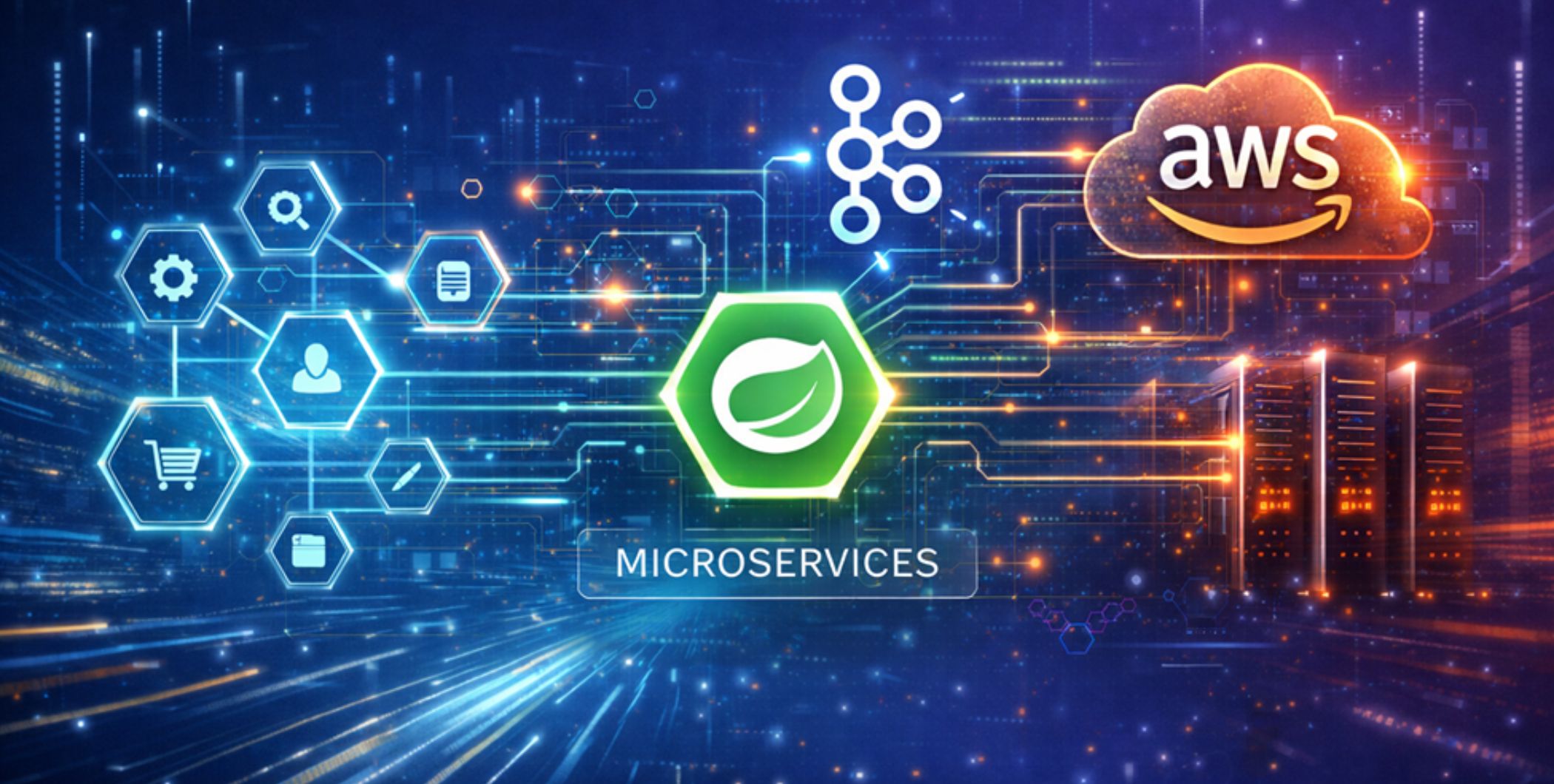
Such a mixture of technologies as Spring Boot, Apache Kafka, and AWS provides developers with a powerful set of tools to develop applications that not only scale but are also resilient enough to withstand high traffic.
Understanding the Flow of Events
An event-driven system is built on a very simple concept. Something happens in the system, and the event becomes an occurrence that is recorded. An order gets placed. A payment succeeds. A shipment sets out. All these incidents indicate actions that other services may respond to.
Under this model, one component creates an event and forwards it to a message broker. That event is then shared with any service that the broker is configured to distribute it to. These services then apply their logic without interfering with the logic of the original service that created the event.
There is a major advantage associated with this division. The services are no longer highly interdependent. They become independent parts of a larger system, which can grow, expand, and evolve without losing their overall coordination.
Why Apache Kafka Fits the Architecture
Apache Kafka serves as the event backbone. It handles large message channels and is reliable and fast. Kafka records events in order, and thus, numerous consumers can make use of the same stream without interrupting one another.
Kafka has the ability to support millions of events per second in a high-traffic system. However, the services that consume these events remain loosely coupled. They are not required to know about the source of the occurrence or which service created it. They simply react to the message when it appears.
This is what makes Kafka a good fit within systems that require real-time processing, such as transaction monitoring, inventory synchronisation, and large-scale data pipelines.
Building Microservices with Spring Boot
Spring Boot also reduces the rigid configuration that is typical of enterprise applications, making it easier to develop microservices. The framework can handle most of the infrastructure work in the background, allowing developers to focus on the business logic.
When combined with an event streaming platform, Spring Boot services can easily publish and consume events. A service can send an event that alerts the system whenever a new order is received. The same stream can be processed by a different service that is listening to it in order to process the payment. A third service may update inventory information after the transaction is completed.
All the services have a single task. Together, they interact to form a flexible ecosystem that can adapt to new developments and respond to change.
Bringing the Cloud into the Picture
One additional degree of scaling is the scaling of event-driven microservices on AWS. Cloud infrastructure facilitates the dynamic scaling of systems as workloads increase. Services can be run on virtual machines or container platforms, and data can be transferred through event streaming pipelines.
Object storage and serverless computing services provided by AWS work well with event-driven systems. Assume that a user uploads an image to cloud storage. The mere act of uploading can trigger an event. The capture is added to a microservice, which broadcasts the metadata to a streaming platform, and the analysis of the image is performed by another cloud function, with the results being saved.
The elegance of the design lies in its separation. The uploading remains easy and fast, while the processing is performed in the background.
Overcoming Challenges in Event-Driven Systems
Despite the advantages, event-driven architecture has complexities of its own. One of the typical challenges is managing changes in event structures over time. As systems evolve, the structure of events may change. The upstream service must be constructed with care to prevent disruption to downstream services.
Eventual consistency is another challenge. The asynchronous nature of services means that data may require a short period of time to synchronise across the system. Engineers should therefore design workflows that can tolerate these short delays.
Another factor is observability. With dozens of services reacting to multiple system events, tracing the route of any given event requires effective monitoring and logging tools.
The Future of Reactive Microservices
EDA is no longer an experimental idea but an industry standard when it comes to scalable backend architecture. Real-time responsiveness to streams of events is increasingly becoming useful as applications grow more distributed and more data-intensive.
Together with Spring Boot, Apache Kafka, and AWS, a platform can be constructed in which services communicate with each other naturally using events rather than request chains. Building systems in this way allows them to handle unexpected workloads while remaining adaptable to change.
Event-driven thinking, rather than request-driven thinking, offers developers of the next generation of backend systems the opportunity to create living applications. They respond quickly, scale easily, and continue operating even when one of their parts changes or fails. It is this shift in thinking that makes event-driven microservices such a strong foundation for modern software systems.