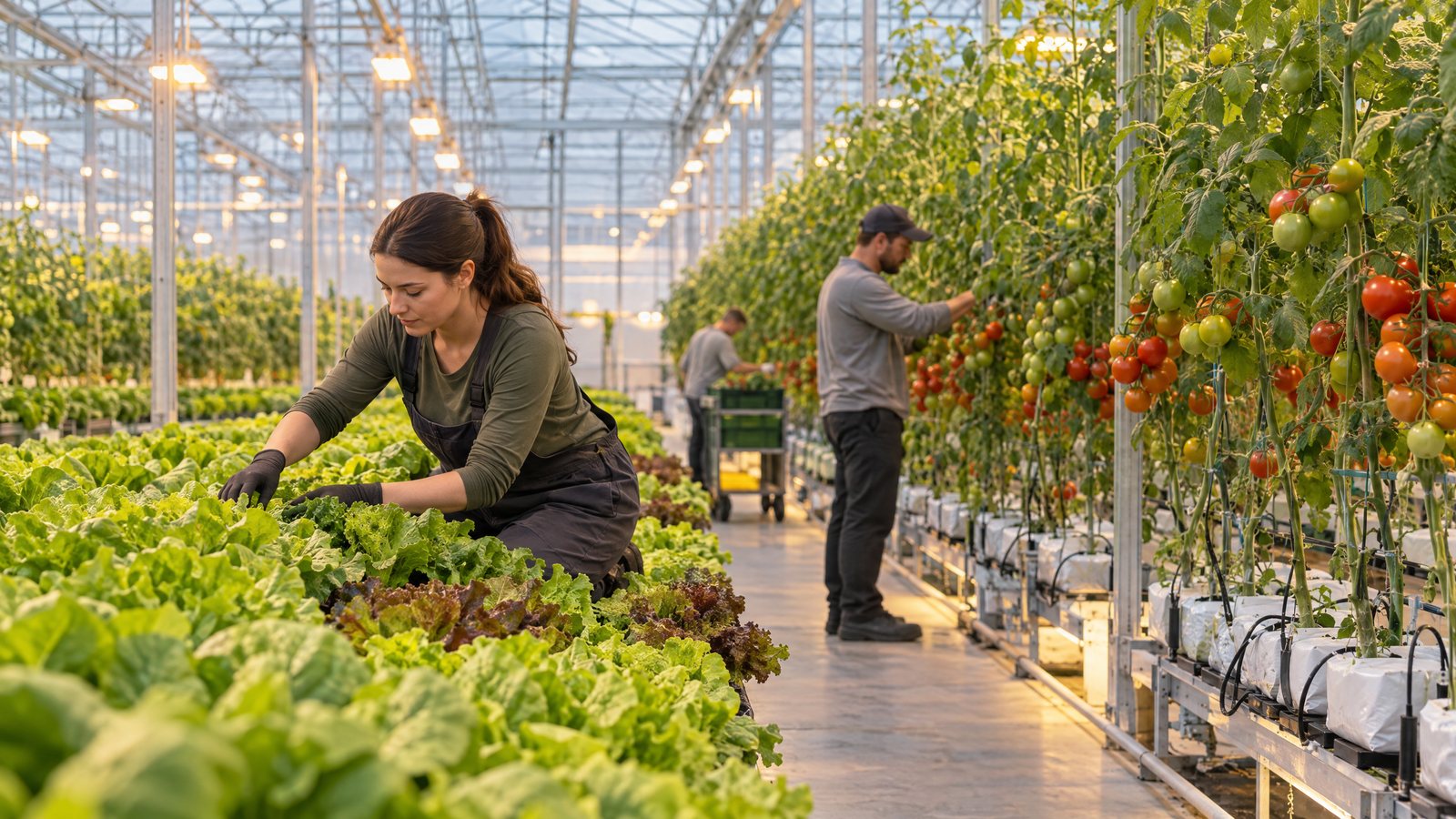

Canada has launched a seven-year, $750 million programme to expand technology-enabled domestic fruit and vegetable production throughout the year. Announced from Ottawa, Ontario, on 30 October 2026, the Controlled Environment Agriculture Growth Pathway Program is intended to reduce reliance on imports and improve food security.
The funding is available through an application-based programme covering Canada. It does not represent production already delivered, and the launch does not establish that households will see immediate price relief. Projects must be approved before they can receive support, with awards ranging from $100,000 to $10 million.
The programme has two streams: $650 million for technology adoption and $100 million for rural and northern community solutions. Together, they form a funding pathway aimed at expanding domestic growing capacity, rather than a statement that additional fruit and vegetables are already reaching consumers.
Technology and community funding
The larger stream supports controlled-environment infrastructure and tools. It includes automation, robotics, lighting and digital growing systems, placing technology adoption at the centre of the programme’s approach to year-round production. These are the specified areas for investment; their inclusion does not mean that any particular installation has already been funded or completed.
The $100 million stream focuses on rural and northern community solutions. That creates a separate route within the wider programme for projects addressing those communities, alongside the larger allocation for technology adoption. Both streams sit within the same seven-year programme and contribute to its stated food-security objectives.
The distinction between the streams is important to understanding the $750 million total. Most of the money is allocated to controlled-environment technology adoption, while a smaller, separately identified share is directed towards rural and northern solutions. The total should not be read as a single award or as money already distributed to projects.
Approved projects may receive between $100,000 and $10 million. That range describes the possible size of support for an individual project, not an automatic entitlement for every applicant. Applying for the programme and receiving approval are separate stages, and the announcement does not establish how many projects will ultimately receive funding.
Current application window
The current intake opened at noon Eastern Time on 30 October 2026 and runs until noon Eastern Time on 23 December 2026, subject to funding availability. The availability condition matters: the stated closing date is part of the application window, not a guarantee that funding will remain available throughout it.
The intake timetable is also distinct from the programme’s seven-year duration. The December deadline applies to the current round of applications; it is not the end date for the wider initiative. Nor does the longer programme period establish when individual projects would begin operating or delivering additional produce.
Reducing import reliance and improving food security are stated aims, rather than results demonstrated by the launch. The funding is intended to support domestic fruit and vegetable production, but the announcement alone does not show a change in the balance between imported and domestically grown food.
The same distinction applies to access and household costs. Making funding available for growing infrastructure and community solutions is not equivalent to making more produce immediately available or lowering retail prices. No immediate production increase or household price reduction is established by the programme’s opening.
For now, the confirmed development is the opening of a national funding programme with two defined streams, a project funding range and a current application deadline. Its significance lies in the scale and focus of the support being offered; its food-security ambitions remain objectives to be pursued through approved projects.