
Few garments have travelled through British culture as widely as the shearling jacket. It has been military equipment, rural workwear, a countercultural statement, a football-touchline uniform, a television costume and a recurring luxury-fashion reference. Each generation has interpreted it differently, yet its fundamental construction has remained remarkably consistent: leather on the outside, wool on the inside and enough natural insulation to handle cold, exposed conditions.
That continuity is what makes the shearling jacket culturally interesting. It did not enter fashion as an ornamental object. Its appearance grew out of function, and much of its appeal still comes from looking as though it has a job to do.
What Is a Shearling Jacket?
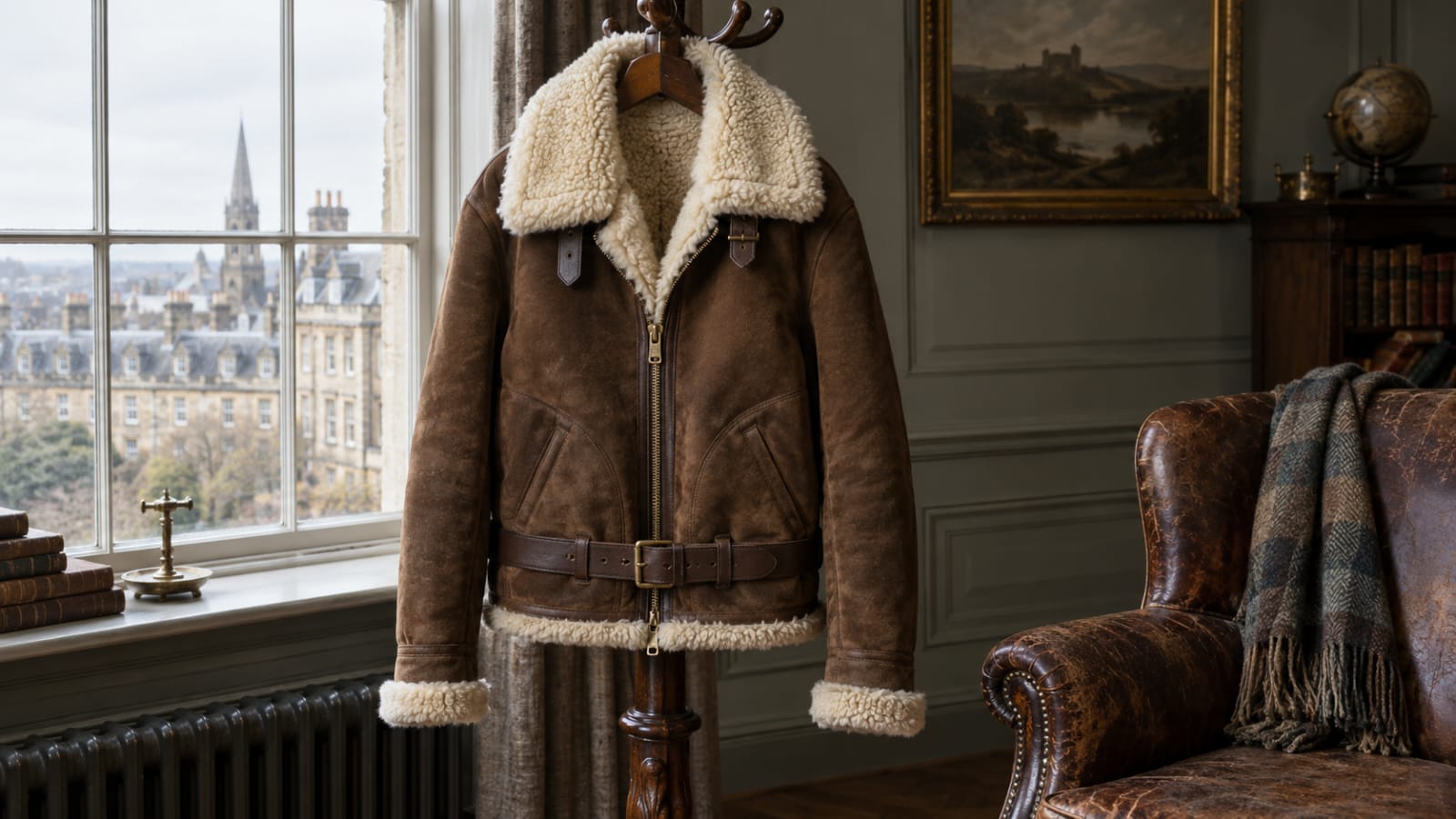
Shearling is processed sheepskin with the wool retained and attached to the hide. In a traditional double-faced garment, the leather side forms the exterior while the wool faces inward to provide insulation. The two surfaces are part of the same skin rather than a leather shell joined to a separate fabric lining.
The language used around the material is not always consistent. “Sheepskin jacket” and “shearling jacket” are frequently used interchangeably in fashion, while “shearling-lined” may describe a different construction in which a lining is attached to an outer shell. Sherpa, meanwhile, usually refers to a synthetic or blended pile fabric designed to imitate the appearance of wool.
These differences matter when examining fashion history because garments that look similar in photographs may have been constructed very differently. Readers who want a closer examination of the terminology, jacket styles and double-faced construction can consult this complete guide to men’s sheepskin shearling jackets.
The British Story Begins in the Air
People had used wool-bearing hides for warmth long before powered flight, but the modern British identity of the shearling jacket was shaped by aviation.
Early aircraft offered pilots and crew members little protection from the environment. Cockpits were unpressurised, heating was limited or absent, and temperatures dropped severely as aircraft climbed. Wind entered through gaps in the aircraft structure, while metal controls and fittings became painfully cold. Ordinary wool uniforms could not provide sufficient protection during extended operations at altitude.
The garment most closely associated with the Royal Air Force was the Irvin flying jacket. Its name came from Leslie Irvin, an American parachute pioneer who established a manufacturing operation in Letchworth, Hertfordshire, during the 1920s. Irvin became an important supplier of flying equipment, and his sheepskin jacket was adopted for British aircrew.
The RAF Irvin should not be confused with the American B-3. Both used sheepskin for high-altitude warmth and shared a family resemblance, but they were different military designs. The British Irvin was distinguished by details such as its full waist belt, broad collar, central zip and relatively simple exterior. Pockets were not a defining feature of the original specification.
Its appearance was a direct result of its purpose. The wide collar helped cover the neck, the belt reduced cold air entering at the waist, and the dense wool trapped insulating air close to the body. Long sleeves extended protection towards the gloves, while sturdy metal zips allowed the garment to be opened or removed without a complicated fastening system.
How Wartime Production Changed Its Appearance
Early Irvin jackets were made from comparatively large sections of sheepskin, producing a cleaner exterior with fewer seams. Wartime demand changed that method of production.
As more garments were required and large, consistently matched hides became harder to use economically, manufacturers began constructing jackets from smaller panels. This reduced waste and allowed more of each available hide to enter production. Later jackets consequently developed a more visibly segmented, sometimes patchwork-like exterior.
Those additional seams were not originally a fashion statement. They were evidence of material conservation and industrial necessity. Modern designers often reproduce multi-panel shearling as a heritage detail, but its visual character began as a practical response to wartime production pressure.
Imperial War Museums records also show how availability influenced who received the jackets. By the later stages of the Second World War, high production costs and limited supply meant that Irvin jackets became particularly associated with bomber crews, although other pilots continued to obtain and wear them.
The jacket’s cultural meaning was already expanding. It represented technical protection, but photographs of aircrew also connected it with courage, machinery and the public image of wartime aviation. Long after its military role declined, those associations remained embedded in the silhouette.
From Military Equipment to Civilian Outerwear
After the war, military clothing entered civilian wardrobes through surplus shops, private ownership and commercially produced adaptations. British consumers were already familiar with the visual language of service clothing. Garments such as trench coats, duffle coats, field jackets and flying jackets could therefore move into everyday use without losing their original associations.
Sheepskin was particularly well suited to this transition. It was warm enough for outdoor work, motoring and winter travel, yet visually distinctive enough to function as more than purely practical clothing. Manufacturers softened the military proportions, introduced hand pockets, adjusted the length and produced versions intended for people who would never enter a cockpit.
The civilian jacket retained the emotional character of the original. A wide fleece collar still suggested aviation. Heavy zips and buckled straps communicated durability. Brown leather that developed marks and tonal variation appeared more convincing with age rather than less presentable.
This was an important reversal of ordinary fashion logic. Many garments are designed to remain visually unchanged for as long as possible. Shearling and leather were appreciated partly because use left visible evidence behind.
Two Sheepskin Traditions Met in 1960s Britain
By the 1960s, British fashion was being reshaped by youth culture, international travel and a rejection of rigid post-war dress codes. Sheepskin entered this changing environment through two very different routes.
The first was the short aviation-derived jacket, carrying the masculine associations of military equipment, motorcycles and mechanical work. The second was the Afghan coat: a longer, softer and often embroidered sheepskin garment connected with Central Asian craft traditions.
Afghan coats reached London through travellers, importers and the overland route commonly called the Hippie Trail. They appeared in boutiques associated with the counterculture and were adopted by musicians and other public figures. John Lennon and a range of other British performers were photographed in embroidered or fur-trimmed versions.
These coats should not be treated merely as British inventions. Their construction and decoration came from Afghan clothing traditions, even though London’s boutiques, musicians and fashion press gave them a new Western context. Their popularity also raises continuing questions about how fashion separates an object from the culture that produced it.
Within Britain, however, the contrast was powerful. The RAF-style jacket represented discipline, machinery and national history. The Afghan coat suggested travel, artistic experimentation and resistance to conventional tailoring. Both relied on wool-bearing hides, but they communicated almost opposite ideas.
Shearling in the 1970s: From Counterculture to the Mainstream
During the 1970s, the visual language of shearling broadened. The material appeared in cropped bombers, long coats, Western-inspired jackets, suede car coats and garments with oversized wool collars. It could look rugged, bohemian, glamorous or comfortably suburban depending on its cut and styling.
This flexibility helped it move beyond the counterculture. Sheepskin coats became ordinary winter clothing for men and women, while aviation styles remained connected to motorcycling and outdoor wear. Longer coats worked with the decade’s wider trousers, roll-neck jumpers and substantial footwear. Short jackets complemented denim and retained a stronger workwear character.
The decade established many of the references designers still revisit. Oversized collars, warm brown suede, contrast cream wool and long shaggy trims are immediately read as “1970s”, even when the contemporary garment has been cut, dyed or lightened using modern methods.
The Television Sheepskin and British Class Codes
By the late 1970s and 1980s, the long sheepskin coat had developed another distinctly British identity. It became associated with horse racing, football grounds, used-car lots and a particular style of entrepreneurial confidence.
Television amplified this meaning. Arthur Daley in Minder used his sheepskin coat, hat and formal clothing to project the image of a successful businessman, even when his dealings were less impressive than his wardrobe suggested. Del Boy Trotter in Only Fools and Horses gave the coat an even stronger place in popular culture. Worn with jewellery, patterned knitwear and irrepressible ambition, it became part of a costume expressing aspiration, salesmanship and South London bravado.
The humour did not come from the coat being inherently unfashionable. It came from what the characters wanted it to communicate. A substantial sheepskin coat looked expensive, worldly and authoritative. On television, that confidence could be exaggerated until the garment became inseparable from the wearer.
This association was strong enough to complicate the coat’s later return to fashion. Designers might view a long shearling as luxurious and cinematic, while British audiences could still see Del Boy. The same object carried high-fashion potential and comic familiarity at the same time.
From Football Touchlines to National Recognition
Sheepskin also became part of British football’s visual culture. Before lightweight technical clothing became standard, managers, commentators and spectators relied on heavy coats during long winter fixtures.
No figure became more closely associated with the look than BBC commentator John Motson. His sheepskin coat was practical clothing for exposed stadiums, but repeated appearances turned it into a personal trademark. It communicated cold weather, live football and the ritual of the British winter season before he had said a word.
This is another reason shearling occupies such a distinctive position in British culture. It does not belong exclusively to fashion. It has repeatedly become a uniform for recognisable occupations and social settings.
Why the Jacket Keeps Returning
Shearling periodically disappears from the centre of fashion, but it never vanishes completely. Its returns are usually connected with a renewed interest in one of its historical identities.
Aviation revivals bring back cropped jackets, oversized collars and buckled throats. Interest in the 1970s produces long coats, suede surfaces and generous wool trims. Workwear trends emphasise visible seams and heavy hardware. Luxury fashion uses carefully selected hides, controlled proportions and unusually dyed wool to turn the same basic construction into something more refined.
Contemporary styling also separates shearling from the literal reproduction of historical uniforms. A jacket may preserve the large collar of an RAF or B-3 design while removing the bulk. Another may combine a motorcycle fastening with shearling cuffs. Long coats can be cut with cleaner shoulders and fewer decorative panels, allowing the material to provide texture without making the entire outfit feel like costume.
This recurring influence remains visible in current fashion coverage. British Vogue’s examination of the returning 1970s jacket trend shows how shearling continues to move between archival reference, runway interpretation and everyday street style.
Authenticity, Imitation and Changing Values
The modern market contains genuine sheepskin, shearling-lined leather and fully synthetic imitations. Each belongs to a different conversation about price, performance, animal welfare, manufacturing and environmental impact.
Natural shearling offers insulation, breathability and the possibility of a long working life, but those benefits do not remove questions about sourcing, tanning and animal welfare. Equally, describing every synthetic alternative as automatically sustainable ignores fossil-fuel inputs, fibre shedding and the shorter usable life of some low-quality garments.
A responsible assessment must consider the complete product rather than relying on a single material label. Provenance, tanning methods, construction quality, repairability, frequency of wear and expected lifespan all affect the garment’s impact.
This is culturally relevant because longevity has always been central to shearling’s reputation. Wartime jackets survive in museum collections and private wardrobes because they were built as equipment rather than disposable fashion. Modern garments inherit that reputation, but they must earn it through material disclosure and construction rather than heritage-inspired styling alone.
More Than a Winter Trend
The shearling jacket has survived in British fashion because it can hold apparently contradictory meanings.
It is military and bohemian. It can suggest rural practicality, aviation engineering, football commentary, market-trader confidence or runway luxury. It belongs to British visual culture, yet part of its fashion history also came through international travel and Afghan craft. It can appear historically specific while remaining adaptable enough to be redesigned every winter.
Most importantly, its form still explains its function. The large collar, exposed wool, substantial seams and short protective body were not created merely to look distinctive. They emerged from the need to keep people warm.
British fashion has repeatedly borrowed that practicality and given it a different cultural role. The jacket has moved from aircraft to music, television, sport and street style, but it has never completely lost the memory of where it began. That combination of usefulness, history and recognisable character is why shearling continues to return long after ordinary seasonal trends have been forgotten.