
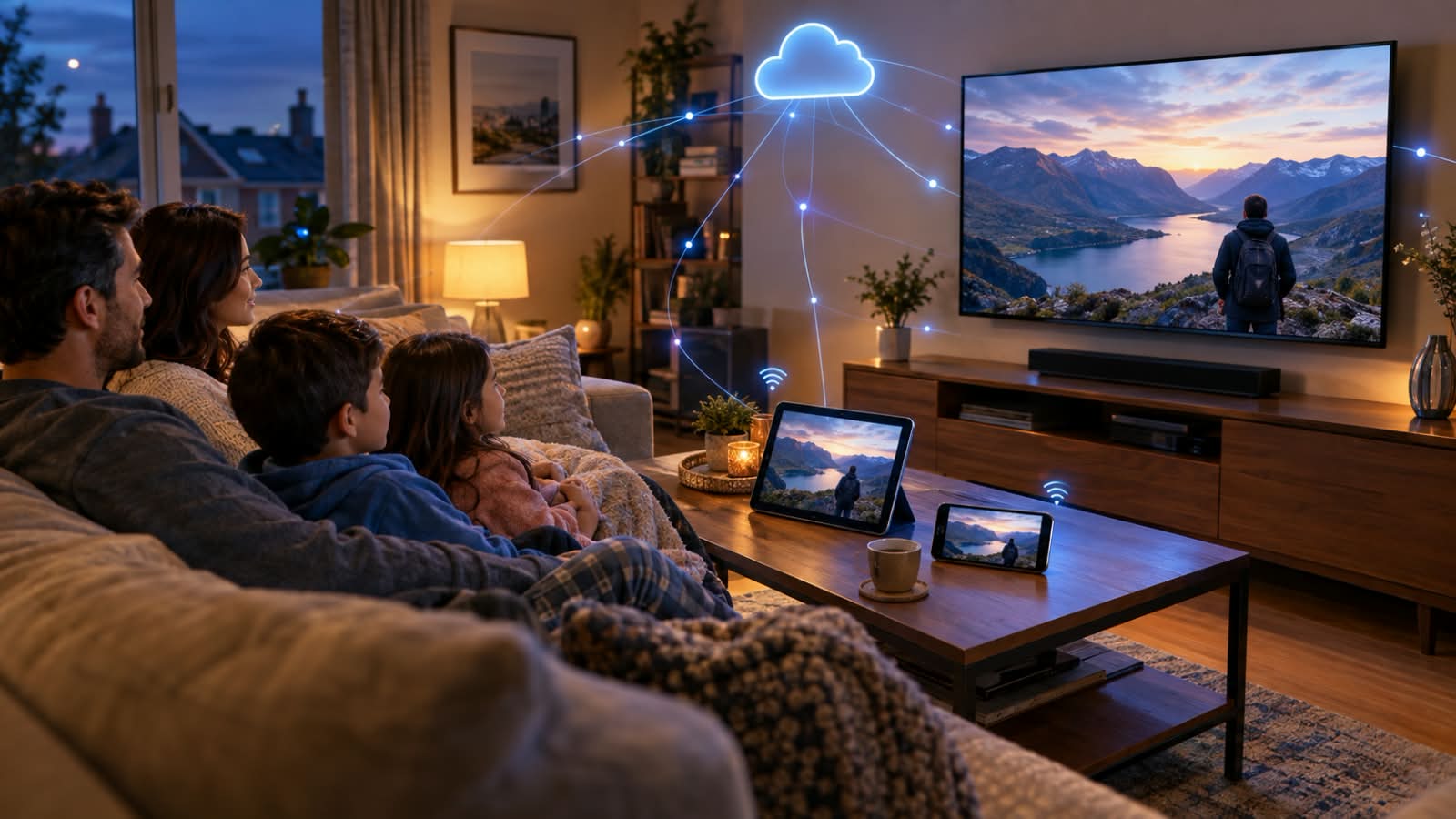
The way the UK watches television is changing. Traditional broadcast TV is still a major part of national viewing, but its weekly reach continues to fall, while streaming and on-demand services keep growing. Ofcom’s Media Nations 2026 report found that viewing of broadcaster-owned on-demand services such as BBC iPlayer, ITVX, Channel 4 Streaming and 5 rose by 9% year on year, making them the fastest-growing category of television service. The same report found that UK viewers are now as likely to turn first to Netflix as to the BBC when deciding what to watch.
Today’s audiences expect on-demand, high-definition video that works on smartphones, tablets, smart TVs and web browsers. For UK media companies, independent filmmakers, sports clubs, faith and community broadcasters, and corporate brands, that shift creates a real opportunity. An owned streaming platform allows an organisation to build a direct relationship with its audience, understand viewing behaviour through its own analytics, and open new revenue streams.
Doing this well takes more than uploading video files to a basic web player. Delivering smooth, secure playback across dozens of device types depends on cloud architecture and specialist software engineering. That is why many organisations work with an experienced OTT platform development company to turn a video catalogue into a scalable streaming service.
What does an OTT development partner do?
An OTT (Over-The-Top) development partner builds, deploys and maintains the infrastructure behind a streaming service. Instead of relying on third-party hosting sites with limited branding and revenue-sharing terms, the organisation gets a technology stack designed around its own business model and brand.
Core services to expect
A capable development firm typically delivers a connected system of cloud back-end services, software modules and viewer-facing apps.
1. Multi-screen app development
Viewers expect a consistent experience on every screen they own. Development teams build native and cross-platform apps for a wide range of devices:
- Mobile and web: native iOS (Swift) and Android (Kotlin) apps, alongside responsive HTML5 web players.
- Smart TVs and connected devices: apps for Apple TV (tvOS), Amazon Fire TV (Fire OS), Roku, Android TV, Samsung (Tizen) and LG (webOS) — the platforms that dominate UK living rooms.
- Cross-device features: shared user profiles, “Continue Watching” across devices, offline downloads and personalised watchlists.
2. Video CMS and content ingest
The video content management system (CMS) is the operational hub for the platform team. It lets operators organise content into categories, manage metadata such as titles, descriptions and cast details, set geo-restrictions for licensed content, schedule releases and build linear FAST (Free Ad-Supported Streaming TV) channels.
3. Adaptive cloud encoding
Raw high-definition files are too large to stream directly. Encoding pipelines using formats such as HLS and MPEG-DASH convert master files into multiple quality levels for adaptive bitrate streaming. This allows playback quality to adjust in real time to the viewer’s connection, which significantly reduces buffering whether someone is on full-fibre broadband or a patchy mobile signal.
4. Content delivery at scale
To handle large audiences, particularly during live events, platforms often use one or more content delivery networks (CDNs). Cached video is stored on servers closer to viewers, reducing latency and helping playback remain stable when demand spikes.
Monetisation models
A streaming platform can earn revenue in several ways, and many services combine more than one. The UK market shows how quickly this is evolving: Ofcom reports that the UK commercial TV and online video market exceeded £18bn in 2025, driven by online growth, while ad-supported tiers have become a significant part of major subscription services.
| Model | How it works | Key benefit | Typical use |
| SVOD (Subscription VOD) | Recurring monthly or annual subscription | Predictable, recurring revenue | Premium libraries, drama series, exclusive content |
| AVOD (Ad-supported VOD) | Free viewing funded by video ads | Low barrier to entry; faster audience growth | High-volume media, news, lifestyle content |
| FAST (Free ad-supported TV) | Scheduled linear channels with ad breaks | Familiar, broadcast-style experience | Archive catalogues, niche themed channels |
| TVOD (Pay-per-view) | One-off fee to rent or buy a title or event | High revenue per transaction | Live sport, concerts, film premieres |
| Hybrid | A mix of SVOD, AVOD and TVOD tiers | Reaches different audience segments | Larger media groups and broadcasters |
Protecting content with multi-DRM
Piracy remains a serious risk for rights holders, particularly in live sport and premium entertainment. Professional platforms use multi-DRM (Digital Rights Management) — typically Apple FairPlay, Google Widevine and Microsoft PlayReady — to encrypt content and control how and where it can be played.
Combined with forensic watermarking, limits on simultaneous streams and geographic restrictions, DRM makes unauthorised copying and redistribution much harder, and watermarking helps trace leaks back to their source. No system can eliminate piracy completely, but these layers substantially reduce the risk.
Custom development vs off-the-shelf SaaS
Organisations planning a streaming service usually weigh up two main routes.
Off-the-shelf SaaS platforms
Turnkey SaaS platforms offer lower upfront costs and quick launch using ready-made templates. The trade-offs can include ongoing per-subscriber or usage fees, limited design flexibility, vendor lock-in and restricted access to viewer data.
Custom-built platforms
A custom build offers greater control over design, features and integrations — for example with UK payment providers, CRMs and analytics tools — along with fuller access to viewer data. Ownership of the source code depends on the contract agreed with the development partner, so it is worth confirming intellectual property terms at the outset. For organisations planning a long-term service, custom development can offer better flexibility, though it usually requires a larger initial investment.
How an OTT platform is built
- Discovery and architecture planning: defining business goals, target devices, monetisation model and cloud infrastructure.
- UI/UX design: creating accessible interfaces that work with TV remotes as well as touchscreens.
- Back-end and cloud setup: deploying cloud services, encoding pipelines, databases and admin tools.
- App development and integration: building client apps and integrating payments, DRM and analytics.
- Testing and QA: testing on low-bandwidth connections, different hardware and high-traffic scenarios.
- Launch and maintenance: publishing to the Apple App Store, Google Play and TV app stores, followed by ongoing updates and support.
Building for the future of UK media
As UK audiences continue to move between broadcast TV, broadcaster streaming services, global subscription platforms and video-sharing sites, competition for attention is intense. For many organisations, an owned streaming service is becoming an important way to reach viewers directly rather than relying entirely on third-party platforms.
The right development partner can help navigate cloud architecture, content protection and multi-device apps. With clear goals, the right monetisation model and careful planning, a custom-built streaming service can give an organisation greater independence, commercial control and room to grow.







