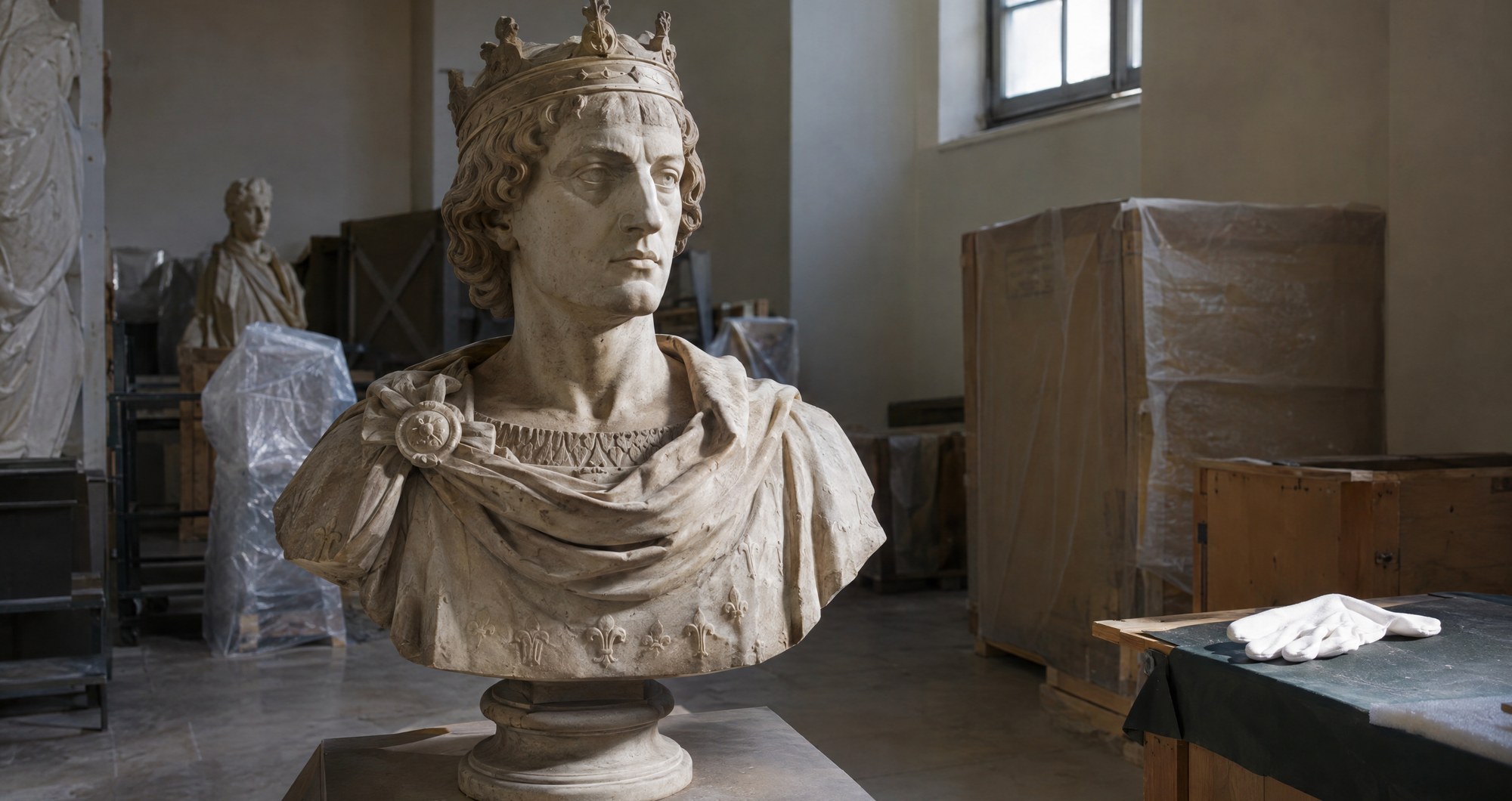

The government has placed a temporary export bar on an eighteenth-century marble bust of Edward of Woodstock, known as the Black Prince, giving a UK museum or gallery time to buy a sculpture credited with shaping his image for nearly three centuries. The intervention concerns a work whose importance lies both in its place in British history and in the influence of its depiction of the medieval commander.
The bust, attributed to the Flemish sculptor Michael Rysbrack and carved around 1735, stands 84cm high. Its recommended purchase price is £496,044.51, with a further £9,920.89 in VAT. The initial export deferral runs to 5 February 2027 inclusive, setting a deadline for efforts to secure the work for a UK collection.
Heritage Minister Baroness Twycross announced the decision following advice from the Reviewing Committee on the Export of Works of Art and Objects of Cultural Interest. The bust has been in a private collection since its sale at Sotheby’s in December 2005.
A portrait that shaped later depictions
The case for keeping the bust in the UK rests partly on its lasting visual influence. It is credited with establishing the image of the Black Prince that later reproductions followed for almost 300 years. That makes it significant not simply as a sculpture of a historical figure, but as a work that helped determine how that figure would be pictured by subsequent generations.
Baroness Twycross said the bust still defines how the prince is imagined in British history and should tell that story in a public collection. Her comments place public access at the centre of the intervention: the opportunity is to acquire an object whose influence extends beyond the private collection in which it currently sits.
The distinction between the subject and the date of the sculpture is important. This is an eighteenth-century representation of a medieval commander, rather than a work made during his lifetime. Its significance is therefore also bound up with how a later period chose to represent him, and how that representation endured in subsequent reproductions.
National history and eighteenth-century sculpture
The reviewing committee judged that the bust met the first and third Waverley criteria. Those findings cover its connection with national history and its significance to the study of eighteenth-century sculpture. They provided the basis for the minister’s decision to defer export and allow time for a purchase by a UK institution.
The two criteria reflect different aspects of the same object. Its subject and the continuing influence of his sculpted image connect it to national history. Its attribution to Rysbrack, date and sculptural character make it relevant to the study of the art of the eighteenth century.
The temporary bar is an intervention in the movement of the work, not an announcement that it has been acquired. No purchase by a museum or gallery has been confirmed in the supplied details. For now, the decision creates a period in which a UK institution can seek to buy it at the recommended price.
From Carlton House to Warwick Castle
The bust is thought to have been commissioned by Frederick, Prince of Wales, for Carlton House on Pall Mall. That proposed origin links it to a royal setting, although the commission is not established as certain. The distinction matters when tracing the sculpture’s early history: its connection with Carlton House is a belief, rather than a confirmed commission.
A later record places the bust at Warwick Castle. It appeared in an 1806 inventory of the State Bedroom, providing a documented point in its history after its creation around 1735. The supplied provenance then records its sale at Sotheby’s in December 2005, after which it remained in a private collection.
Those details give the sculpture a history extending from a possible royal commission to a recorded castle setting and, more recently, private ownership. They also provide context for the minister’s wish to see it enter a public collection.
February deadline for a UK purchase
The immediate question is whether a UK museum or gallery can secure the money needed to acquire the bust. The recommended price and VAT together amount to £505,965.40. Alongside the initial deadline of 5 February 2027, that sum sets the practical terms of the opportunity created by the export deferral.
The bar does not itself resolve where the sculpture will be kept. It gives a UK institution time to pursue a purchase before the initial deferral ends. A successful acquisition would bring into a public collection a work recognised for both its historical connection and its role in shaping the enduring image of the Black Prince.