
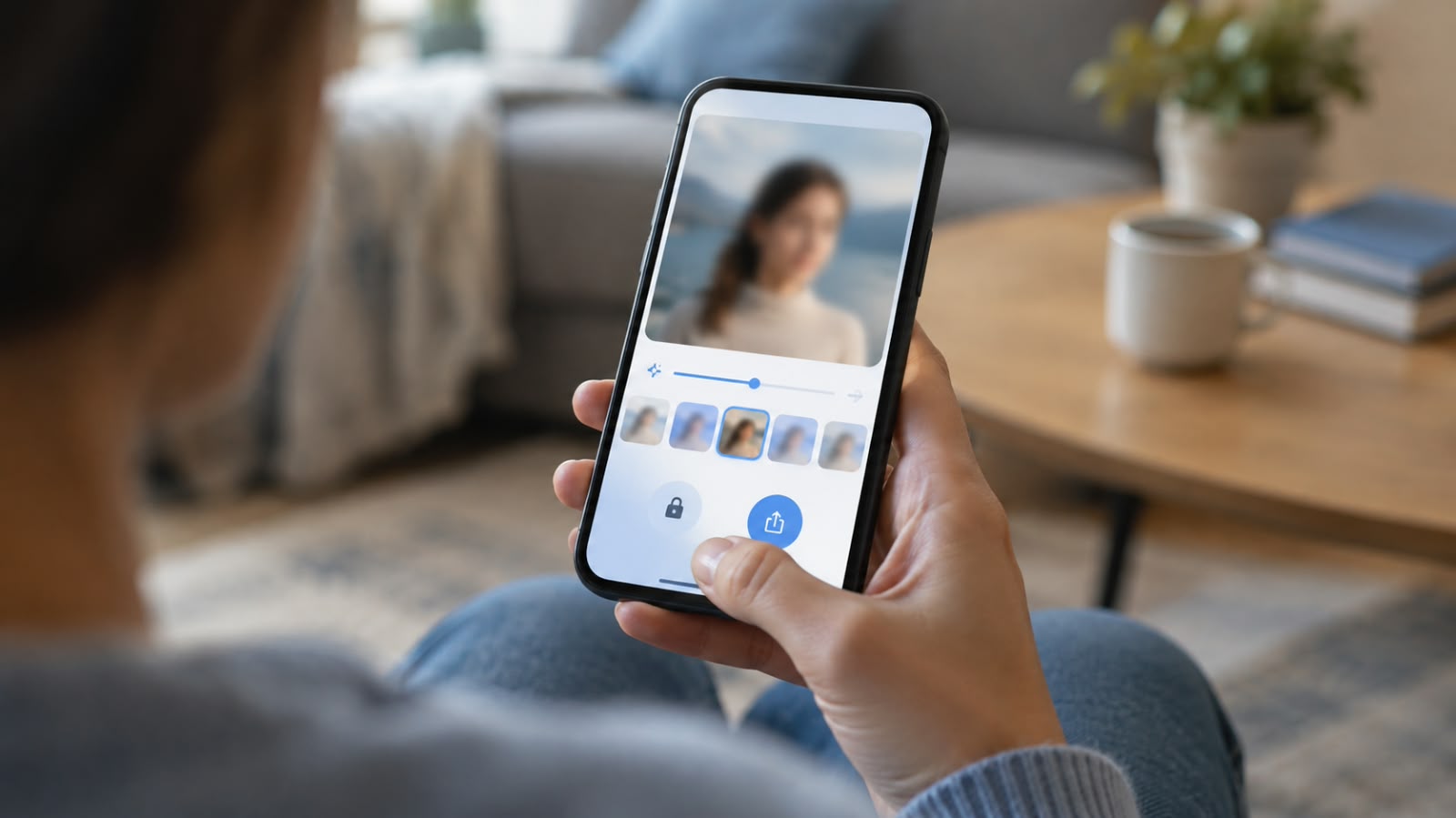

Products such as Vofy treat a heavier-looking version of a face as a preview: you look at the result, and then you decide what to do with it. The same capability now sits in a browser tab as a fat filter for anyone who wants it, and that reach is exactly why the argument around this effect keeps going in circles. It is usually conducted as a debate about whether altering a body in a photograph is acceptable in principle, which is not the question that decided anything in the cases that actually mattered.
Consider the same edit made twice. In one version, a person runs the effect on their own photograph, looks at the result, and closes the tab. In the other, the effect is applied to a picture taken from someone else’s profile, given a caption, and posted. The pixels barely differ. Only the second version resembles the trend that ended with a similar effect being pulled from TikTok in March 2025, and the difference between the two has nothing to do with editing.
Two questions that keep getting merged into one
The public argument over body-editing effects almost always arrives as a question about retouching: whether it is honest, whether it feeds an unhealthy standard, whether it should exist at all. Those are legitimate questions. They are simply not the ones that shaped the outcome, because the criticism that led to the removal in March 2025 was never about the capability being available. It was about how the effect was used, whose photographs it was applied to, and what happened to the results afterwards.
Stated once, and then left to the evidence: the line runs between permission and publication. An edit made to your own image and kept on your own device is a different act from an edit made to someone else’s image, and it is also a different act from an edit made to your own image and then handed to an audience. How realistic the outcome looks, how quickly it renders, whether the tool costs anything: all of that sits downstream of those two facts. Arguments that stay on the technical side are usually arguments about something else in a technical costume.
The second question is worth splitting once more, because it is not only about audience size. It is also about occasion. Three friends laughing with the person in the photograph is a different event from three hundred strangers laughing at them, and the number is not what separates the two; the framing is. A caption that turns the result into a punchline makes a broadcast out of something that could have stayed a private joke, and captions travel further than images do.
What the complaints actually said
Because the episode is usually summarised as a general backlash against body shaming, it is worth looking at what the reporting actually recorded.
The first concern was framing. As CNN described it, the videos followed a fixed pattern: an unedited photo of the user, usually slim, followed by the filter spreading down the screen and reshaping their body. The transformed body was the punchline, not the effect.
The second concern was what happened underneath the posts. UK creator Sadie Bass, one of the most prominent voices calling for the filter to be removed, told the BBC that the trend meant thousands of people imitating bodies like hers while comment sections treated those bodies as something to laugh at. She also pointed out that the average woman in the UK wears a size 14 to 16, so the body being presented as the joke was, in practice, an ordinary British one. That detail matters, because it means the joke was never the transformation. The joke was the body.
The third concern, and the one that receives the least attention, was consent: the effect could just as easily be applied to someone who had never agreed to it, with a face taken and altered without the subject knowing it had happened.
The platform’s response is telling. TikTok told the BBC that the filter, which had been uploaded by CapCut, a separate company under the same parent, ByteDance, had been removed. It also said videos using the effect were being made ineligible for recommendation and blocked from teen accounts. In other words, the remedy was aimed at distribution, not only at the tool.
Reaction from outside the platform was just as specific. Luna, a health and wellbeing app for teenagers, criticised the filter for promoting body shaming and unhealthy beauty standards. Food and nutrition scientist Dr Emma Beckett told the BBC the trend was a step backwards on weight stigma and warned that it could feed diet culture.
Two of those three concerns are about publication. One is about permission. None of them is about how convincing the transformation was.
Why the harm never needed a convincing fake
There is a tempting assumption that the danger scales with realism: that a crude edit is harmless and a seamless one is not. The reporting does not have that shape. The clips that drew the backlash were plainly recognisable as edits, and the objection was to the caption and the audience rather than to the quality of the transformation.
This matters for how a tool gets judged. If harm tracked fidelity, the responsible design choice would be to degrade the output and make the result visibly wrong. That would satisfy nobody, because the effect’s legitimate use is a preview that the person involved can assess, and a preview that looks nothing like the outcome has no value to the person asking for it.
What the coverage describes instead is a harm that travels through distribution. An image can be altered badly and still do all of the damage, as long as the subject never agreed and the result reaches an audience that has been invited to laugh. The reverse is equally true, and it is why the argument keeps stalling: a well-executed, clearly labelled body preview, kept by the person who requested it, appears nowhere in the complaints. Both statements point at the same variable, and it is not image quality.
Where the pressure sits in the UK now
The scrutiny has not faded; it has widened from a single platform filter to the way altered images circulate in general, and the UK already has more rules in this area than most markets. In 2021, the Advertising Standards Authority ruled that influencers should not apply filters to promotional images of beauty products where the filter is likely to exaggerate what the product can do. Under the Online Safety Act, Ofcom’s children’s safety codes, in force since July 2025, require platforms to protect younger users from content harmful to them, with bullying among the categories named.
The pattern in both cases matches the one from the filter row. The images that attract regulation and criticism are commercial or public ones: images that were published, and often published by someone other than the person depicted. Nobody launches a campaign over a private experiment.
Some tool makers have begun to absorb this into their own pages. One fat filter page, for example, asks users to edit only their own photo or one they have permission to edit, to keep prank edits clearly fictional, to keep the person recognisable, and to review the result for dignity and identity stability before sharing it anywhere public. That framing is not unique to one product, and it does not need to be. It is simply what permission and publication look like once they are written into a product instead of being left entirely to the user’s discretion.
The takeaway
The useful line is not the one the debate usually draws. It does not run between effects that flatter and effects that do not, and it does not run between a convincing edit and an obvious one. It runs between a photograph whose subject asked for the change and one whose subject did not, and between a result that stays where it was made and one that is handed to an audience.
Set against that, most of the familiar concerns turn out to be rearrangements of the same two questions. The filter withdrawn in 2025, the comment sections that formed beneath it, and the filtered adverts UK regulators have already ruled on all fail the same test at the same step: not when the image is altered, but when it leaves. A preview that never leaves the person who asked for it does not fail that test at all. It is a narrow distinction, and it is the one everything else depends on.







