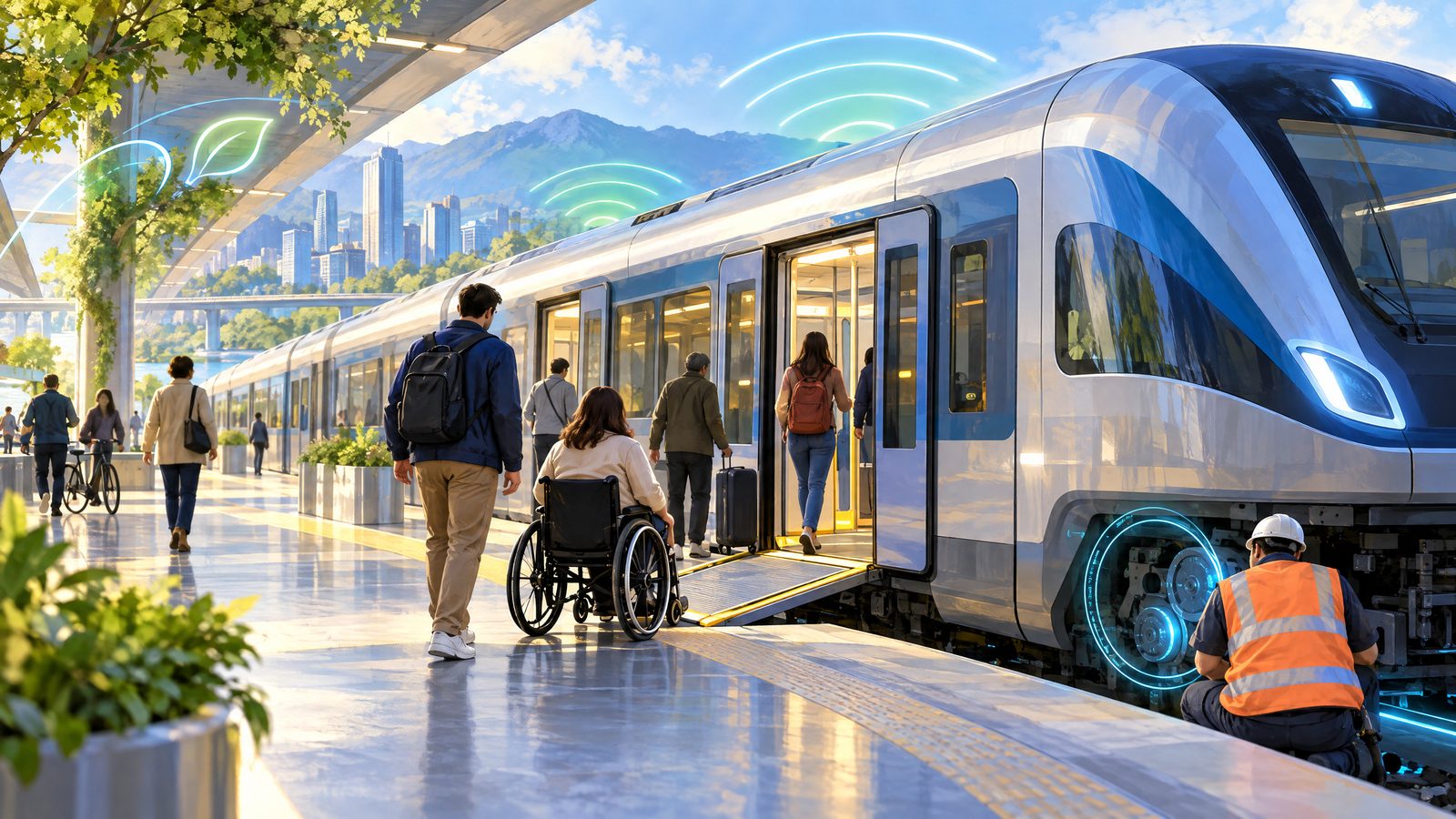

Ten early-stage companies have been selected for a rail-sector support programme intended to help them understand how their technologies might progress towards use on the railway. The cohort spans passenger accessibility, safety, maintenance, connectivity, air quality and infrastructure resilience.
Each company will receive tailored business support valued at up to £25,000 from Connected Places Catapult. The programme is delivered with Network Rail and supported by Innovate UK. Its announced activities include access to rail-industry expertise, mentoring, connections with stakeholders, station visits and help with designing trials.
Ten different rail challenges
The selected firms are Cloudavian, GoRolloe, Rivelin Rail, Future Transformation, Amygda, Rinicom, Civil Water Management, Digital Creativity in Disability, Transport Direction and Inclutech. Their proposed work ranges from passenger-facing digital tools to systems for infrastructure and fleet teams.
Several projects focus on making journeys more accessible or safer. Cloudavian is developing an AI travel companion and station kiosk with step-free route information, assistance details and rebooking support during disruption. Transport Direction is working on an AI-enabled assistant for unstaffed stations, designed to answer passenger questions and pass assisted-travel requests to train crews. Inclutech is developing digital reporting that would allow passengers and staff to communicate safety concerns without relying on speech.
Other projects address operational information and asset care. Future Transformation is developing station analysis intended to help operators identify passenger flows, accessibility barriers and safety risks. Amygda’s platform is designed to help fleet reliability teams prioritise which trains and subsystems need attention. Rivelin Rail is developing handheld and on-board tools to help operators understand wheel-and-rail friction and friction management.
Infrastructure and connectivity also feature. Civil Water Management is developing modular drainage for railway filter drains, while Digital Creativity in Disability is working on a trackside millimetre-wave network intended to provide high-capacity connectivity on trains. GoRolloe’s proposed mobile emissions-control unit is aimed at improving air quality for transport workers and passengers. Rinicom is developing train-to-platform systems that use real-time detection to identify platform risks.
Support is not a deployment decision
The selection marks entry to a support programme, not confirmation that any product has been procured, approved for routine use or rolled out across the network. Trial-design assistance can help a company consider how a test might work; it does not mean that a trial has taken place. The announcement gives no timetable for deployment or evidence that the listed technologies have already produced operational results.
That distinction matters because rail solutions must fit complex operating environments. A station tool may need to work for passengers with different access needs and alongside existing assistance arrangements. A maintenance system must provide useful information to the teams responsible for assets, while infrastructure changes need to be assessed against railway operating requirements. Mentoring, site visits and conversations with industry stakeholders are intended to help firms understand these conditions and the route towards adoption.
The programme page describes its purpose as capability-building for early-stage solutions and says its modules include workshops, industry mentoring or matchmaking, site visits and trial-design support. It frames the work as helping small and medium-sized businesses understand progression towards procurement, rather than as a procurement award in itself.
The new cohort builds on the Station Innovation Zone, which the Catapult says has supported more than 35 small and medium-sized businesses, enabled 12 live trials at Bristol Temple Meads and awarded more than £670,000 in funding. Those figures relate to the earlier initiative; they are not results achieved by the ten companies newly selected.
For the cohort, the immediate task is therefore to refine proposed solutions and develop relationships with the people who operate and maintain the railway. Whether an idea advances to a designed trial, procurement or wider use will depend on later work and decisions. The programme offers a structured route to explore those possibilities, while leaving the outcome open.