
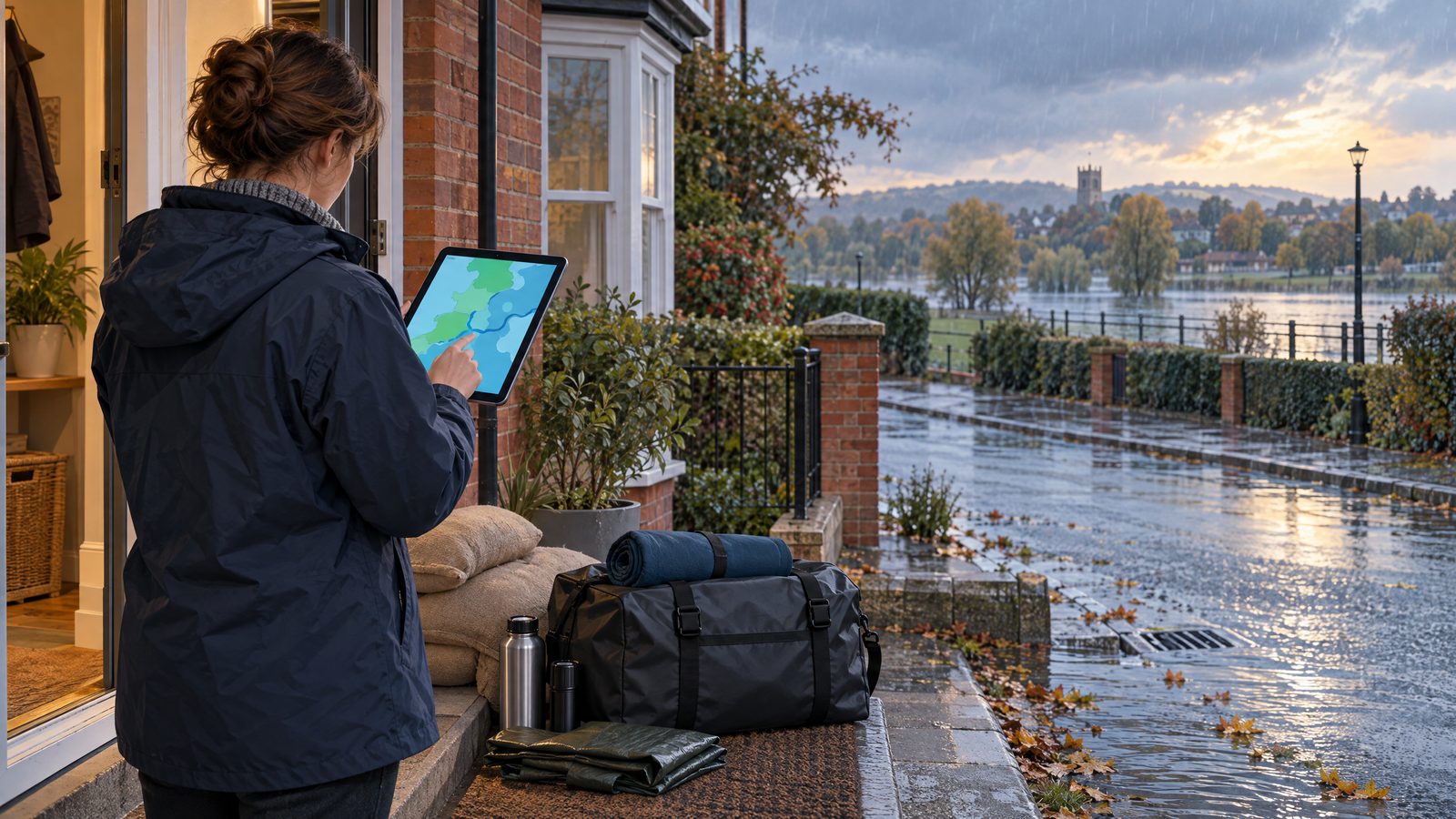

Flood Action Online has launched in England as the government sets a target for 200,000 properties to benefit from flood-defence investment by March 2029. The new online service brings flood-risk checks, flood-warning information and preparedness advice into one place for households considering the risks around their home.
The service is designed to help people find out whether flooding could affect their area, arrange to receive flood warnings and reach weather alerts during an incident. It also directs homeowners to information on property flood-resilience measures. It is an advice and information service: people should still use the warnings and information issued for their own area when conditions change.
The launch forms part of Flood Action Week, the annual campaign intended to encourage advance preparation. The government and the Environment Agency are asking people to understand their flood risk, make a plan and sign up for warnings. Flood risk can relate to rivers, the sea or surface water, so an individual check is more useful than assuming a home is safe because it is not near a watercourse.
Two different funding periods
The 200,000-property target is linked to a £4.2 billion programme running from April 2026 to March 2029. The government says the funding is intended for repairs and replacement of existing defences as well as new construction. It expects hundreds of projects to be completed during that three-year period. These are official aims and planned activity, not a guarantee that works will be completed on the same timetable in every location.
The government estimates that the target could be associated with £27.9 billion in avoided flood damage. That is a projected economic benefit attached to the programme, rather than a sum already saved. The announcement does not identify every property that may benefit or provide a project-by-project completion schedule.
A separate £2.65 billion figure relates to the earlier two-year investment for the 2024/25 and 2025/26 financial years. The launch announcement describes this as spending in the government’s first two years, while earlier official programme material identifies the period as ending in March 2026. It is therefore not spending in the first two years of the April 2026 to March 2029 programme.
For that earlier two-year investment, the government reports that almost 62,000 properties were better protected, compared with its original target of 52,000. It also reports that 93 per cent of flood assets were at or above their required condition at the end of March 2026. The next asset-condition target is 93.5 per cent by March 2029; this remains a target rather than a confirmed future result.
Preparing before flooding
For households, the practical advice is to prepare before an incident. The Environment Agency advises people to check their risk, sign up for flood warnings and make a flood plan. Its guidance also recommends keeping important documents in a waterproof place and preparing an emergency kit with essentials such as a torch, a battery-powered radio, first-aid supplies, warm clothing and copies of important documents.
Property-level measures may be worth considering, but the appropriate option depends on the building and the source of risk. When a warning is issued, residents should follow the current official information for their area and any emergency directions. Preparation can help people act promptly, but it does not remove the possibility of flooding or replace public warnings.
The launch gives residents a single digital starting point for these checks and plans. The investment figures set out two distinct periods: reported spending and outcomes for 2024/25 to 2025/26, followed by planned work and targets from April 2026 to March 2029. Keeping those periods separate makes clear which figures are reported progress and which are future aims.







