
Food waste collections reach 5,934 more Tower Hamlets households
Tower Hamlets Council says 5,934 additional households have gained access to its expanded food-waste collection service during its first week of collections. The newly reached households represent 31.5 per cent of the council’s own housing stock, as the service begins a phased expansion across the borough.
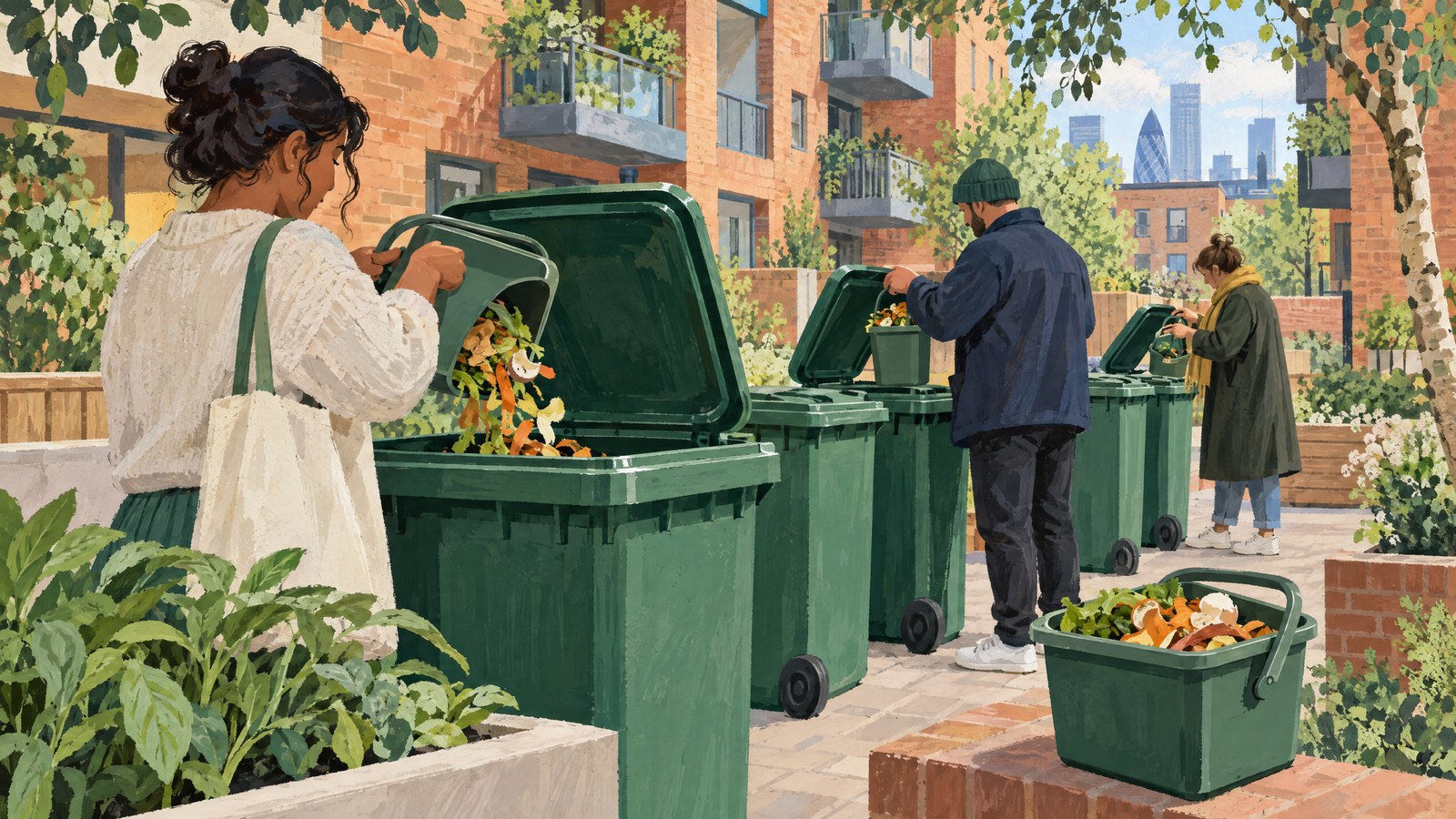
The latest phase has involved delivery of 283 communal food-waste bins to council-managed estates. Of those, 219 have a capacity of 240 litres and 64 hold 140 litres. The council says the bins allow residents to separate food scraps from general rubbish, with the rollout continuing in further areas in phases.
A phased service for flats
The first collections took place on 12 October. The expansion is being introduced first on council-managed estates, with other parts of the borough due to follow. The council says it will work with landlords, housing providers and managing agents as it extends collections to more properties. Its published programme describes a rollout across 2026 and 2027, with some areas receiving the service sooner than others.
The 5,934 figure is an additional number of households with access, not the total number of households served across Tower Hamlets. Likewise, the 31.5 per cent measure refers to the council’s own housing stock, rather than all homes in the borough. The milestone does not mean that the service has reached every household. Existing provision already includes houses and a small number of flatted properties, while the new phase is extending provision to more flats.
On estates, the council provides residents with a kitchen caddy, liners and instructions, alongside communal bins, usually placed near a bin store. Residents can transfer food waste from a full caddy into the communal food-waste bin. These bins are collected weekly.
What residents can put out
Accepted items include cooked or raw leftovers, plate scrapings, fruit and vegetable peelings, bread, dairy, eggshells, meat and bones, fish, rice, pasta, tea bags and coffee grounds. Packaging should be removed first, including packaging labelled compostable or biodegradable. The council also excludes liquids, cooking oil and plastic bags from the food-waste bins.
Food waste collected in the borough is taken to a specialist facility for processing into biogas, fertiliser and compost for agriculture, the council says. Biogas is a source of renewable energy. The service is intended to separate food waste from general rubbish and mixed dry recycling; residents should use the separate caddies and communal containers rather than place food waste in general waste bins.
Why the expansion matters
The council estimates that food waste accounts for around 30 per cent of rubbish thrown away in Tower Hamlets. That is the council’s stated local estimate, rather than a figure independently measured in this first week of collections. It says separating food waste offers an opportunity to increase recycling and reduce the amount of waste sent for disposal.
The first-week update is an operational milestone, not a boroughwide completion announcement. Further areas are expected to join as arrangements are made with the relevant housing providers and managing agents. Residents in flats may therefore receive the service at different times, depending on the phase covering their home.
Households joining a phase are due to receive a starter pack once collections begin in their area. The council advises residents to use the kitchen caddy and communal food-waste bin for food scraps only, and to keep packaging, liquids, cooking oils and plastic bags out. Its wider aim is to give all borough residents the opportunity to recycle food waste separately as the phased programme progresses.