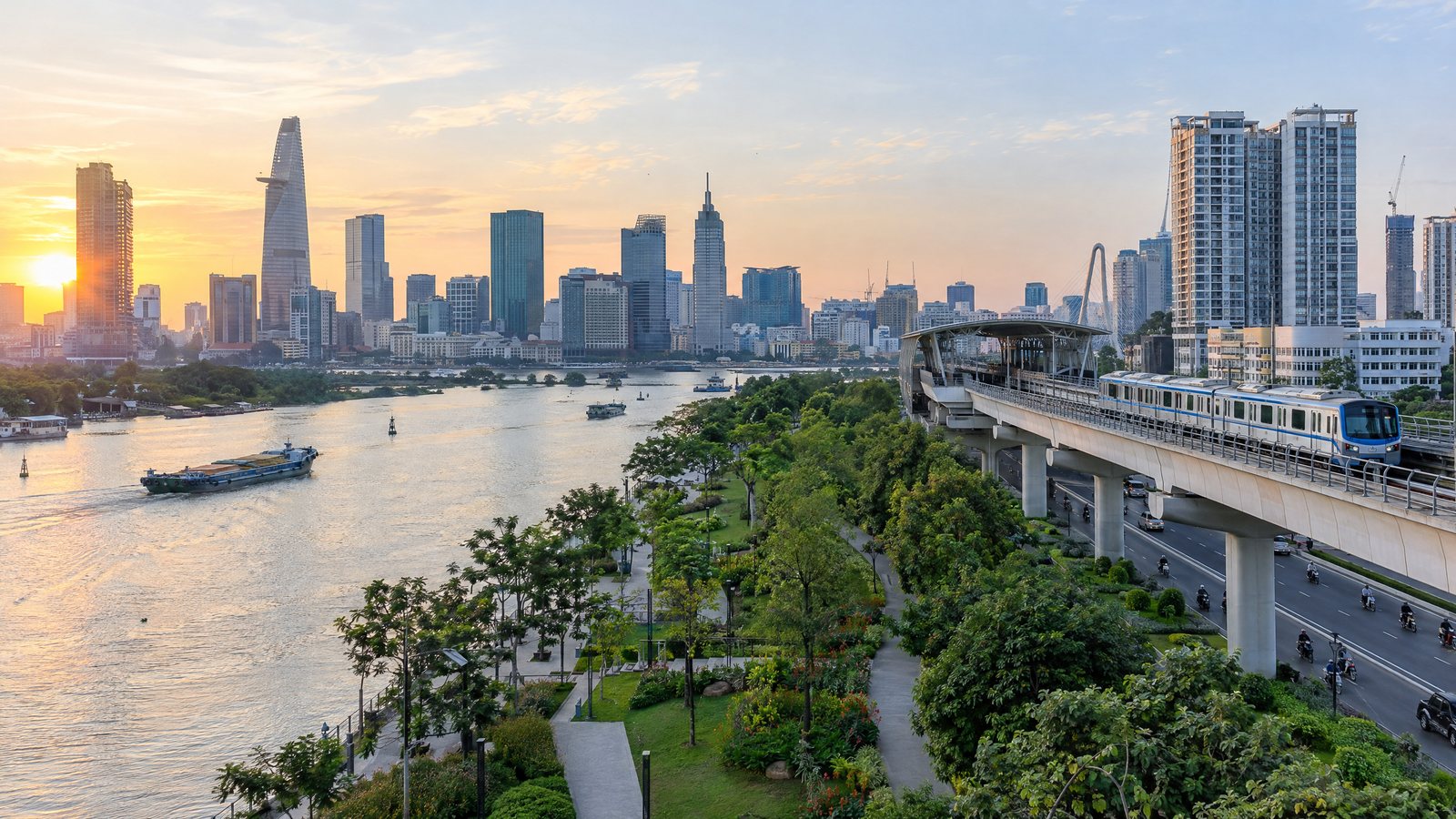

Ho Chi Minh City’s council has adopted a master plan for 2025–50, setting out a long-term spatial framework for the Vietnamese city alongside a 100-year vision. The plan brings together five growth poles, satellite centres and transport and environmental infrastructure, with climate resilience and social housing among its stated elements.
The council adopted the plan on 30 October 2026. Formal approval by the chair of the city’s executive authority is still required, so the council’s decision should not be treated as making every proposed component legally operative. It is an adopted planning framework, rather than evidence that the developments it describes have been completed.
Covering roughly 6,772 square kilometres and 168 administrative units, the plan also considers connections with neighbouring provinces and maritime areas. Its geographical scope therefore extends beyond the relationship between districts within the city, taking account of wider links while setting out a structure for development across the area covered.
Five growth poles
The proposed growth poles have distinct functions. One centres on international finance and services, while another focuses on innovation. A northern pole is intended for industry and logistics, and a southern pole combines ports, free trade and energy. The western pole brings together urban development, education and healthcare.
These five poles form the core of the proposed spatial structure. Their different functions distinguish the plan’s approach from a single, undifferentiated development area: finance, innovation, industrial activity, port-related uses and public services each have a place within the framework. They remain planning proposals, not descriptions of five completed growth centres.
Alongside the growth poles, the framework includes five satellite centres. These are a separate part of the spatial arrangement, adding another layer to the plan’s organisation of the city. The distinction matters: the five growth poles and five satellite centres are different elements, rather than alternative names for the same set of locations.
The plan also identifies ten management zones. Together, the poles, satellite centres and zones describe several levels of spatial organisation within the broader framework. Council adoption establishes support for that framework, but does not remove the remaining requirement for formal approval or demonstrate that its individual elements are already in operation.
Transport and environmental priorities
Five strategic connectivity systems are included in the framework, alongside integrated transport and environmental infrastructure. Connectivity sits within the same long-term plan as the proposed development centres, rather than being presented as a separate subject. The supplied details establish the number of systems, but not individual routes or construction schedules.
Transit-oriented development is another stated element. Its inclusion places the relationship between urban development and transport within the planning framework. It should not be read as confirmation that particular transport projects have opened, or that development around them has already taken place.
Climate resilience and river-system protection are also part of the plan. These environmental elements accompany the proposed economic and urban functions, including the southern focus on ports, free trade and energy. The framework thus addresses environmental infrastructure as well as the distribution of development across the city.
Social housing sits alongside education and healthcare within the plan’s stated priorities. Their inclusion gives the framework a social dimension as well as an economic and infrastructure focus. It does not, by itself, establish how much housing will be delivered or when any new facilities will become available.
The distinction between the 2025–50 planning period and the accompanying century-long vision is central to understanding the decision. The council has adopted a framework with both horizons; formal approval remains outstanding. Its proposed centres, connections and environmental measures describe the direction of planning, not a completed transformation of Ho Chi Minh City.