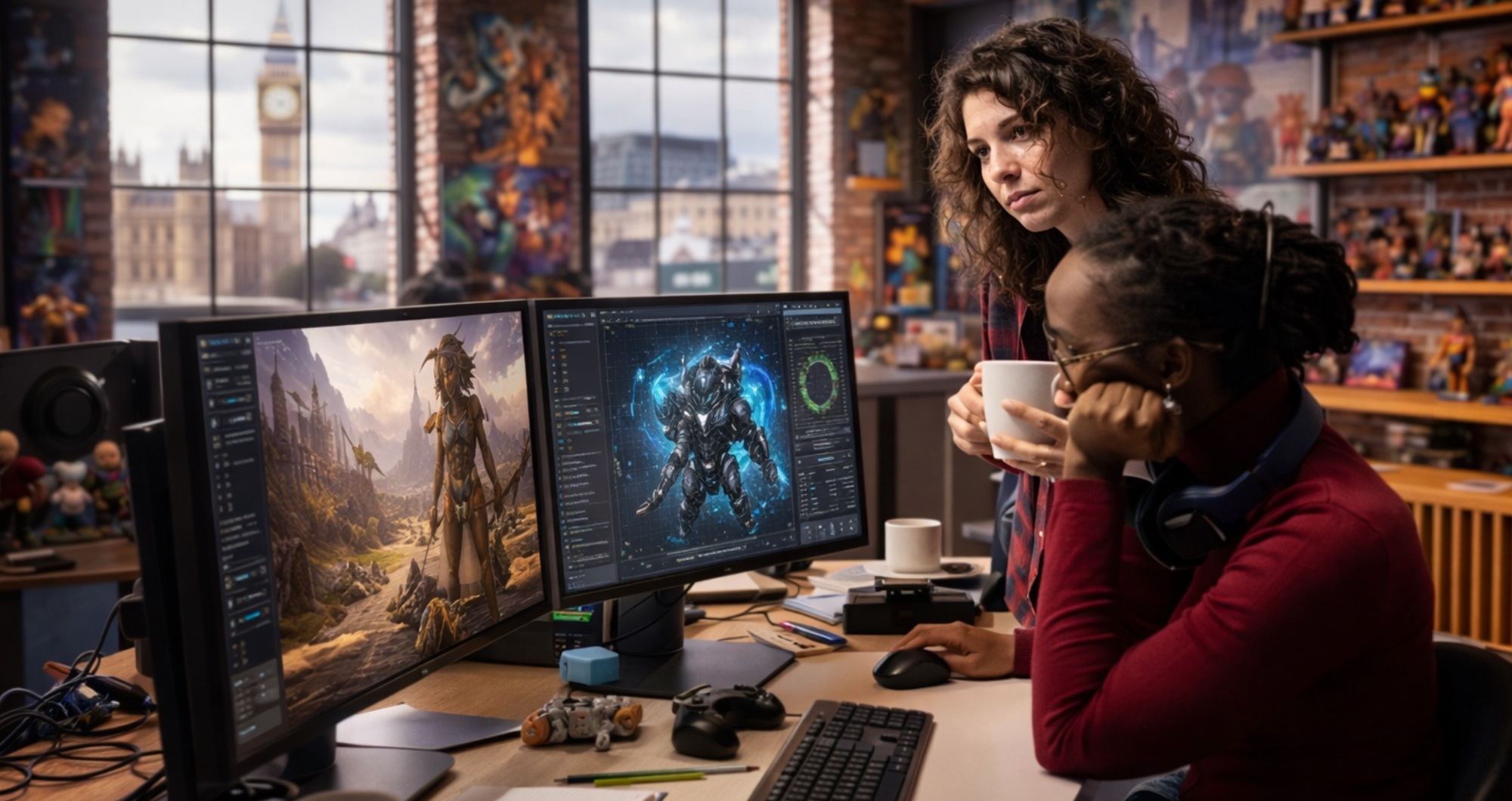

AI is changing creative work in UK game development, but not by replacing human imagination. Instead, it is changing how ideas are explored, tested, refined, and turned into playable experiences. In the UK, that matters because the games sector already sits where storytelling, art, design, and technology meet. Ukie says the UK has more than 2,000 games businesses, which shows why this is now a real sector-wide shift rather than a niche experiment.
That is why the topic deserves a clear and narrow focus. This is not mainly a story about automation, operations, or software efficiency. It is a story about creativity. AI is helping teams compare more visual directions, test more narrative possibilities, and shape more responsive player experiences before they commit to final choices. So, for any modern game development company, the real issue is not whether AI exists in the workflow. The real issue is how AI supports stronger creative thinking without weakening originality, authorship, or artistic control. tech UK frames this change as part of a wider shift in how games are developed and experienced.
Why Creativity Is the Real Centre of the Topic
Many articles on AI in games drift too quickly into speed, scale, and cost. Those points may matter in business terms. However, they do not fully answer this title. The stronger question is much more specific: how is AI changing the creative process inside UK game development?
The answer begins in early-stage experimentation. That is where AI is having the most visible effect. It can help teams generate first-pass options in concept art, dialogue structure, environmental mood, quest variation, and adaptive system design. As a result, creative teams can review more possibilities before they decide what fits the game best. That changes the shape of creative work. Instead of spending most of the early phase on slow repetition, teams can now spend more time judging quality, refining tone, and protecting the identity of the game. tech UK’s games coverage supports this broad direction by describing AI as a force reshaping both development and gameplay.
So, the main creative gain is not that AI “creates better art” by itself. The real gain is that AI expands the range of early options. Then, human creators decide which ideas are worth taking forward.
How AI Is Expanding Creative Possibility in UK Game Development
This is where the strongest change is happening. AI is widening the creative field before final production decisions are made.
Concept art and visual development
AI can help artists and creative leads test art styles, lighting moods, environment directions, and aesthetic variations more quickly than before. Therefore, the team can move past the blank-page stage faster. Yet the final visual identity still depends on people. Art directors still decide what belongs in the world. Artists still refine the look. A serious game development company does not use AI to replace visual authorship. Instead, it uses AI to widen early exploration while keeping the final artistic direction human-led. tech UK highlights AI-enabled content creation as part of the broader transformation taking place in gaming.
Narrative design and world-building
AI is also supporting creative writing workflows. It can help with early dialogue variations, branching quest paths, lore structures, and first-pass world logic. Because of that, narrative teams can test more routes before locking the final version. Still, tone, pacing, humour, emotional meaning, and character voice remain human responsibilities. So, AI can help expand the draft stage, but writers still shape the story into something coherent and memorable. That distinction matters because players do not respond to volume alone. They respond to writing that feels intentional.
Gameplay systems and player experience
Creativity in games is not only about visuals or story. It also lives inside systems. AI can help support more dynamic NPC behaviour, more adaptive player support, and more flexible gameplay responses. That does not mean every studio uses these tools in the same way. However, the direction is clear. AI can help games feel less rigid and more responsive when studios apply it carefully. So, a game development company can use AI not only to develop faster, but also to shape more creative player experiences. Tech UK’s sector coverage points to AI-driven gameplay and personalisation as important areas of development.
Creative iteration
Another major shift is happening in iteration. Better games rarely come from one perfect first idea. They usually come from rounds of review, comparison, rejection, and refinement. AI can shorten that loop. It can help teams generate more first-pass options and then move faster into evaluation. As a result, the creative process becomes more flexible. Teams get more room to test and revise without slowing everything down.
What AI Supports Well, and What Still Needs Human Control
A clean way to explain the topic is to separate support from authorship.
AI can support:
- rapid visual exploration
- draft dialogue options
- alternative quest or systems ideas
- early-stage iteration
- pattern spotting in player response
Human creators still lead:
- artistic identity
- narrative meaning
- emotional tone
- pacing and rhythm
- final creative approval
This distinction is important because strong studios do not confuse speed with originality. Instead, they use AI to create more room for stronger human choices. That is the more credible creative model for a UK-facing game development company.
Why this matters specifically for UK studios
The UK angle should not sit at the edge of the article. It belongs in the core argument. The UK games sector is already a strong mix of creative talent and technical capability. Ukie describes it as a sector that sits at the intersection of cultural creativity and advanced technology. That makes the UK especially relevant to this discussion. AI is not entering an empty space. It is entering an environment where games, immersive technology, design, and interactive storytelling already overlap.
London strengthens that picture further. tech UK’s work on London’s creative industries describes a wider cluster where games, immersive tools, VFX, and interactive media increasingly connect. Therefore, the effect of AI on creativity in the UK is not just about one tool inside one studio. It is about how creative disciplines are beginning to work together in a denser digital ecosystem. That makes the UK context more important than a generic global framing.
UK Games Fund also helps ground the topic in real sector activity. It says it has supported more than 400 interactive digital projects from independent studios across the UK. That matters because AI may be especially helpful when smaller teams need to explore more ideas without carrying the full cost of repeated manual early-stage work. So, a smaller game development company can use AI to support experimentation while still keeping creative ownership in human hands.
Why Human Creativity Still Decides What Players Remember
No matter how advanced the tools become, players still respond to human choices. They notice the atmosphere. They notice the character’s voice. They notice pacing, humour, tension, and surprise. They also notice when writing feels hollow or when a visual world feels assembled without a clear point of view.
That is why human judgment remains the final creative filter. A game development company may use AI to widen the option set, but people still decide what belongs in the game. They decide what feels emotionally right. They decide which visual direction supports the world. They decide which systems improve the player experience instead of making it feel artificial. So, while AI can support exploration, it does not replace taste, restraint, or creative conviction.
What the Best Creative Approach Looks Like Now
The strongest approach is simple. Use AI where it increases creative range. Then keep people in charge of meaning, tone, and final direction.
A focused creative model looks like this:
- use AI to generate early options, not final identity
- let artists refine style instead of just selecting output
- let writers use AI for variation, not for emotional truth
- use AI to support experimentation, not flatten originality
- keep final sign-off with people who understand the game’s voice
This model works because it protects what players actually care about. Players do not remember how many options a tool produced. Instead, they remember atmosphere, story, rhythm, and emotional payoff. So, the real value of AI is not that it can produce more material. The real value is that it can help creative teams find the right idea faster.
Final Thoughts
AI is transforming creativity in the UK game development sector by changing where human effort creates the most value. It is helping teams explore more visual directions, test more narrative paths, and shape more adaptive experiences earlier in development. However, the final creative strength of a game still comes from people. It still comes from judgment, taste, tone, and intention.
So, the sharper takeaway is this: the future will not belong to the studio that uses the most AI. Instead, it will belong to the studio that uses AI to support stronger human creativity. That is the real shift now facing every forward-looking game development company in the UK.