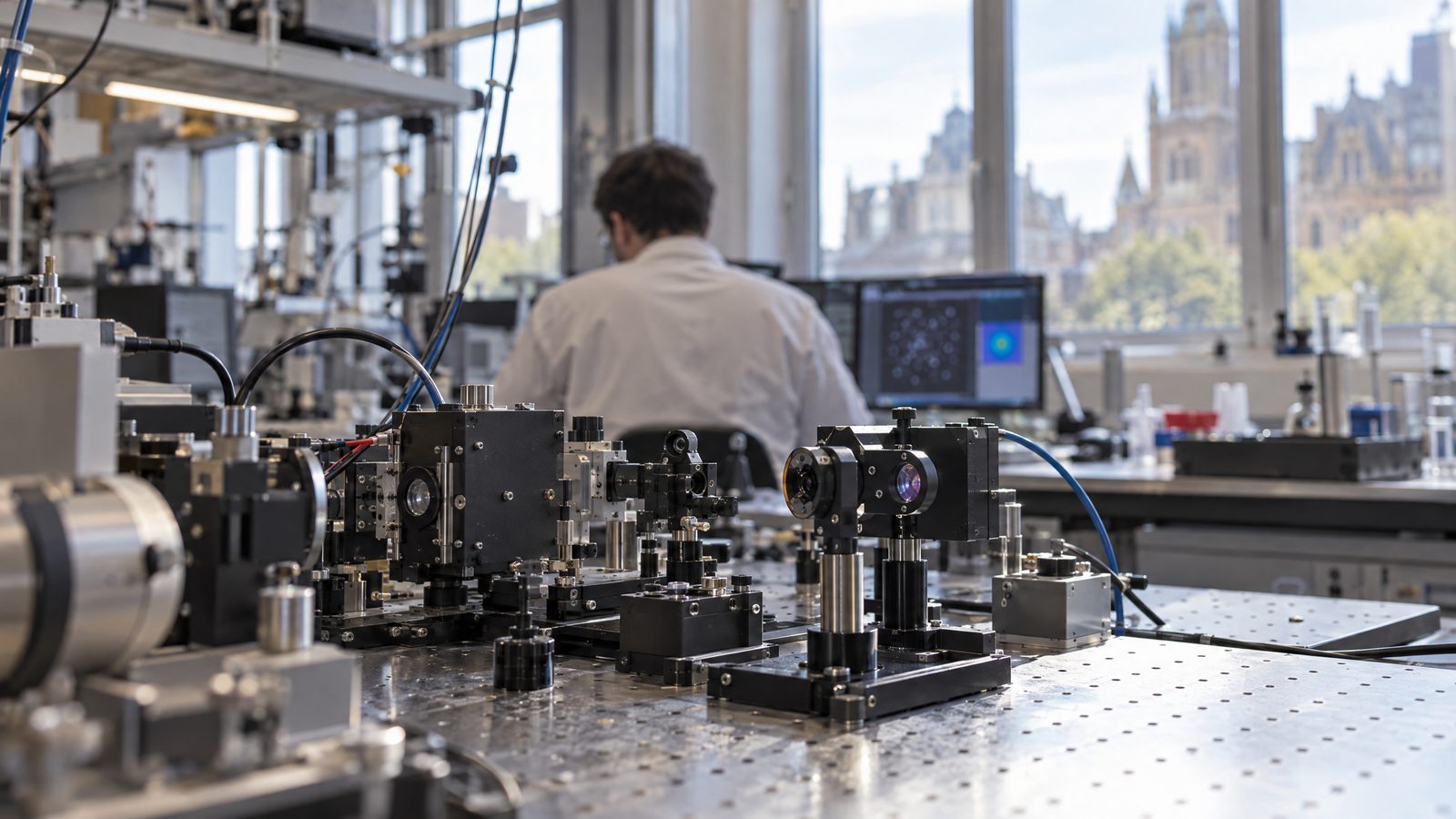

A London university is joining a €4.2 million European research effort to explore low-energy physical artificial intelligence, with work aimed at developing systems that can carry out machine-learning tasks directly through physical processes.
The project will investigate nonlinear physical systems as an alternative to relying on conventional GPU-centred architectures. Its focus is on exploring whether physical learning networks can perform the tasks being studied, rather than announcing a finished technology or a product ready for use.
The university’s contribution will involve developing physics-aware training methods and testing physical learning networks. Those two strands place both the training approach and the networks themselves within the planned research. The work is an investigation into how such systems might be developed and tested, not a claim that their intended capabilities have already been demonstrated.
The London involvement is based at its South Kensington campus. The wider consortium includes partners across Italy, Sheffield, Germany and the Netherlands, bringing the university into an international effort around the proposed approach to machine learning.
The €4.2 million figure relates to the European project. It should not be read as an amount allocated solely to the university or to its London work. The announcement concerns the shared research effort, with the university taking part through its planned work on training methods and physical networks.
At the centre of the proposal is the idea of executing machine-learning tasks directly in nonlinear physical systems. That is the distinction the project will explore against conventional GPU-centred architectures. The research aim is to investigate the physical approach itself; it does not establish that conventional architectures have been replaced.
Low-energy operation is an ambition of the project, rather than an achieved result. The research announcement does not establish a measured reduction in energy use or a demonstrated performance advantage. Any prospective energy benefit therefore remains part of what the work is intended to explore, not a confirmed outcome of the funding announcement.
Potential applications named for the research include local health monitoring, neuroprosthetics and robotics. These are prospective uses for the approach, not descriptions of deployable products. Their inclusion indicates areas in which the project’s work might have relevance, while leaving open whether the research will produce systems suitable for those uses.
The health-related possibilities require the same distinction. Local health monitoring and neuroprosthetics are identified as potential applications, but the announcement does not demonstrate a clinical outcome. It is not a statement that a new monitoring tool or neuroprosthetic device is available, or that either has been shown to benefit patients.
Robotics is likewise a possible application rather than a delivered result. The project’s planned investigation of physical learning networks should not be confused with the announcement of a working robotic product. The stated work remains the development of training methods and the testing of networks within a research programme.
For London, the announcement places a South Kensington university within a European project exploring a different approach to machine-learning computation. Its significance at this stage lies in the funded research and The university’s participation, rather than in any established energy saving, practical deployment or health benefit.
The immediate focus is therefore on the research questions: developing physics-aware training methods, testing physical learning networks and exploring direct execution of machine-learning tasks in nonlinear systems. The prospective applications give that work possible directions, but they remain possibilities rather than demonstrated outcomes.