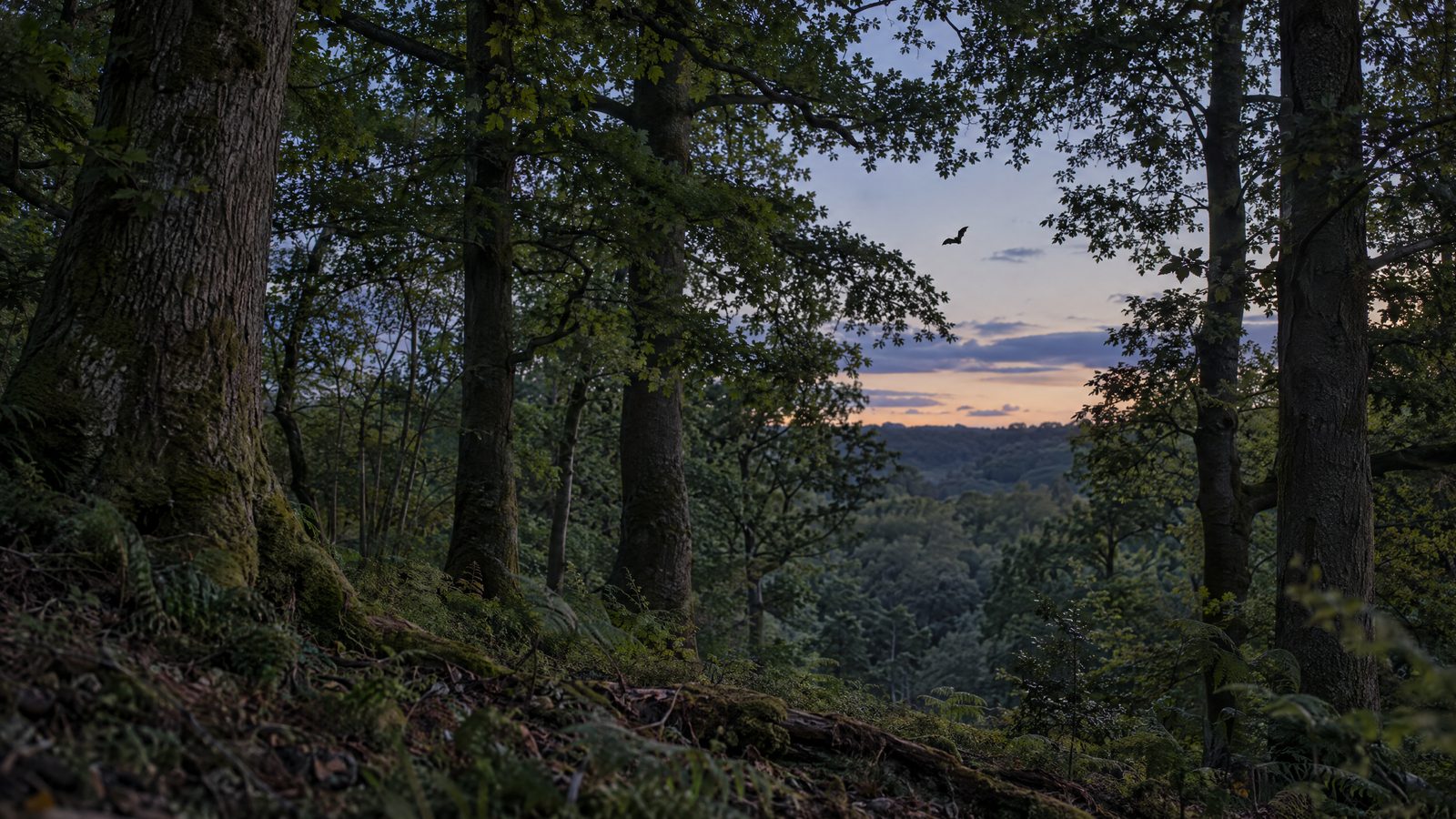

An AI-assisted survey has produced a woodland bat baseline built from 98 million calls, involving a London research team and survey sites across England. The work combines automated acoustic identification with expert checks, providing national-scale monitoring data without establishing bat population sizes or trends.
The survey found that broadleaved woods had the highest average bat activity. That finding concerns activity recorded through acoustic detections: it is not a finding that those woods contain the largest bat populations. The distinction is central to understanding both the woodland comparison and the wider dataset.
The London connection is a research team at UCL East. The survey itself extends beyond the capital, drawing on sites across England. Its national scale therefore refers to a monitoring effort across those survey sites, rather than a study confined to London or a single woodland.
Automated acoustic identification was used to process the bat calls, with a subset checked by 19 expert verifiers. The combination puts automated identification and human verification within the same survey. However, the stated checking arrangement covers a subset of the material, not an expert examination of every call in the dataset.
The 98-million-call total describes the scale of the acoustic material. It should not be read as a count of individual bats. Calls, detections and recorded activity are the measures described here; the survey is presented as a conservation baseline and a data resource, rather than a population estimate.
For several species, the work has produced national-scale monitoring data. That is a distinct result from demonstrating a change in their numbers. The survey does not establish that any species has increased or declined, and the existence of a large dataset does not alter that limitation.
The broadleaved woodland result is similarly specific. These woods had the highest average activity in the survey, but the finding does not supply a population-size comparison. Nor does the stated result explain why average activity was highest there. It records a difference in activity without attaching a cause to it.
As a baseline, the survey sets out recorded woodland bat activity at national scale. Its conservation role rests on that monitoring record, not on a claim that it has already demonstrated improvement or deterioration. The baseline and the species data are the outputs described, while conclusions about population trends remain outside the findings.
The use of AI is one part of this picture, alongside the acoustic records and expert verification. The survey offers an example of automated identification applied to a large environmental dataset. It does not, on the information available, establish that automated identification alone was sufficient, or that every identification received human confirmation.
For readers, three separate elements matter: the volume of calls, the comparison of average woodland activity and the monitoring data for several species. Each describes an aspect of the survey. None can be substituted for a count of bats or a conclusion about whether their populations are rising or falling.
The result is a substantial acoustic baseline with a clearly bounded interpretation. Across survey sites in England, broadleaved woods recorded the highest average activity, while automated identification and checks by 19 experts contributed to the work. For the London team, the milestone is a national-scale conservation data resource—not evidence, by itself, of population growth or decline.