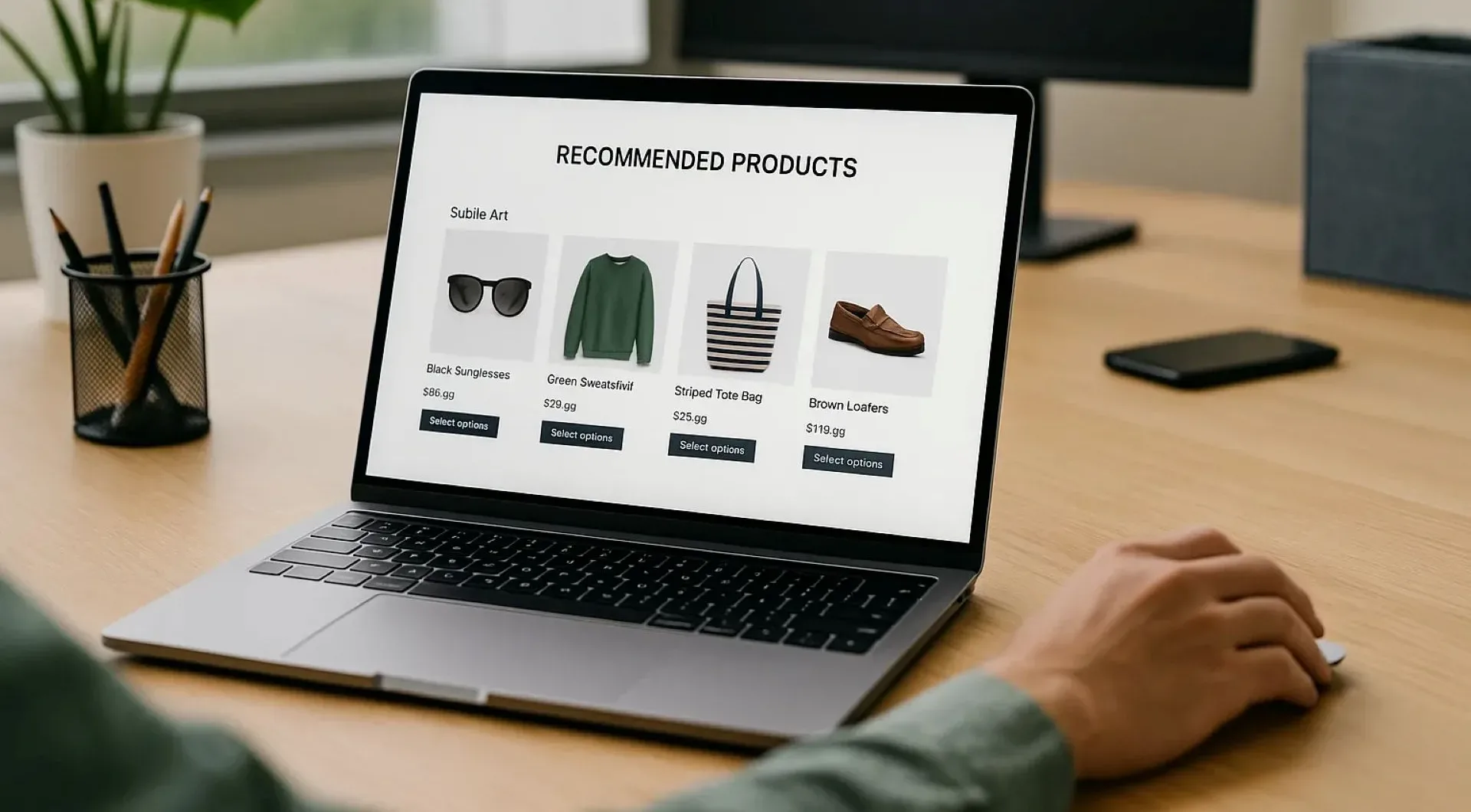

An established e-commerce company specialising in fashion retail wanted to improve its product recommendation engine. Despite having a solid product catalog and a loyal user base, the brand struggled to convert casual browsers into buyers. By partnering with a provider of advanced AI development services, the company implemented a machine learning-based personalisation system, resulting in a 40% increase in conversions within four months.
Client Background
- Industry: E-commerce (Fashion Retail)
- Target Market: B2C (millennials and Gen Z consumers)
- Challenge: Low conversion rates despite high traffic
Project Goals
- Increase product discovery and engagement.
- Personalise the shopping experience across all customer touchpoints.
- Use real-time data to dynamically adjust recommendations.
- Measure ROI using clear A/B testing strategies.
The Problem: Why the Old Recommendation System Failed
Although the client invested heavily in marketing, their conversion rates stagnated at around 1.8%. Customers were browsing but not purchasing. Internal analysis revealed that their existing recommendation system relied on static, rule-based filters:
- Customers were shown popular products, not personalised ones.
- Search and recommendation results did not adapt to user behaviour.
- Relevance was low for returning users.
The lack of intelligent personalisation left potential revenue on the table.
Why They Chose Custom AI Development Services
The client had tested third-party recommendation tools but faced limitations:
- Rigid algorithms that couldn’t be retrained or tuned.
- Inability to access raw model performance metrics.
- No real-time behavioural integration.
They needed a solution built from the ground up:
- One that could ingest real-time clickstream data.
- Learn from user sessions.
- Integrate with the existing tech stack without overhauling infrastructure.
The decision to hire a firm specialising in AI development services enabled them to get a custom-built engine tailored to their workflows and customer behaviour.
The Solution: How the AI System Was Designed and Deployed
The solution involved three major components:
1. Behavioural Data Pipeline
- Implemented trackers across product pages, category views, and cart behaviour.
- Data was processed in near real-time using Apache Kafka and stored in Amazon Redshift.
2. Machine Learning Model Development
- Used a collaborative filtering and content-based filtering hybrid model.
- Added session-based recommendations using RNN (Recurrent Neural Networks).
- Tuned model using TensorFlow and PyTorch.
3. Personalization Algorithm Engine
- Real-time engine built in Python.
- Integrated with the frontend via REST APIs.
- Delivered updated recommendations within 200ms response time.
The system was designed to:
- Score product relevance for each user based on browsing patterns.
- Consider contextual factors such as time of day, device type, and past purchase history.
- Auto-adjust recommendations as users clicked, searched, or added items to cart.
Step-by-Step Implementation Timeline for the AI Recommendation System
Phase 1: Discovery & Data Mapping (Weeks 1-2)
- Analysed existing datasets.
- Identified high-traffic product categories.
- Mapped technical dependencies.
Phase 2: Model Building & Training (Weeks 3-6)
- Trained initial ML models using historical customer data.
- Validated predictions using accuracy and diversity metrics.
Phase 3: Integration & A/B Testing (Weeks 7-10)
- Deployed engine to 50% of live traffic.
- Ran A/B test against existing rule-based system.
Phase 4: Optimisation & Rollout (Weeks 11-16)
- Tweaked models based on test results.
- Rolled out to 100% of users.
- Set up dashboards for continuous monitoring.
What Changed: Results and Measurable Business Impact of the AI System
Key Performance Improvements:
- Conversion Rate: Increased from 1.8% to 2.5% (approx. 40% improvement).
- Average Session Duration: Up by 18%.
- Click-through Rate on Recommendations: Jumped from 4.2% to 7.9%.
- Cart Abandonment: Reduced by 12%.
A/B Testing Findings:
- Variant A (Old system): 1.8% conversion
- Variant B (AI-powered): 2.5% conversion
- Statistical significance achieved after 14 days
These results were made possible by aligning the AI recommendation engine to actual user behaviour and real-time feedback.
Behind the Scenes: Technical Architecture That Powered the AI Engine
Data Sources:
- User behaviour logs (clicks, views, cart actions)
- Product metadata (colour, category, price, etc.)
- User profiles and historical purchases
Tech Stack:
- Data Processing: Apache Kafka, Amazon Redshift
- ML Modelling: Python, TensorFlow, PyTorch
- API Delivery: FastAPI
- A/B Testing: Optimizely
- Monitoring: Grafana, Prometheus
The modular setup allowed for scalability and easy updates as the catalog evolved.
Key Takeaways: What the Team Learned from Building the AI System
- Rule-based recommendation systems are limited in scale and personalisation.
- A/B testing is critical in validating machine learning systems.
- Real-time feedback loops significantly enhance AI effectiveness.
- Transparent model evaluation metrics build internal trust among business teams.
Conclusion: How AI-Powered Personalisation Transformed E-commerce ROI
The e-commerce brand saw a measurable business impact within a short time by leveraging custom AI development services. By moving from a rule-based to a dynamic AI-powered recommendation engine, they not only increased conversions but also improved user engagement across the board.
The case underlines the importance of:
- Custom AI over off-the-shelf tools for personalisation
- Investing in behavioural data infrastructure.
- Building machine learning pipelines that are testable and interpretable.
For businesses looking to increase e-commerce ROI, AI-based product recommendations are not just a trend they’re a necessity.