
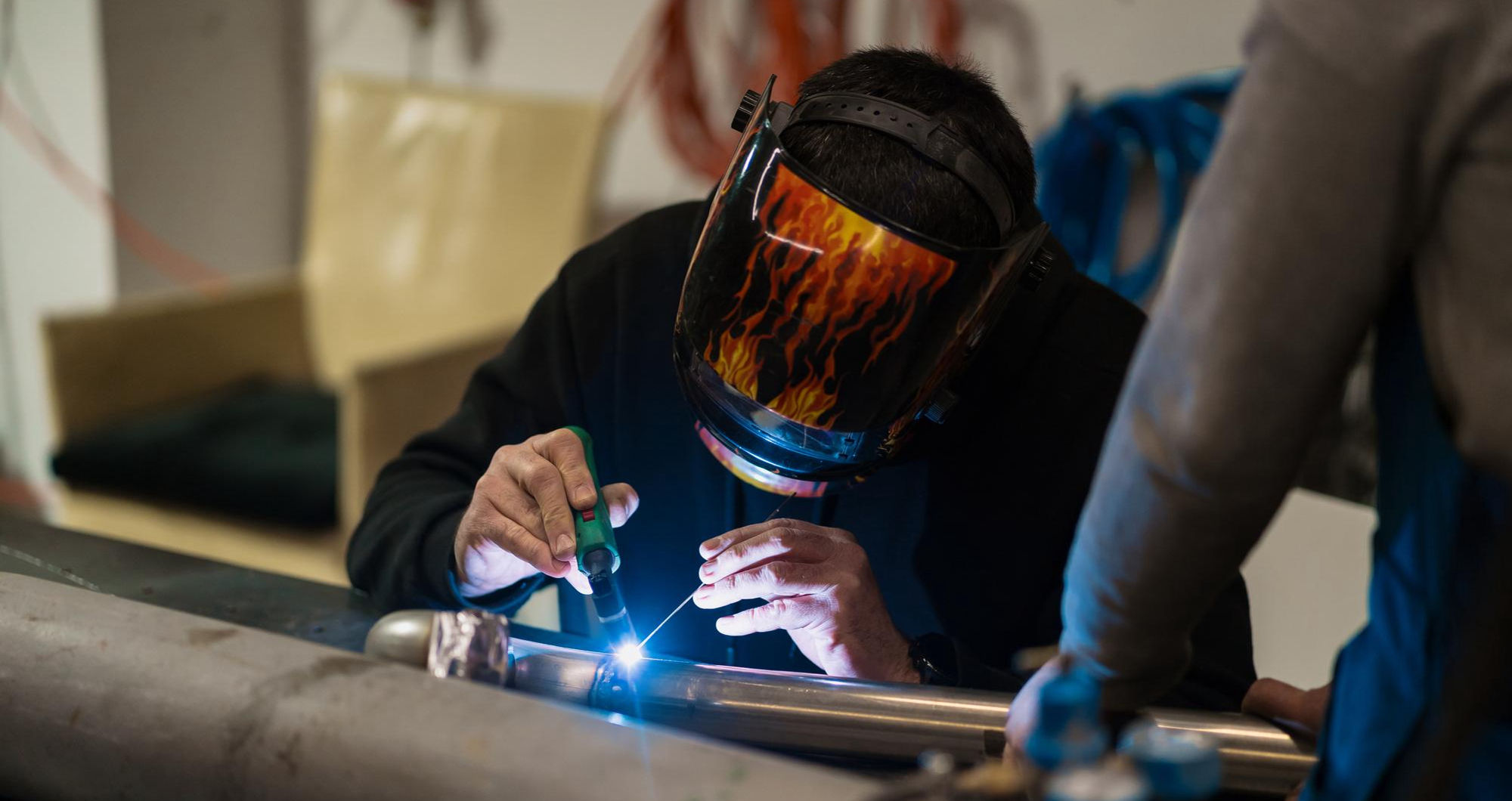

Have you ever wondered how laser welding works and why it is transforming manufacturing? In fact, choosing the right welding method can really significantly enhance production efficiency and precision.
At Dynalasers, we are constantly researching and applying laser welding and are well aware of its advantages. In this guide, we will take you through the process of laser welding in a clear and understandable way, and also share some practical experiences. Are you ready? Let’s get started!
What Is Laser Welding
Laser welding is a joining process that securely bonds materials such as metals or thermoplastics through a high-energy laser beam. The laser beam is focused onto the joint of the workpiece, melting the material instantly and solidifying upon cooling to form a strong and precise weld seam. With advanced design and stable performance, a Dynalasers fibre laser welder makes this process more efficient and reliable for industrial applications.
Key Components of Laser Welding Systems
- Laser source: Common types include fibre lasers, carbon dioxide lasers and solid-state lasers. Among them, fibre lasers are widely used due to their high efficiency, high precision and ease of integration.
- Optical system: Focuses the laser beam onto an extremely small point, concentrating its energy to a great extent, thereby generating an extremely high power density.
- Shielding gas (optional): During the welding process, protective gases such as argon and nitrogen can prevent the molten pool from being oxidised or contaminated, thereby ensuring the quality of the weld seam.
- Workpiece operating system: It is used for positioning, moving or fixing the workpiece to ensure that the material is always in the correct position during the welding process, thereby improving welding accuracy and consistency.
Two Main Modes of Laser Beam Welding
Laser welding generally operates in two modes, depending on the material and weld depth needed:
- Conduction Welding: The weld it forms is relatively shallow, making it particularly suitable for thin sheet metals and other materials. Due to the limited penetration of heat, it can effectively reduce the risk of deformation and maintain a small heat-affected zone, thereby improving the welding quality.
- Keyhole Welding: This welding can create deep and narrow weld seams, making it highly suitable for welding thicker materials. It not only ensures a secure connection but also significantly enhances production efficiency, especially in mass production.
Step-by-Step Guide: How Laser Welding Works
Laser welding is a very precise process, and using a modern handheld laser welding machine ensures accuracy and consistency throughout. It usually involves several key steps to create a strong and smooth joint. Let’s take a closer look at the specific procedure:
Step 1: Setup and Alignment
Before welding, the workpiece is precisely positioned and fixed by the fixtures. This ensures that all components fit closely together and do not shift during the welding process. Good alignment not only ensures a uniform molten pool but also significantly enhances the strength of the final joint.
Step 2: Laser Generation
During welding, the laser source emits high-energy laser beams to heat and melt the materials. Common fibre lasers are widely used in this process due to their high efficiency and stable power. The laser beam is the core energy source that promotes the fusion of materials.
Step 3: Beam Delivery and Focusing
The optical system will focus the laser beam into a very small and concentrated light spot. As a result, the energy density of the beam will increase significantly, enabling the material to be rapidly and precisely melted within an extremely short period of time.
Step 4: Material Interaction and Weld Pool Formation
When the focused laser beam is directed onto the material surface, it will quickly melt the material, forming a small weld pool. Sometimes, a filler rod is also used to enhance the bonding strength and fill the gaps. Due to the high precision of the laser beam, the heat is almost exclusively concentrated in the weld area and does not spread to the surrounding areas.
Step 5: Solidification and Joint Formation
As the molten pool gradually cools down, it solidifies and forms a strong and precise weld point. Due to the concentrated and controlled heat, the heat-affected zone (HAZ) is minimised, thereby reducing deformation and allowing the material to retain its original properties very well.
Step 6: Quality Control and Testing
After the welding process is completed, quality inspections are usually carried out, such as ultrasonic testing or penetrant testing, which are non-destructive testing methods. This allows for the confirmation that there are no defects inside or on the surface of the weld, ensuring that the joint is firm and reliable, and meeting the quality standards of the industry.
By following these steps, laser welding delivers fast, reliable, and high-quality welds with minimal cleanup, making it ideal for industries like automotive, aerospace, and electronics.
Why Can Laser Welding Achieve Precise Welding
Laser welding has many significant advantages and thus is widely adopted in various industries. Especially in fields where precision and efficiency are of utmost importance, it has become the preferred technology. Now let’s take a look at the advantages of using laser welding. The following are the advantages of laser welding:
- Minimal Distortion
Laser beam welding can produce fine and smooth weld seams, with minimal heat-affected zone. This means that the material after welding will hardly deform or warp, which is particularly important for thin metals or fragile components.
- Faster Welding Speed for Production
Compared with traditional welding, laser welding is much faster. This makes it highly suitable for automated production lines, especially useful in situations where efficiency and output are crucial. At the same time, it can also reduce labour costs and shorten the overall production cycle.
- Versatility Across Materials
Laser welding is applicable to various materials, including steel, aluminium, titanium, thermoplastic, and composite materials. Its versatility enables you to handle different types of projects without the need to change equipment, making it highly suitable for diverse manufacturing requirements.
- Cost-Effectiveness and Energy Efficiency
Laser welding does not require additional post-processing steps such as grinding or cleaning, thus reducing workload and material waste. Moreover, its energy-saving feature is also more energy-efficient than many traditional welding methods, thereby reducing costs and operational expenses.
- Environmental Benefits
Compared with arc welding and other traditional welding methods, laser welding generates less waste and consumes less energy. This makes it a more environmentally friendly option, and it aligns with the increasingly strict environmental regulations and sustainable development goals of the American manufacturing industry.
Overall, laser welding not only offers high precision, fast speed, and wide applicability, but also helps reduce costs, while making the production process cleaner and more efficient.
Challenges and Considerations in Laser Welding
Although laser welding has many advantages, it also has some aspects that require attention, which is particularly important for manufacturers considering investing in this technology.
Initial Cost and Investment
Compared with traditional welding equipment, the initial investment of laser welding machines is higher. However, this cost can usually be compensated for through the following aspects:
- Faster production speed leads to long-term savings.
- Post-welding processing workload is reduced.
- Energy consumption has decreased.
Material Limitations
Not all materials are equally easy to weld with lasers. For example:
- Increase production speed and achieve long-term savings.
- Reduce the post-welding processing work.
- Reduce energy consumption.
Operator Training and Skill
To achieve the best results, experienced technicians are required. Through appropriate training, it can help them reach their peak performance:
- Laser parameters.
- Fixturing and Alignment.
- Quality control measures.
How Dynalasers Addresses These Challenges
Dynalasers is well aware of these challenges and has provided a series of mature solutions. These solutions not only lower the threshold for the use of laser welding, but also enable enterprises to achieve high-quality and low-cost production goals more quickly:
- User-friendly equipment: The machine has a compact structure and an intuitive operation interface. Installation and learning to use it are both very convenient.
- Systematic training courses: From basic operation to process optimisation, helping your team master laser welding technology in the shortest possible time.
- Continuous maintenance & technical support: Offer regular inspections and remote assistance to ensure that the equipment remains in optimal condition at all times.
Why Choose Dynalasers Laser Welder for Laser Welding
In the field of laser beam welding, Dynalasers’ laser welder stands out with its advanced fibre laser systems. These systems are specifically designed for high precision and high efficiency, and can fully meet the demanding requirements of modern manufacturing industries.
Features That Make Dynalasers a Top Choice
- High energy efficiency: Dynalasers machines operate with lower energy consumption.
- Automation compatibility: Integrated into CNC systems and robot systems.
- Low maintenance: Designed specifically for durability and low failure rate.
- Versatile welding modes: Supports conductive welding and micro-hole welding, suitable for materials of different thicknesses and types.
- Faster production cycle: Enhancing overall capacity and efficiency.
- Reduce the heat-affected zone: Minimise material deformation and maintain structural performance.
- Cleaner and stronger weld seams: Meeting the requirements of high precision and high reliability.
- Reduce the post-welding processing procedures: Lower costs and save time.
Many manufacturers have adopted Dynalaser’s technology to improve their production lines. Whether you aim to enhance production efficiency or strive for higher welding quality, Dynalasers can offer you the appropriate solutions.
Conclusion
Laser welding, with its high precision, high strength and high efficiency, is redefining modern manufacturing. This guide provides you with comprehensive insights. For enterprises seeking reliable and efficient welding solutions, choosing the right equipment is crucial. The fibre laser welding equipment from Dynalasers combines innovative technology with a user-friendly design, making precise welding more convenient and efficient, and helping your production process achieve optimal performance. Contact Dynalasers immediately, schedule a demonstration, and experience for yourself how their technology can transform your welding methods.







