
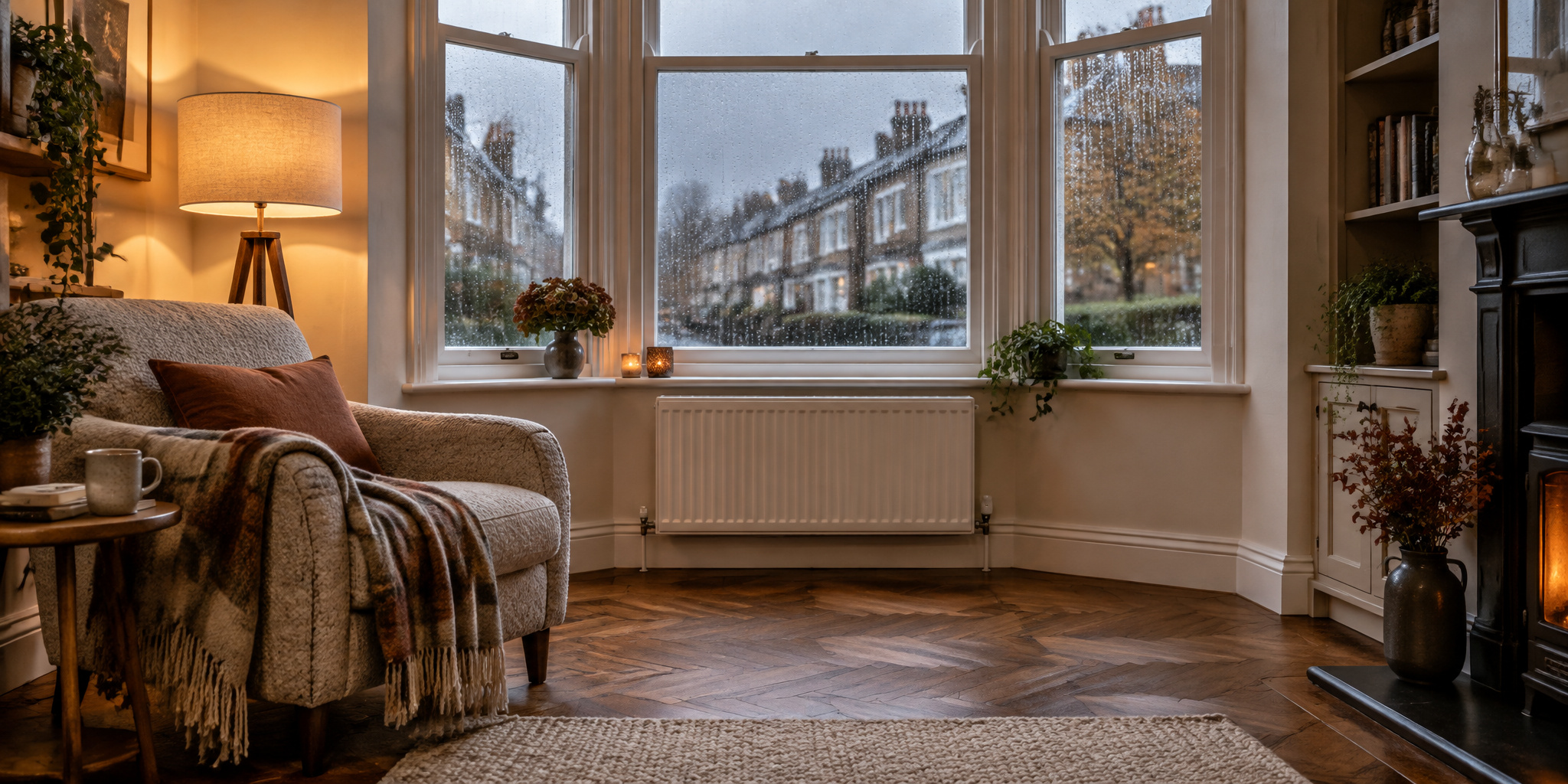

Most homes have radiators, and most people never think about them. They are fitted, they warm up when the heating comes on, and they are ignored until something goes wrong. Yet the efficiency of a radiator—how well it converts energy into heat, and how effectively that heat reaches the room—has a significant effect on comfort and on bills.
An inefficient radiator is not simply a minor inconvenience. It is a system running below its potential, wasting energy and money in the process. Understanding how radiators work, and what makes one efficient, is the first step towards fixing the problem.
What Efficiency Means for a Radiator
Radiator efficiency is not measured in the same way as boiler efficiency. A boiler has an efficiency rating, expressed as a percentage of fuel converted into heat. A radiator does not convert fuel; it distributes heat that has already been produced.
Efficiency in a radiator therefore refers to how well it transfers heat from the water inside it to the air in the room. Several factors affect this.
Size relative to the room. A radiator that is too small for the space will never heat it adequately, no matter how hot the water. An oversized radiator will heat the room quickly and then run at a lower temperature, which is often more efficient.
Position. Radiators work best when placed under windows, where cold air enters and is warmed immediately. They work poorly when blocked by furniture, curtains, or shelving.
Type and design. Panel radiators, column radiators, and designer models all emit heat differently. Some are better suited to certain rooms and heating systems than others.
Condition. A radiator that has not been bled, that contains sludge, or that has a faulty valve will not perform as it should.
The Common Problems
Several issues routinely reduce radiator efficiency, and most are easy to identify.
Trapped air. Air in the system prevents hot water from filling the radiator fully, leaving cold spots at the top. Bleeding the radiators regularly solves this.
Sludge and scale. Over time, debris and mineral deposits accumulate inside the system, reducing flow and heat output. A system flush or chemical treatment restores performance.
Blocked radiators. Furniture placed in front of a radiator absorbs heat, preventing it from reaching the room. Curtains hanging over radiators have the same effect.
Faulty valves. Thermostatic radiator valves can stick or fail, leaving radiators either permanently hot or permanently cold.
Incorrect balancing. In a system with several radiators, some may receive more hot water than others. Balancing the system ensures even distribution.
The Balancing Question
Balancing is one of the most commonly neglected aspects of radiator efficiency.
A heating system is designed so that each radiator receives the correct flow of hot water. Over time, or after alterations, this balance can be lost. Radiators near the boiler may get very hot while those further away stay lukewarm. The system works harder to compensate, wasting energy.
Balancing involves adjusting the valves on each radiator so that heat is distributed evenly. It is a straightforward job for a heating engineer, and the improvement in comfort and efficiency is often immediate.
The Thermostatic Valve
Thermostatic radiator valves allow individual radiators to be controlled independently. They sense the room temperature and adjust the flow of hot water accordingly.
Used well, these valves improve efficiency considerably. Rooms that are not in use can be kept cooler, and rooms that are occupied can be kept comfortable. Used poorly—left fully open, or set to maximum in every room—they deliver none of their benefit.
A sensible approach is to set valves to a comfortable temperature in living spaces, lower in bedrooms and hallways, and lowest in unused rooms. The system then heats only what is needed.
Upgrading Old Radiators
Older radiators, particularly the thin steel panels common in post-war homes, are less efficient than modern equivalents. They hold less water, emit less heat, and often lack thermostatic control.
Replacing them with modern panel radiators or column radiators can improve both comfort and efficiency. Modern radiators are often designed to run at lower flow temperatures, which pairs well with condensing boilers and heat pumps.
The upgrade is not always necessary. A well-maintained older radiator in a well-insulated room can perform perfectly adequately. But where radiators are cold, slow to heat, or poorly controlled, replacement is worth considering.
The Insulation Factor
A radiator cannot compensate for a poorly insulated room. Heat lost through walls, windows, and floors will always exceed the heat a radiator can supply efficiently.
Before investing in new radiators, address insulation and draught-proofing. Loft insulation, cavity wall insulation, and double glazing all reduce the heat required, which in turn reduces the load on the radiators. A well-insulated room needs smaller radiators and less energy to keep warm.
This is the least glamorous part of heating efficiency, and the most effective.
The Heat Pump Question
For anyone considering a heat pump, radiator efficiency becomes a central concern.
Heat pumps operate at lower flow temperatures than gas boilers, typically around 35°C to 45°C. Standard radiators sized for a gas boiler often cannot deliver adequate heat at those temperatures. The solution is either larger radiators, underfloor heating, or a combination of both.
Assessing radiator efficiency is therefore part of planning for a heat pump. A heating engineer will calculate the heat loss of each room and specify radiators accordingly. This is not a reason to avoid heat pumps, but it is a reason to plan carefully.
Finally
Radiator efficiency is not a single number or a single fix. It is the result of correct sizing, sensible positioning, regular maintenance, proper balancing, and good insulation.
Most homes could improve their radiator efficiency with a few straightforward steps: bleed the radiators, clear the obstructions, set the thermostatic valves properly, and have the system balanced. These measures cost little and deliver immediate results.
Beyond that, the question is whether the radiators themselves are suited to the room and the heating system. Where they are not, replacement may be worthwhile.
Efficient radiators do not just save money. They make a home warmer, more comfortable, and more responsive to the way it is actually used.







