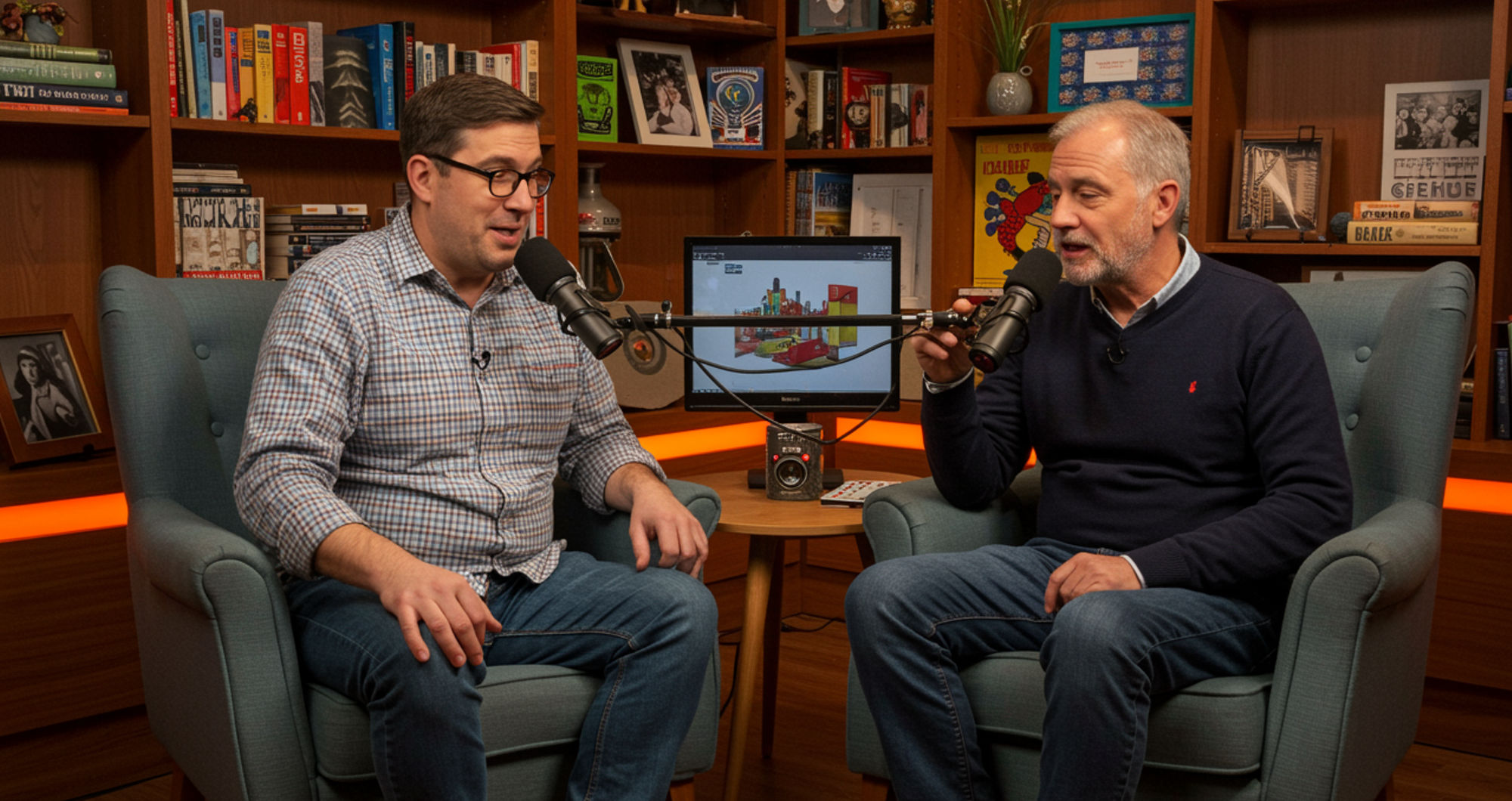

There was a time, not very long ago, when the path to a UK comedy commission was relatively well-mapped. A comic worked the club circuit for a few years, took a show to Edinburgh, hopefully picked up a Time Out review and a curious agent, and – if the stars aligned – got a development meeting with a broadcaster who might commission a pilot.
That route still exists. It is no longer the only one, and increasingly it isn’t even the main one. The comedy podcast, once treated by broadcasters as a promotional sideline, has quietly become one of the most reliable places British television looks when it wants to know what’s funny, what’s working and who can carry a room.
The numbers tell part of the story. Help I Sexted My Boss, the etiquette-meets-chaos podcast hosted by William Hanson and Jordan North, has clocked more than 100 million listens since launching in 2018, won the Listeners’ Choice prize at the British Podcast Awards, sold a Sunday Times bestseller and put 15,000 tickets on sale for its 2026 arena tour in three hours. Off Menu with Ed Gamble and James Acaster fills theatres in a fortnight. My Therapist Ghosted Me with Vogue Williams, and Joanne McNally regularly tops the UK comedy charts. None of these existed as TV shows when they launched. All of them now operate at a scale that broadcasters take seriously.
The development room nobody pays you to attend
Speak to comedy writers about what’s actually changed, and the same point comes up. Podcasts let you do, in public, the thing that used to happen invisibly in writers’ rooms or at late-night previews – work out whether something is funny by trying it on people.
Beth Granville, the comedy writer behind the BBC Radio Wales sitcom Foiled and a script consultant whose clients include Drag Race UK winner Divina De Campo, Hypothetical regular Josh Pugh and Torchwood‘s Tom Price, co-hosts a weekly podcast called Smashing Sundays with model and broadcaster Lucy Pinder. She’s described the show, in interviews, as a useful counterweight to the more controlled work of script editing – somewhere to keep the live-comedy reflexes sharp while the day job involves sitting alone with someone else’s draft.
That dual function – performance gym and writers’ room rolled into one – is what makes the podcast a uniquely efficient development tool. A weekly recording with even a modestly engaged audience generates more usable feedback than a year of pitching documents. Listeners tell you, instantly and at scale, which bits land. Producers and commissioners listen. Patterns emerge. By the time anyone formally pitches a TV version, the format has been stress-tested by tens of thousands of people for free.
Why broadcasters started paying attention
The shift in how UK broadcasters scout comedy has been driven less by enthusiasm than by maths. The traditional development pipeline is expensive, slow and prone to producing safe, formulaic ideas. A pilot episode for a half-hour sitcom can cost upwards of £150,000 to produce; the BBC’s recently announced search for a new comedy entertainment format for iPlayer and BBC Two earmarks £75,000 per episode for a ten-part series. In December 2025, BBC’s head of entertainment commissioning, Kalpna Patel-Knight, openly told the Content London conference that the corporation was looking for “format-first” ideas grounded in spontaneity rather than heavy scripting.
A successful podcast solves several of those problems at once. The format is already proven. The hosts have demonstrable chemistry, audience and tone. The production cost per minute is a fraction of what a scripted comedy demands. And, perhaps most importantly for nervous commissioners, there is a measurable audience already attached to whatever the TV version becomes.
The result has been a fairly abrupt rewriting of how risk gets allocated. In the old model, the broadcaster took the financial risk of developing an unknown idea. In the new one, the comedians take the creative and time risk of developing in public, often for years, and the broadcaster commissions only once the format has effectively de-risked itself.
What this looks like from the writer’s side
For comedians and comedy writers, the shift is genuinely double-edged. On the upside, the podcast has democratised access to the development process in a way that nothing in British comedy has done since the Edinburgh Fringe of the 1980s. You don’t need a representation deal, a development slot or a producer to make one. You need a microphone, a co-host with whom you have actual chemistry, and the discipline to keep showing up every week.
On the downside, “make a podcast” has quietly become an additional, unpaid prerequisite for a career that already had several. Writers and performers who would once have spent their development time in writers’ rooms or working on spec scripts now spend much of it producing free weekly content in the hope that an audience will accumulate. The lucky few build something the size of Sexted or Off Menu. Most build something modest, useful and unlikely to ever pay rent.
For working script editors and comedy writers – the people who tend to get pulled in once a podcast does start attracting commissioner interest – the change has been more straightforwardly positive. Adapting a podcast for television isn’t the same skill as writing a sitcom from scratch. It requires translating audio chemistry into visual storytelling, building structure into something that previously thrived on improvisation, and figuring out which elements of the podcast’s appeal are actually transferable. That work has become a significant and growing part of how UK comedy gets made.
A different kind of pipeline
It would be premature to declare the traditional comedy commissioning route dead. The Edinburgh Fringe still produces breakouts. Writers’ rooms still exist, even if they’ve shrunk. Spec scripts still occasionally land on the right desk at the right time. But for an entire generation of comedy talent now in their twenties and thirties, the dominant assumption is no longer that you write a pilot and hope. It’s that you build an audience, demonstrate a format, sustain a voice over hundreds of hours of public output, and let the broadcasters come to you.
That is, in many ways, a healthier system than the one it’s replacing. It rewards consistency over connections, and it gives audiences a direct say in what gets made. It also asks more of comedians than the old system ever did – more output, more weeks, more years, more of what is essentially unpaid R&D before the cheque ever arrives.
Whether that trade is worth it depends on who you ask. What’s no longer in dispute is that the podcast has stopped being a side project and started being the proving ground. Anyone trying to understand what British TV comedy looks like in five years’ time would do well to spend less time watching pilots and more time looking at what’s currently in the top fifty on Apple Podcasts.
That’s where the next sitcom is being written. It just hasn’t been called one yet.