
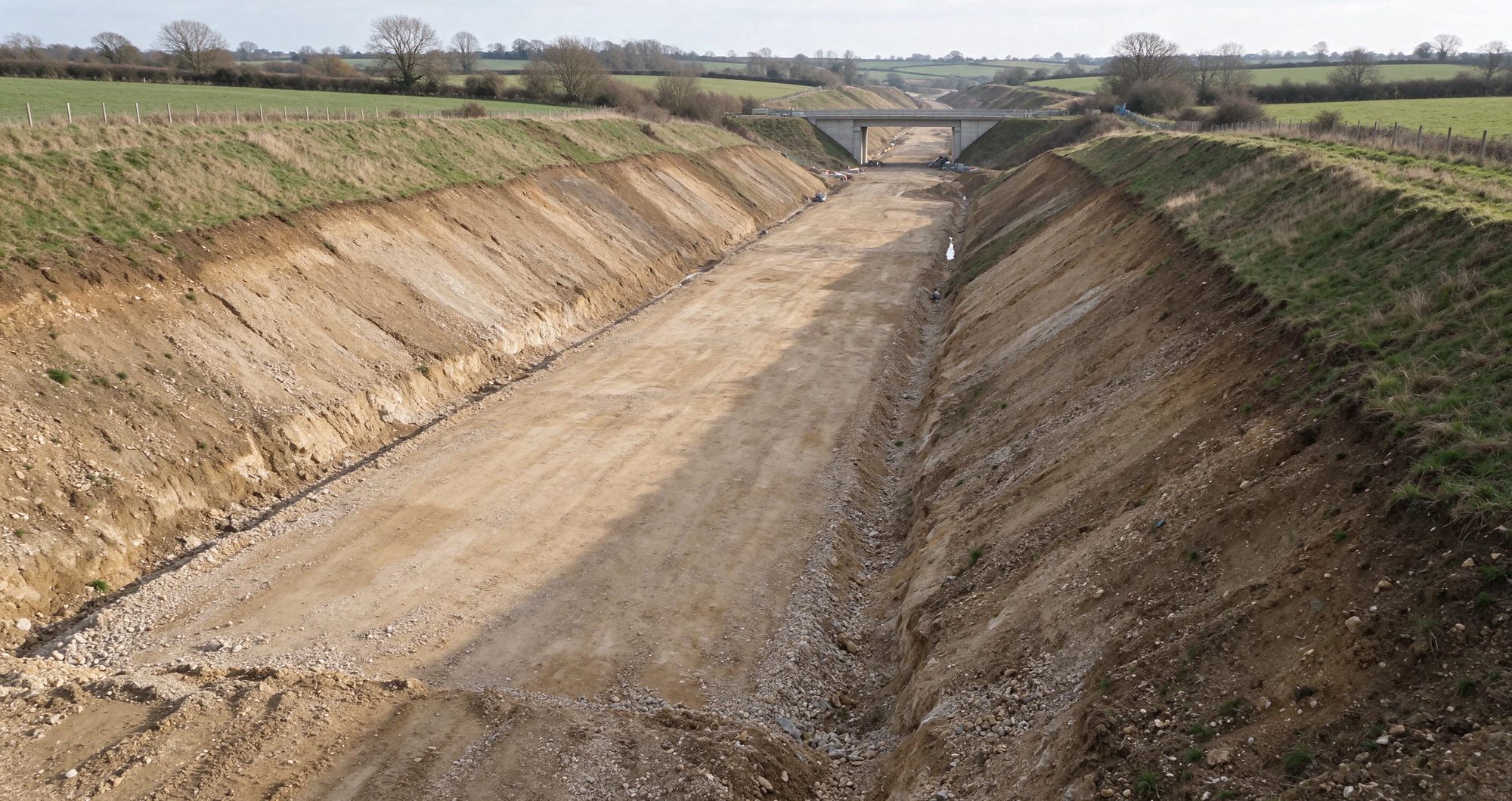

HS2 has completed the bulk excavation of a two-mile railway cutting in Buckinghamshire, preparing another section of the London to Birmingham route for drainage and track-bed construction.
The company announced the milestone on Friday, 27 November. The Calvert cutting is 2.1 miles, or 3.4 kilometres, long and is the second-longest cutting on the high-speed railway project.
Although the construction site is outside London, it forms part of the new railway linking the capital with the West Midlands. Completing the excavation does not mean the section is ready for trains: drainage, a stable foundation and track installation are still required.
Work began in 2022 under EKFB, the joint venture comprising Eiffage, Kier, Ferrovial Construction and BAM Nuttall. Specialist earthmoving contractor Kier Transportation helped excavate more than 1.6 million cubic metres of material, HS2 said.
The excavated earth and clay are being reused elsewhere on the project for embankments, noise barriers and landscaping, rather than being treated solely as material to remove from the site.
Bridges and roads shaped the work
The cutting runs from south of Calvert Green towards Twyford, passing the area around Steeple Claydon. It broadly follows the former Great Central Railway, which closed in the 1960s.
Unlike that older railway, which ran on an embankment, HS2’s route has been lowered into the landscape. The company said this would conceal high-speed trains as they pass the nearby villages.
The excavation involved four major road crossings and the East West Railway, with five major bridges, three drainage culverts and 12 major utility diversions. HS2 said the bridges had to be built before excavation could be completed.
The final bridge, carrying West Street over the cutting, opened earlier in November. Its completion allowed the remaining excavation work to proceed beneath the crossing.
EKFB project manager Gavin Llewellyn acknowledged that construction had caused disruption for people living nearby. He said the contractor was focused on reopening roads across Buckinghamshire as quickly as possible and had reopened 14 across the county.
Drainage and a future freight corridor
The southern half of the Calvert cutting is 56 metres wide, making room for two conventional railway tracks alongside the two high-speed tracks. Most other cuttings on the project are wide enough only for the high-speed pair.
HS2 said the additional space would allow Network Rail to reinstate the former freight line between Aylesbury and the FCC waste facility at Calvert, with a future connection to East West Rail.
That provision preserves a corridor for conventional rail use. It is not an announcement that the freight line has reopened or that trains are already running on it.
With the main excavation finished, workers will install drainage before adding a surface layer of aggregate to provide a stable foundation for the railway tracks. Llewellyn said teams would concentrate on preparing the track bed over the winter.
The next phase also requires specialist skills. HS2 said EKFB had worked with Bicester Skills Centre earlier this year to create 170 tailored training places for local people, supporting drainage construction across the contractor’s wider 80-kilometre section.
That wider programme includes around 200 kilometres of drainage, ranging from trackside ditches and culverts to balancing ponds. The training is intended to leave participants with skills they can use beyond the project.
HS2 said EKFB had moved 18 million cubic metres of material across its sites this year. Project director Bill Clowes credited the unusually dry summer, together with earlier planning and preparation, for helping teams make progress.
For London, the wider project’s stated purpose remains increasing rail capacity. HS2 says moving long-distance services onto dedicated tracks will free space on existing routes for local, regional and freight trains. The Calvert milestone advances construction towards that aim, while substantial work remains before services can begin.







