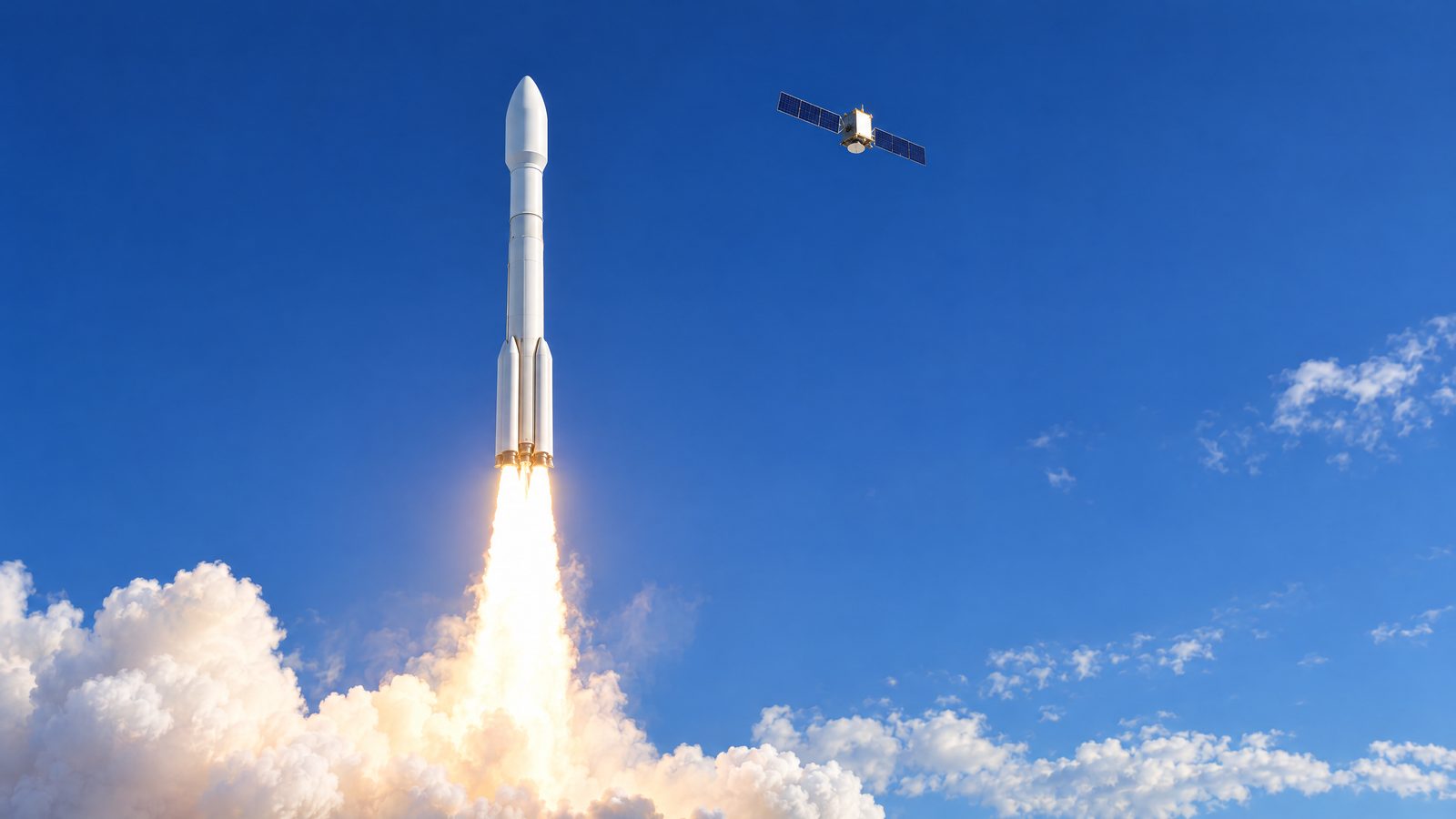

ISRO’s GSLV-F18 launched the NVS-03 navigation satellite from Sriharikota on 30 October 2026, placing it into its intended geosynchronous transfer orbit about 18 minutes after liftoff. ISRO described the launch as successfully executed, confirming the transfer-orbit placement as the mission’s reported outcome.
Liftoff took place at 23:51 IST from the Second Launch Pad at Satish Dhawan Space Centre, SHAR. The late-night launch carried the third satellite in ISRO’s next-generation navigation-satellite system, which the organisation identifies as intended to support continuity of IRNSS navigation services.
ISRO’s mission page confirms both the successful execution of the launch and NVS-03’s placement into geosynchronous transfer orbit. Technical remarks on the outcome were also attributed to ISRO chairman V. Narayanan. The reported result concerns the launch and the orbit reached by the satellite.
The timing places the reported orbital insertion around 18 minutes after the 23:51 IST departure. That interval describes the period from liftoff to the intended transfer orbit; it should not be read as a timetable for the satellite to begin contributing to navigation services.
Transfer-orbit placement confirmed
The central result is that GSLV-F18 placed NVS-03 into the orbit intended for this stage of the mission. ISRO’s description of a successful launch is therefore tied to a specific outcome: delivery into geosynchronous transfer orbit. It is not, by itself, a statement that every subsequent part of the satellite’s mission has been completed.
That distinction is important when describing the launch. “Transfer orbit” is the status confirmed for NVS-03, and the reported success should remain attached to that status. The satellite’s wider purpose concerns navigation-service continuity, but its placement into transfer orbit and its contribution to those services are separate matters.
The launch account does not establish that NVS-03 has begun providing navigation services. Nor does the reported 18-minute interval establish when it might do so. Any account of the satellite’s later status would need a separate confirmation rather than treating the successful orbital placement as evidence of an operational start.
For now, the settled outcome is the one ISRO has stated: GSLV-F18 successfully launched from the Second Launch Pad and placed NVS-03 into geosynchronous transfer orbit. That provides a clear description of what the launch achieved without extending the announcement to later stages that have not been established.
Continuity of navigation services
ISRO identifies NVS-03 as the third satellite in its next-generation navigation-satellite system. Its stated role is continuity of IRNSS navigation services. This gives the launch a defined significance beyond the orbital placement itself: the satellite belongs to a navigation programme whose stated purpose includes sustaining those services.
Being the third satellite identifies NVS-03’s place in that next-generation system. It does not establish how many satellites are currently delivering services, the condition of other spacecraft or the effect of this launch on service availability. Those questions are distinct from the confirmed facts about NVS-03’s launch and intended role.
The service-continuity purpose should likewise be distinguished from a claim of an immediate change for users. ISRO’s identification explains what NVS-03 is intended to support; the launch result establishes where GSLV-F18 placed it. Neither statement, alone, confirms a new service capability or a completed transition to operational navigation duties.
The mission therefore has a confirmed launch outcome and a stated navigation purpose. NVS-03 reached its intended transfer orbit following the Sriharikota liftoff, while its place in the next-generation system links it to continuity of IRNSS services. The confirmed milestone remains transfer-orbit placement, rather than the start of navigation operations.