

Jordan advances underground copper project with Manaseer agreement
Jordan has signed an executive agreement with Manaseer Group to develop a proposed underground copper project across about 78 square kilometres in the country’s south. The signing on 21 October moves the project into a further assessment and planning phase; it does not mean a mine is approved to operate or that the preliminary mineral estimates are confirmed reserves.
The project area includes Wadi Khaled, Wadi Al-Nuhas, Wadi Al-Jariya and Wadi Al-Mahash. Energy and Mineral Resources Minister Saleh Kharabsheh and group chairman Ziad Manaseer signed the agreement. The printed publication time on the official report was 15:20:38 on 21 October; no timezone was specified.
Preliminary geological findings put the quantity of copper ore at about 45 million metric tonnes, potentially containing 500,000 to 600,000 tonnes of copper metal. Those figures remain estimates. The company is required to carry out further technical and feasibility work to verify resources and reserves, assess how much material could be recovered economically and estimate the capital needed. The project’s investment value, production capacity and construction timetable have not been disclosed.
Studies and approvals still required
The agreement sets out work that must precede any mining operation, including technical, economic and environmental studies. Environmental impact assessment, licences and regulatory approvals remain outstanding. The signing therefore creates a framework for advancing the proposal rather than a final construction or operating decision.
The exploration work preceding the agreement followed a memorandum signed in June 2022 between the ministry and Jordanian Integrated Mining and Exploration Company, a Manaseer subsidiary. Reported work included geological surveys, exploratory drilling and trenching, and laboratory analysis of samples. Initial sample results indicated copper concentrations of about 1.36 per cent in the southern geological formation, with some samples above 3.5 per cent. Sample grades describe material tested; they do not by themselves establish the quantity or economic viability of a deposit.
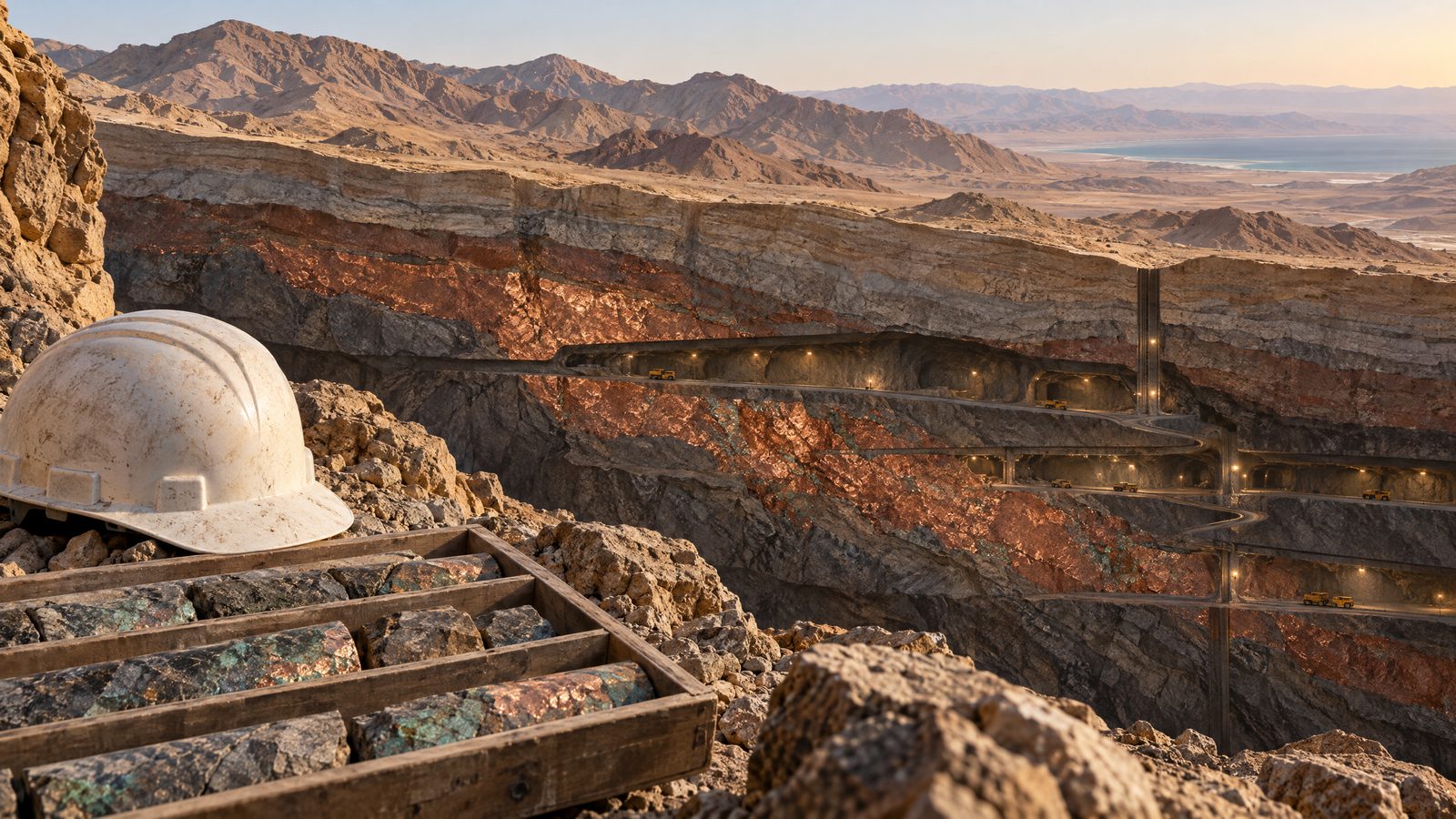
The planned method is underground extraction rather than an open pit. Under the stated approach, mining and ore-processing facilities and supporting infrastructure would be placed outside the designated area, with limited access points and tunnels to reach deposits below ground. Their locations and design still depend on technical studies and environmental review. The approach is intended to reduce effects on the landscape and ecosystems, but actual impacts cannot be assessed fully before project-specific studies and approvals.
Authorities have described coordination involving the energy and environment ministries, the Royal Society for the Conservation of Nature and other relevant agencies. That process is particularly significant because the agreement covers a defined southern landscape and environmental assessments have not yet been completed. A planned underground method and facilities outside the area are design commitments, not evidence that impacts have already been ruled out.
Local employment is a stated aim
The project is expected to offer employment, training and vocational development to nearby communities, with a target of about 90 per cent Jordanian workers. This is a stated target, not a confirmed workforce plan: no construction schedule, hiring numbers or production timetable has been announced.
The agreement is described as Jordan’s second executive agreement for copper development. It follows a separate agreement for the Abu Khushaibeh area of Wadi Araba, but the Manaseer project is a distinct proposal with its own study, environmental and approval requirements. For now, its significance lies in the move from exploration indicators to a structured development process. Whether the estimated material can be mined economically, and on what terms it could proceed, remains unresolved.







