
A major exhibition exploring Agatha Christie’s life and work has opened at a library in St Pancras, London, bringing together more than 200 archive and loaned objects. It opened on 30 October 2026 and runs until 20 June 2027, with five immersive sections covering her life, travels, writing and adaptations.
The displays include correspondence, family photographs, notebooks, typescripts, a typewriter, records and costumes. Together, these materials give the exhibition a scope beyond finished books, encompassing personal life, the practical materials of writing and the ways Christie’s work has been adapted. The mix of archive and borrowed objects brings several kinds of evidence into one exhibition.
Its five sections use country-house, pharmacy, rail-travel, archaeology and theatre settings. Rather than treating Christie’s career as a single subject, the exhibition separates it into distinct environments through which to explore her life and work. Those settings provide the framework for a display that combines written material with photographs and physical objects.
The country-house setting is one part of that structure, alongside environments associated with travel, archaeology, pharmacy and performance. The breadth of the arrangement matters: this is an exhibition about Christie as a person and a writer, as well as about adaptations. Its subject is not confined to the books alone.
Correspondence and family photographs form part of the material relating to her life. They sit within an exhibition whose stated scope includes both personal history and travel, allowing those subjects a place alongside writing. These are different forms of archive material from the notebooks and typescripts, broadening the kinds of objects through which Christie is presented.
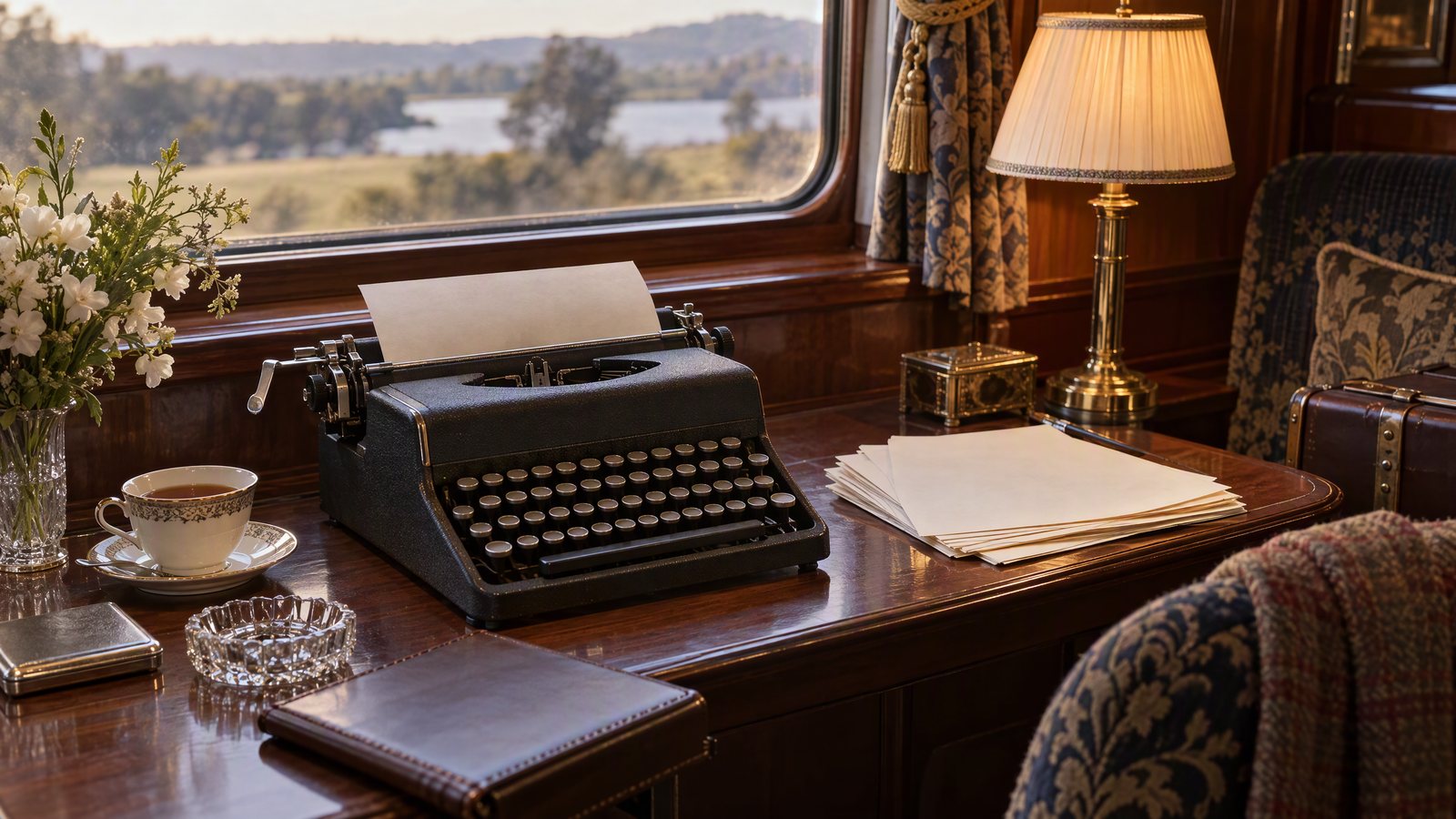
The writing materials are a substantial part of the selection. Notebooks, typescripts and a typewriter bring the physical apparatus of authorship into view. Their inclusion distinguishes an exhibition of objects from a simple account of published works: the focus extends to the pages and equipment associated with writing, rather than remaining solely with the resulting books.
There is a similar distinction between the written material and the costumes. The latter belong within the exhibition’s wider attention to adaptations, while the theatre setting gives performance its own place in the five-part layout. This expands the subject from Christie’s writing to its presentation in other forms, without making adaptations the exhibition’s only concern.
Travel also receives a defined place through the rail-travel setting. Archaeology is another of the five environments, alongside the pharmacy section. Taken together, these settings underline the range of subjects covered by the exhibition, moving between Christie’s life, her travels, the materials of her work and its adaptation.
The objects vary in both form and purpose. A family photograph, a notebook and a costume each offer a different kind of material to examine. Bringing them together enables the exhibition to address several strands of its subject, with personal images, writing materials and performance-related objects all included in the same overall display.
Organisers put the total at more than 200 objects, drawn from archives and loans. The selection includes both paper-based material and items such as the typewriter and costumes. That combination is central to the exhibition’s format: it places physical objects alongside correspondence and working pages across the five immersive sections.
The exhibition remains open at the St Pancras venue through 20 June 2027. Its central focus is the relationship between Christie’s life, travels, writing and adaptations, explored through the varied materials brought together for the display.