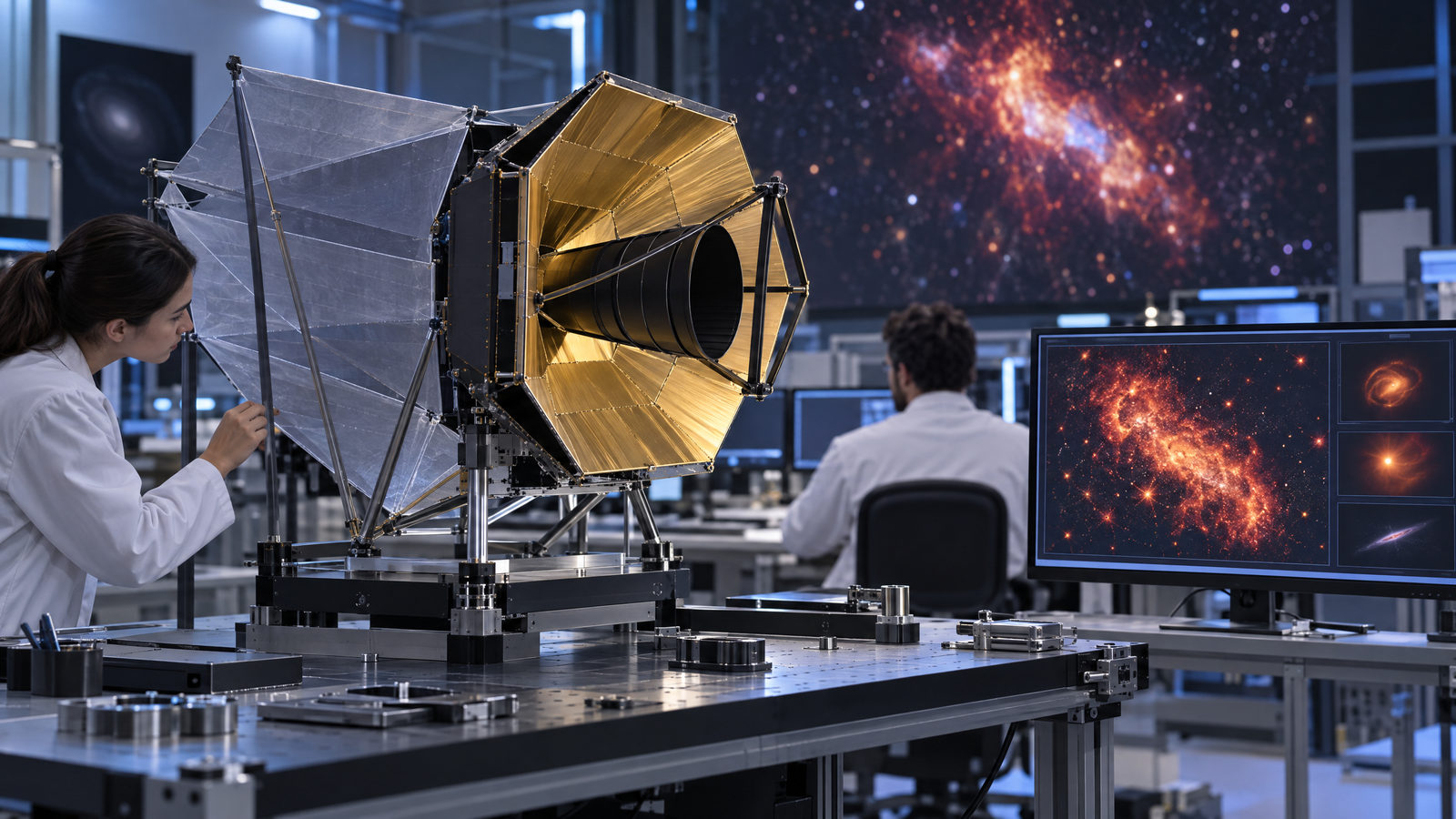

A new observatory intended to examine some of the universe’s coldest and dustiest regions has cleared an important early milestone. PRIMA, short for the PRobe far-Infrared Mission for Astrophysics, has been selected to move into the next stage of development as the first project in a new class of medium-scale astrophysics missions.
The decision does not mean that the telescope is built, funded in full, or ready for launch. It does, however, move the proposal into Phase B: the point at which preliminary design and key technology work are advanced in greater depth. A further confirmation review must still judge the programme’s technical readiness, schedule and cost performance before it can move to implementation.
That distinction matters. Space missions can take many years to pass from a scientific idea to an operational observatory. The new selection is therefore best understood as a commitment to develop a specific concept, rather than a guarantee of a final mission. If it clears the later review, the observatory is targeted for launch in 2033 and a planned five-year operating life.
Looking at a hidden part of the universe
PRIMA is being designed around a 1.8-metre telescope, or roughly 5.9 feet across, that will observe far-infrared light. That range is especially useful for studying material which can be difficult to investigate in visible light, including cool dust between stars and within distant galaxies.
Dust is not simply a visual obstruction for astronomers. It is part of the material from which stars and planetary systems form, and it carries clues about the elements that have accumulated through cosmic history. By making deep, sensitive surveys at far-infrared wavelengths, the planned observatory is intended to help scientists investigate how planets take shape, how galaxies and their central black holes grow, and how dust and heavy elements have built up across the universe.
The wavelength range also fills an observational space between existing infrared observatories and radio telescopes. Different telescopes are sensitive to different forms of light, so the value of a new mission is not simply that it would produce another view of familiar objects. It could allow researchers to compare observations across ranges that reveal different physical processes.
For planetary science, far-infrared measurements can help trace cold material in discs around young stars, where planets are forming. On much larger scales, the same capability can be used to examine the gas and dust associated with galaxy evolution. The mission is also intended to provide evidence about the history of water and the conditions that lead to the formation of planetary atmospheres.
A new mission class, not a flagship replacement
The project is the first selected for the new Probe Explorers class, which is intended to sit between smaller, more frequent scientific missions and the largest flagship observatories. The class was recommended by a major astronomy planning exercise, reflecting a desire for a steadier pipeline of ambitious projects without treating every scientific question as a flagship-scale undertaking.
If confirmed, PRIMA’s project cost would be capped at $1.2 billion. That figure does not include its launch or other non-project costs, and it is a cap rather than a prediction of the final amount spent. The pending review remains the point at which the project’s affordability and implementation case will be tested.
Britain has a direct, if not yet fully detailed, connection to the mission. The UK’s national space body is listed among the international contributors alongside partners in Europe, North America and Asia. The announcement does not set out the precise British hardware, funding or scientific role, so it would be premature to claim a particular UK contract or instrument contribution.
That international approach is significant in its own right. Large astronomy missions increasingly combine expertise in detectors, instruments, operations and data analysis from several countries. For researchers and engineers, the value is not only the telescope itself but the long scientific programme that follows once its data begin to reach Earth.
For now, the most concrete development is the choice to take PRIMA into detailed preparation. The next tests will be less visible than a launch countdown but just as consequential: turning a promising far-infrared concept into a mission that can meet its technical and financial requirements.