
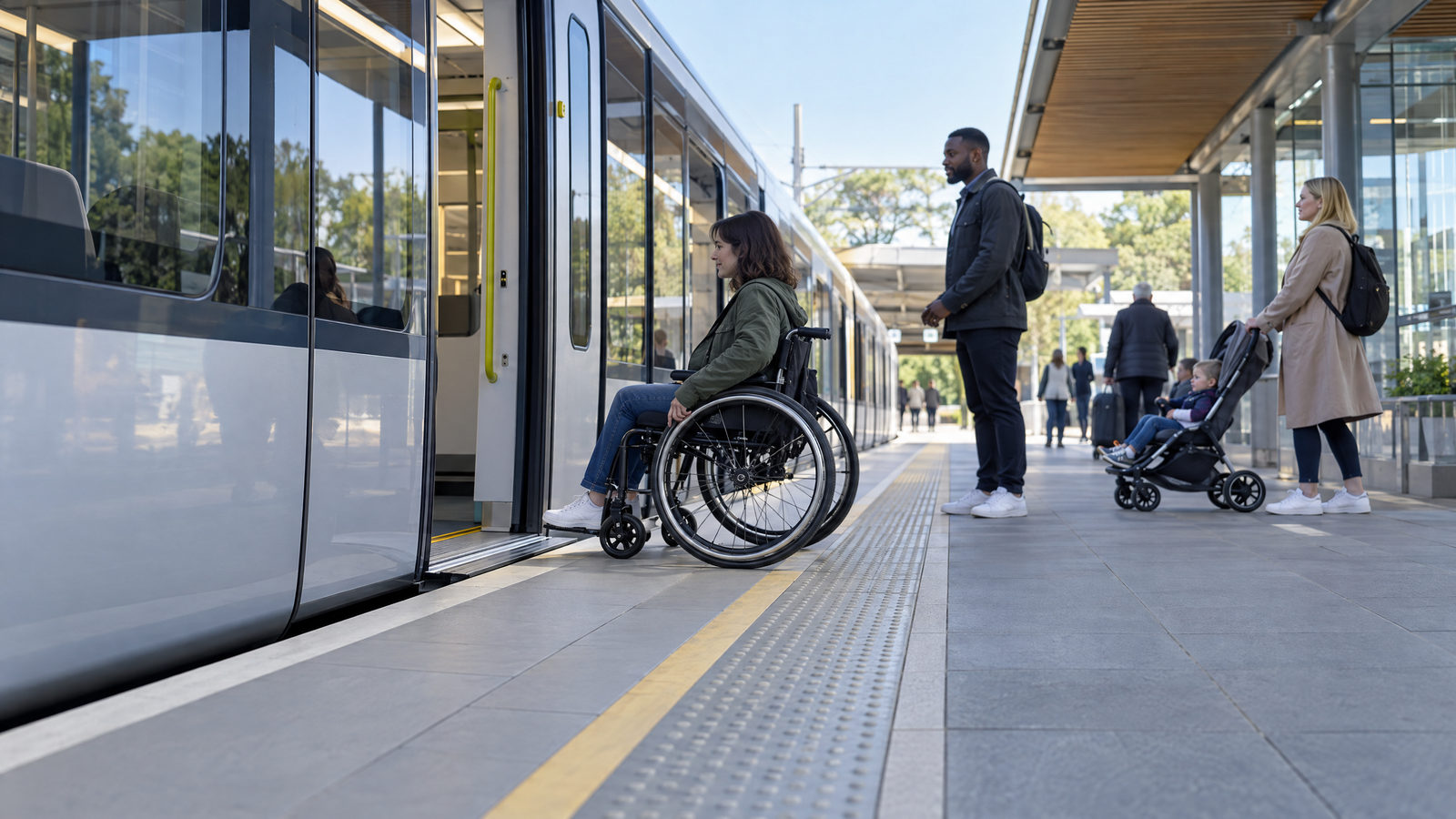

New Great British Railways trains are set to use unassisted level boarding as their baseline design wherever this is practicable, under a newly announced national rolling-stock strategy. The change is intended to make it easier for passengers to move between a train and platform without a ramp or staff assistance.
The policy is aimed at a familiar obstacle on Britain’s railways: the step and gap at the door. For wheelchair users and other disabled passengers, that interface can make an otherwise straightforward journey dependent on booked assistance. It can also be difficult for older people, parents travelling with pushchairs and people carrying heavy luggage. The strategy’s central aim is to make independent boarding more commonplace as fleets are replaced.
A baseline, not an instant network-wide change
There is an important limit to the commitment. It applies to new trains and is framed as a baseline expectation rather than a guarantee at every station. Platform heights vary across the network, and many platforms are curved, which can make one train design unsuitable for level access everywhere. Existing trains will not suddenly be converted, and the announcement does not mean every platform will immediately offer a step-free train-to-platform journey.
The strategy says the most practical route to faster progress is through future fleet replacement. New trains will normally be designed with low floors and doors aligned to the standard Network Rail platform height of 915mm. Where needed, deployable gap fillers or other bridging measures may be used. Exceptions can be made when operational or technical constraints make the approach impracticable or disproportionately expensive.
That distinction matters for passengers planning journeys today. Assistance, ramps and other arrangements remain part of the railway for many trips, particularly where the platform, track layout or existing rolling stock does not support level boarding. The policy sets a direction for procurement and design; it is not a timetable for an immediate change at a named station.
Why the platform still matters
Level boarding depends on more than the train door. The vehicle, platform height, track position and the space between train and platform all need to work together. A train can be designed for accessible entry but still need a ramp at locations where the infrastructure is not compatible. The strategy acknowledges this and says a network-wide study is under way with Network Rail to identify what would be required to achieve level boarding more widely.
That work is intended to inform future train specifications, alongside an Accessible Travel Charter and inclusive-design guidance developed with disabled travellers and accessibility panels. The long-term ambition is to reduce the occasions on which people with mobility impairments have to seek help from a member of staff across most of the network. It does not remove the need to address difficult or constrained stations individually.
Separate investment in stations
The new-train commitment sits alongside almost £280 million announced this year for the Access for All programme, with more than 30 schemes under way across England, Scotland and Wales. That programme concerns step-free access at stations, while the level-boarding policy concerns the point at which a passenger crosses from platform to train. Both parts are needed for a journey to be genuinely easier from start to finish.
For Londoners using national rail services, the announcement is relevant beyond a single operator or route. Many journeys begin or end at stations where a train-platform gap, rather than the concourse entrance alone, can determine whether a passenger can travel independently. Over time, common expectations for new trains could make that experience more consistent, but the pace will depend on replacement programmes and on work to make platforms compatible.
The practical test will be whether the commitment is carried through into future orders, station planning and passenger information. The strategy marks a clear shift in the design expectation for newly procured trains. Its success, however, will be measured by the journeys on which people no longer need to arrange help just to get through a train door.







