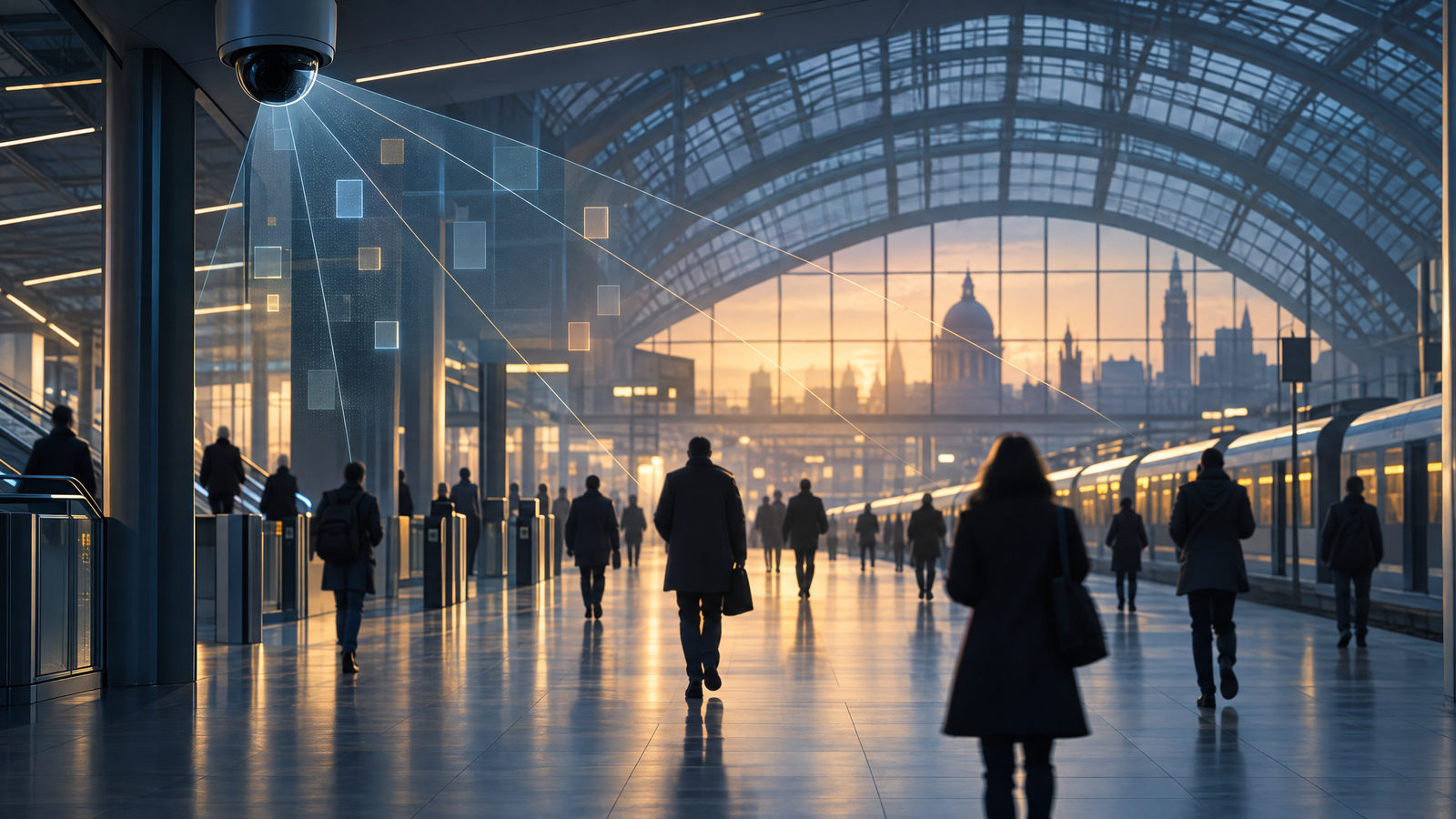

A six-month live facial-recognition trial at major London railway stations scanned more than 530,000 faces, cost £320,786 and produced one alert that proved to be an incorrect match. No arrest resulted directly from an alert during the February-to-July pilot.
The figures put a cost and an outcome against the British Transport Police’s first extended test of the technology on the rail network. Across 18 deployments, equipment hire and police staffing accounted for the reported bill, while officers spent almost 100 hours on the operations. The system was intended to flag people on a police watchlist, including people sought by police or courts and those subject to relevant court conditions.
One alert, then a human check
Live facial recognition compares images captured in a designated area with photographs on a watchlist. A computer-generated alert is a possible match, not proof that a person is wanted or has broken the law: an officer must compare the image with the person before deciding whether to approach them.
In the railway phase, that process produced one alert, which was found to be a false positive. There were no confirmed matches from the system and no arrests directly attributable to an alert. Separate arrests were made while deployments were taking place, including for assault, theft, possession of an offensive weapon and public-order offences, but those cases did not arise from an LFR alert and were excluded from the technology’s performance figures.
The distinction matters. A count of arrests made during a camera operation is not the same as arrests made because a system identified someone. Equally, one incorrect alert in more than half a million scans does not by itself establish how the system would perform with different locations, operating hours or watchlists. The available figures describe this trial, not a general accuracy rate.
Trial now includes Underground stations
The police pilot began on 11 February and was extended in August for a further four months, taking it to November. It now includes selected London Underground stations as well as railway hubs. The expansion is meant to test the system in a different transport setting and continue refining how deployments and watchlists are managed.
Since the extension, three further alerts have been confirmed, involving people who were subsequently found to be complying with sexual harm prevention orders or other court-imposed conditions. That description does not mean the people had breached those conditions, nor does it establish that the alerts led to arrests. The results should be read separately from the single false alert recorded in the first six months.
The scale of scanning also frames the privacy question. The system processes images of everyone passing through its camera zone, not only people suspected of wrongdoing. Under the published operating arrangements, people who are not on the authorised watchlist are not identified and their facial images and biometric data are deleted immediately. The Underground deployments are to be clearly signed, with alternative routes available for passengers who do not want to enter a recognition zone.
Assessment due after the pilot
The trial is intended to examine effectiveness, public-safety impact and public response. The final assessment will therefore need to explain not only alerts and arrests, but how locations and watchlists were chosen, what safeguards operated, and whether the results justify processing large numbers of passengers’ faces. Transport planners have also committed to assessing the trial’s impact on passengers, staff and stations, including perceptions of safety.
For now, the published record shows a costly first phase with one incorrect alert and no direct arrest, followed by an expanded trial whose early alerts involved people found to be complying with court conditions. The next substantive test will be the full evaluation due after the November end date, when the claimed policing benefit can be weighed against the scale of surveillance and its effect on people travelling through London.