
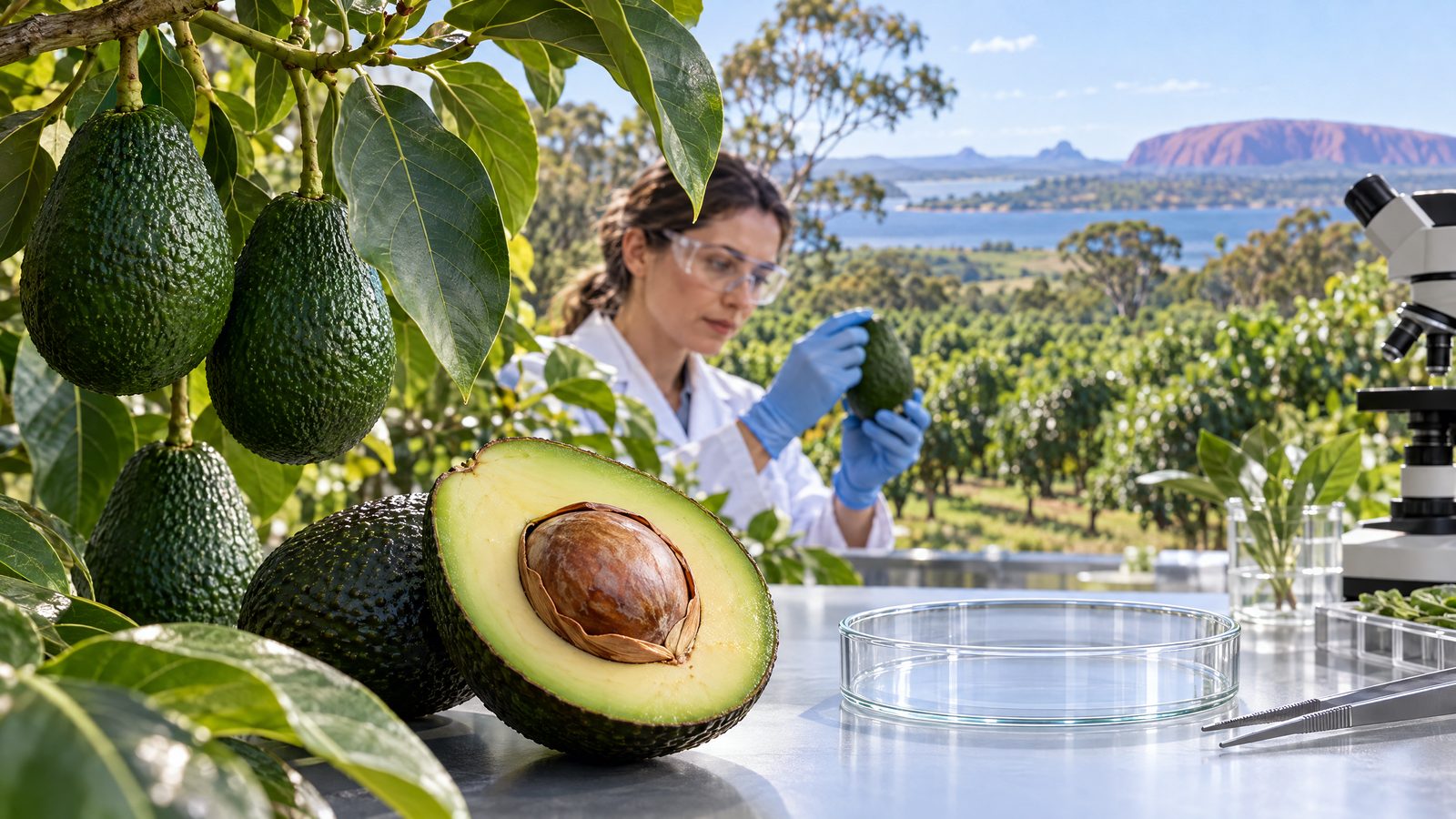

Researchers trace avocado fruit drop to changes in the seed coat
A five-year Australian study has identified a sequence of hormonal and developmental changes in avocado fruitlets that precedes immature fruit drop, a recurring source of lost yield for growers. The findings point to the seed coat—the tissue surrounding the seed—as an early site where the process begins, rather than establishing a ready-made treatment to prevent it.
The research found that fruitlets destined to detach first stop growing, then shrink before falling from the tree. Changes in gene activity appeared first in the seed coat and were later seen in the fruit flesh and embryo. The researchers linked this shift to reduced carbohydrate availability and changes in hormone activity, including lower auxin activity and increases in abscisic acid, an ethylene precursor and a bioactive jasmonate.
That pattern suggests the fruitlet’s development is redirected before the physical separation occurs. In the study’s proposed model, the seed coat enters a senescence programme, while the seed shows signs of a dormancy-like state. Together, these changes are associated with arrested growth and eventual detachment. The findings describe a biological pathway observed by the researchers; they do not mean every fruitlet drop has a single cause or that the pathway has already been turned into a reliable orchard intervention.
From growth arrest to detachment
Measurements of developing fruitlets showed that those which later abscised had a period of growth arrest before shrinking. In one monitored trial, the slowdown and cessation of growth took about six days, followed by a further four to six days before the fruitlet detached. Across that trial, trees dropped an average 47.4 per cent of fruitlets by its end. That figure is a result from the study conditions, not a national estimate for all orchards or seasons.
The project examined fruitlets in Queensland orchards, and its wider programme also involved field trials in South Australia’s Riverland, south-west Western Australia and central Queensland. Those locations matter because fruit drop is affected by growing conditions, while orchards and seasons differ. The research release describes immature fruit abscission as an important contributor to variable yields, but the study does not claim that its observations settle every environmental or management influence on crop outcomes.
Avocado trees naturally shed fruitlets, and the problem under investigation is the scale of immature drop and its impact on the crop that reaches harvest. The work adds detail to how the process unfolds inside the fruit. By locating early signalling in the seed coat, it gives future research a more specific biological target than simply observing that small fruit have fallen.
Potential management tools remain to be tested
The study was led by CSIRO with support from Hort Innovation. Its published results are now being used in a second phase that is investigating plant growth regulators with potential to reduce fruitlet drop. Identifying candidates is an early research step: it is not proof that a regulator is safe, effective, economical or suitable for commercial use across different varieties, orchards and conditions.
That distinction is important for growers facing seasonal uncertainty. A treatment would need to be tested for its effect on retention and final marketable yield, as well as timing, dose and possible effects on tree growth or fruit quality. The current findings explain a potential trigger and point towards experiments; they do not yet offer growers a validated prescription.
Australian avocado production exceeds 130,000 tonnes a year and is valued at about A$800 million, according to the project’s release. For an industry of that scale, more stable yields could have practical value, but the size of any eventual benefit will depend on whether the next stage produces management approaches that work in commercial orchards. The five-year study therefore marks a shift from investigating why immature fruitlets are lost towards testing whether that knowledge can inform a response.







