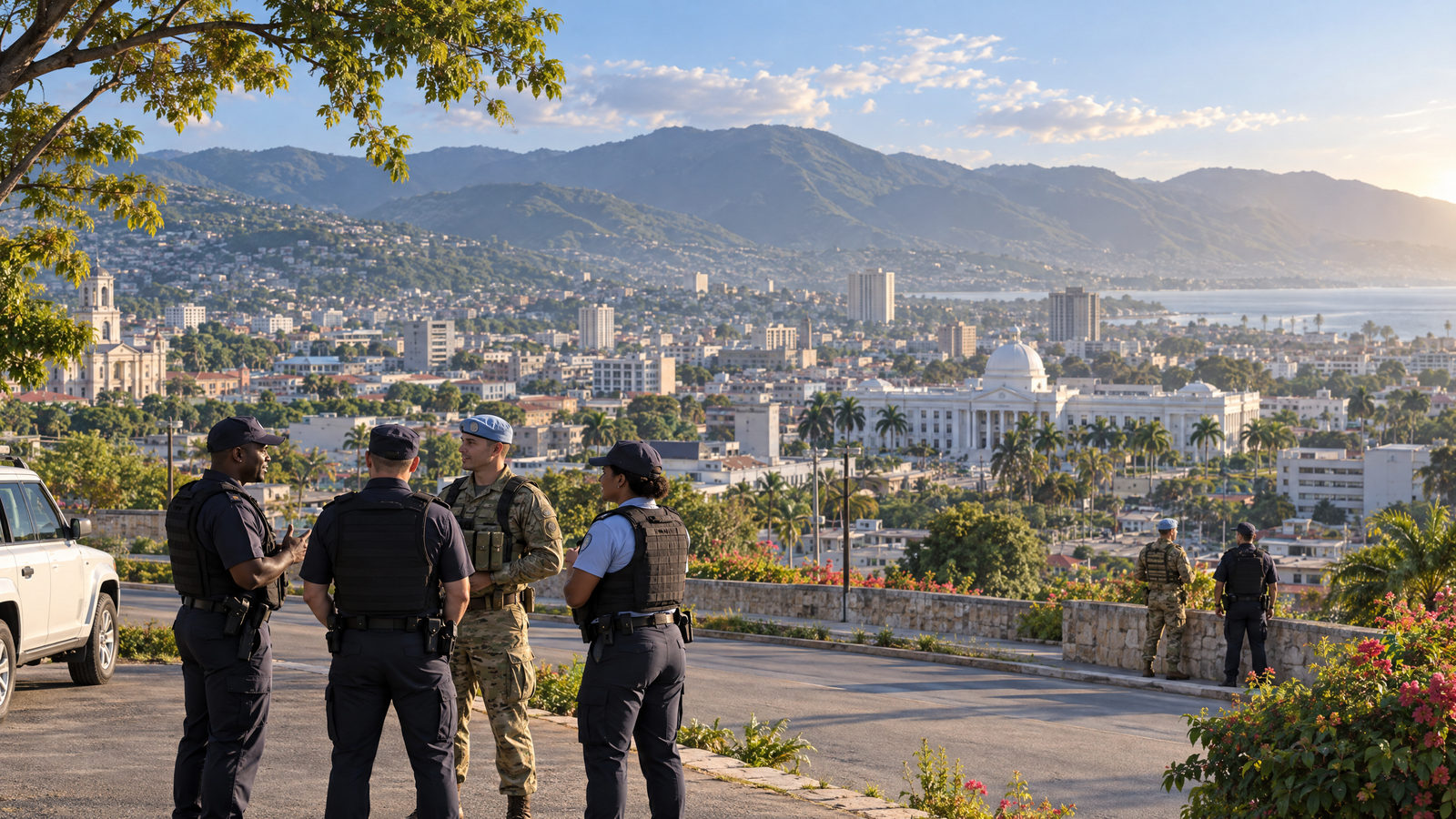

The Security Council has renewed the mandate of Haiti’s Gang Suppression Force through 31 March 2027, giving the multinational operation a further six months to deploy and operate. Resolution 2829 was adopted on 29 September by 12 votes to none, with China, Pakistan and Russia abstaining. The force had otherwise been due to reach the end of its authorisation on 30 September.
The immediate effect is continuity rather than an automatic increase in personnel. The decision keeps the legal framework in place while participating countries, Haiti and the United Nations Support Office in Haiti address the practical work of deployment, equipment, funding and coordination. The Support Office’s logistical and operational backing also continues under the renewed arrangement.
What the renewal does — and does not — change
The Gang Suppression Force is a Security Council-authorised multinational operation, rather than a conventional United Nations peacekeeping mission. It succeeded the earlier Kenya-led Multinational Security Support mission and has a counter-gang role that can involve working with the Haitian National Police and armed forces, or operating independently within its mandate.
The new resolution is best understood as a short extension of that existing framework, not a new force or a wholesale rewrite of its tasks. It allows the Council to retain an operational instrument while deployment remains incomplete, and to review progress again at the end of March. The resolution also keeps regular reporting on benchmarks for Haitian security capacity and border management in view.
A mandate is not the same as a full deployment
The central constraint is capacity. An earlier United Nations assessment put the force’s military component at 1,083 personnel on 8 July, alongside 16 civilian staff, far below its authorised ceiling of 5,550 personnel. At the Council meeting, the United States representative said about 1,500 personnel were then operating in Haiti and that more were expected in the coming months. Those figures were reported at different points and should not be read as a single real-time census, but they illustrate the gap between authorisation and full operational strength.
That gap matters because the political goal attached to the force is broader than conducting individual operations. Haiti’s representative told the Council that the intended objective was to help the state regain control of areas held by armed criminal groups, secure critical infrastructure, restore public authority and create the security conditions needed for constitutional order and elections. He also argued that recovered areas would need to be held and public services restored, rather than merely cleared.
In practical terms, the next six months will test whether additional personnel, transport, communications, intelligence-sharing and support arrangements arrive quickly enough for the force to work alongside Haitian institutions at a wider scale. A renewed mandate permits that effort; it does not guarantee that countries will supply the people, equipment or sustained financing required.
Security, state authority and elections
The Council discussion repeatedly linked security to Haiti’s political timetable. The force is intended to support conditions in which citizens can travel, public institutions can function and an electoral process can take place more safely. But delegates also stressed that a security deployment cannot substitute for Haitian-led governance, policing, justice and basic services. The stated aim is to reinforce national institutions, not replace them.
This distinction is important. A deployment that produces short-term access to a road or neighbourhood but is not followed by police, local administration and services may not deliver durable control. Conversely, an election timetable is not by itself evidence that safe, inclusive conditions exist. The Council’s renewal keeps the security component available while recognising that the wider response must be political, institutional and humanitarian as well as operational.
Why the vote still carried a warning
The three abstentions did not prevent adoption, but they showed that support for renewal was qualified. China’s and Russia’s representatives questioned whether an externally deployed force could address a crisis rooted in governance and economic conditions; Pakistan’s representative called for a nationally owned, holistic response and sustained funding. Other members backed the extension while pressing for a quicker deployment and stronger accountability.
Resolution 2829 reiterates that the force must operate in compliance with applicable international law, including international human rights law, and highlights standards of transparency, conduct and discipline for participating contingents. It also refers to reintegration, psychosocial support and education for children formerly associated with gangs. These are not peripheral details: they set conditions for how a security response is expected to be pursued.
By March, the useful measure of this renewal will not simply be that the force remains authorised. It will be whether the deployment gap has narrowed, Haitian institutions have gained practical capacity and the security conditions for a credible electoral process have improved. The Council has bought time; the result will depend on what is done with it.