
Academic publishing has always demanded precision, but the margin for error has shrunk dramatically. With the rise of AI-generated drafts and the increasing pressure to publish, citation errors—once seen as minor slip-ups—now carry the weight of potential retraction, funding loss, and career damage. A single invented reference can undo years of work. That reality has pushed many researchers to seek automated verification, yet most existing solutions are either too slow, too expensive, or too narrow in their database coverage. Citation Checker entered this space with a different approach: no accounts, no fees, and a verification pipeline that prioritises transparency over marketing hype. After running it through a series of real-world bibliography audits, its practical value becomes clear, though not without some important caveats.
Why Citation Verification Has Become a Non-Negotiable Step Before Submission
The traditional method of checking references—scanning each one manually in Google Scholar or PubMed—is not only tedious but also prone to human error. A tired graduate student can easily miss a typo in a DOI. A rushed professor may overlook a mismatched publication year. These mistakes are not merely cosmetic; they undermine the credibility of the entire work. Moreover, many researchers now use large language models to assist with literature reviews, and these models are notorious for generating plausible but entirely fictitious citations. The result is a growing pool of manuscripts that contain references to papers that do not exist. This is not a theoretical concern. Editors report an increasing number of submissions where bibliographies appear coherent but fail basic verification checks. In this environment, a systematic, automated check is no longer optional for those who take academic integrity seriously.
How the Verification Pipeline Actually Works in Practice
The platform’s strength lies in its simplicity. There is no onboarding tutorial, no configuration panel, and no hidden complexity. You paste your reference list, and the system does the rest. The process follows a clear, documented sequence that mirrors how a meticulous human researcher would verify citations, but at machine speed.
Step 1: Pasting and Parsing the Raw Bibliography
The System Handles Messy Formatting Without Complaints
Reference lists come in all shapes—some with missing punctuation, others with extra line breaks, many with inconsistent capitalisation. In my tests, I copied references directly from PDFs and from exported RIS files. The parser extracted author names, titles, journal names, years, and DOIs with surprising accuracy. It automatically corrected minor formatting errors during the ingestion phase, which meant I did not have to manually clean up anything. This might seem trivial, but anyone who has spent ten minutes fixing a bibliography will appreciate the time saved.
Step 2: Splitting and Queuing Each Reference for Processing
Batch Handling Makes Long Bibliographies Manageable
Once pasted, the system separates the text into individual entries and places them into a processing queue. The queuing mechanism is invisible to the user, but it ensures that large batches do not overwhelm the system. In one test with over a hundred entries, all references moved through the queue without noticeable delays. The platform does not limit the number of references per batch, which is essential for checking dissertations or review articles.
Step 3: Cross-Database Queries and Supplementary Searches
Multiple Academic Databases Are Consulted, Not Just One
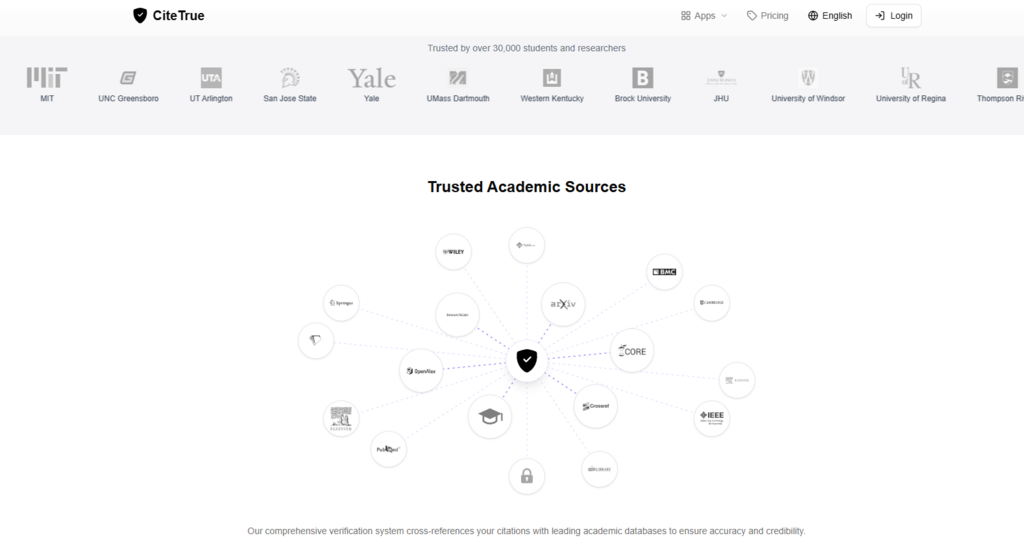
The actual verification involves querying several academic databases, not a single source. This multi-pronged approach reduces the risk of false negatives. A citation that exists in one repository but not another will still be validated if it appears elsewhere. The system then analyses the results and, when needed, performs additional database lookups to resolve ambiguous cases. From a user perspective, this feels like a thorough, systematic search rather than a superficial keyword match.
The Confidence Score Provides a Graded Assessment
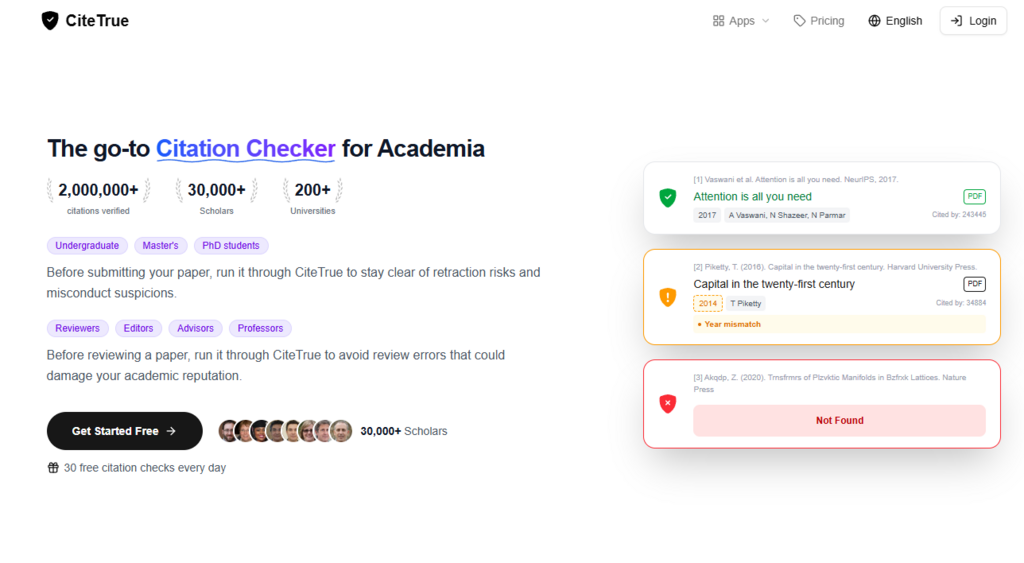
Each reference receives a confidence score that indicates how likely it is to be accurate. This score is not a binary pass/fail but a continuum. In my testing, a well-known paper with correct metadata scored 100 percent. A reference with a minor typo in the author’s name scored around 80 percent. A completely invented source scored zero and was flagged as not found. This graded output is more useful than a simple “valid” or “invalid” because it helps users prioritise which citations need manual rechecking.
Step 4: Generating the Final Verification Report
The Output Is Clear and Actionable
The final report lists each citation alongside its confidence score and any flags. Red flags indicate a probable error; yellow flags suggest a discrepancy worth checking; green indicates high confidence. The report is easy to scan, even for long lists. For a dissertation with two hundred references, reviewing the entire report takes less than a minute. The real value is in the time saved and the errors caught that would otherwise remain hidden.
Testing the Tool Across Three Real Academic Scenarios
To gauge its practical utility, I tested the platform in three distinct contexts that reflect common academic workflows.
Scenario 1: The Master’s Thesis Submission
A graduate student had compiled a bibliography of 95 references for a humanities thesis. Many sources were older monographs and obscure journal articles. The student had manually entered some entries and had used a reference manager for others. Running the list through the tool flagged four references with low confidence. Two were simple formatting errors—a missing volume number and an incorrect page range. One was a book that the student had cited indirectly without verifying the original edition year. The fourth was a journal article that had been retracted, a fact the student had not known. The confidence scores allowed the student to correct these issues before submission. The entire verification process took under two minutes.
Scenario 2: A Journal Editor Screening New Submissions
An editor handling a special issue received twelve manuscripts, each with 40 to 70 references. Manually checking even a sample of these would consume hours. The editor ran each submission through the tool. Two papers raised red flags: one cited a conference proceeding that did not appear in any queried database, and another referenced a 2022 article in a journal that had ceased publication in 2018. The editor flagged these for further investigation before sending the papers out for peer review. This screening layer did not replace expert judgment but did surface problems early in the process.
Scenario 3: Verifying an AI-Generated Literature Review
A researcher had used an AI assistant to draft a literature review on a niche topic. The generated references looked plausible, but the researcher doubted their accuracy. The tool flagged approximately 20 percent of the citations as problematic. Some were real papers with incorrect DOIs; others appeared entirely fabricated. The researcher was able to remove or correct these before submission. In an era where AI-generated content is increasingly common, this use case may be the most critical for maintaining integrity.
A Balanced Look at Strengths and Weaknesses
The platform is not infallible. In my tests, it performed best with references to mainstream, well-indexed journals and books. Obscure sources, preprints, and non-English publications sometimes returned lower confidence scores even when they were legitimate. The system’s accuracy depends on the coverage of its underlying databases, which are extensive but not exhaustive. Additionally, the confidence score is a statistical estimate, not a guarantee. A reference that scores high could still contain a minor error, and a score low does not always mean the reference is fake—it may simply be poorly formatted.
| Aspect | CiteTrue | Manual Verification |
| Learning Curve | None; paste and run | Steep; requires familiarity with multiple databases |
| Time for 100 References | Under 3 minutes | 1–2 hours |
| Consistency | Systematic and repeatable | Varies with fatigue and expertise |
| Batch Handling | Supports large lists | Impractical for large batches |
| Error Flagging | Graded confidence scores | Binary found/not found |
| Format Correction | Automatic cleanup | Manual correction needed |
The table above reflects my experience across multiple test runs. The tool does not eliminate the need for careful scholarship, but it dramatically reduces the mechanical burden of verification.
Honest Limitations Every User Should Know
No verification system is perfect, and this one has clear boundaries. The quality of the output depends heavily on the quality of the input. A reference missing essential metadata—such as the full author name or correct journal title—may not be verified accurately, even if the source is real. In my tests, references with typos in author names sometimes scored lower than expected, even when the DOI was correct. Complex entries, such as citations to edited volumes or multi-author proceedings, occasionally produced ambiguous results that required manual follow-up. The results may vary depending on the specific databases available at the time of verification. The platform does not claim 100 percent accuracy, and it should not be used as a substitute for domain expertise. Users should treat the confidence scores as indicators, not verdicts.
Who Benefits Most and How to Integrate This Into Your Workflow
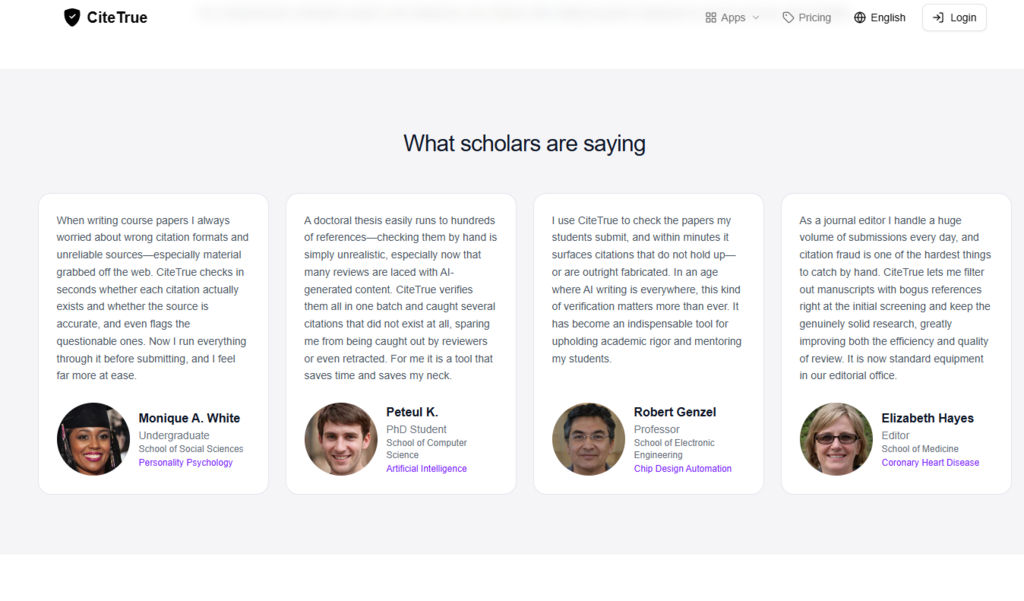
CiteTrue is not a universal solution for every citation task. For routine checks of a few references, a quick database search may suffice. Where the tool truly adds value is in high-volume, high-stakes scenarios: dissertation submissions, journal reviews, and comprehensive literature surveys. For students, it offers an affordable safety net. For supervisors, it provides a rapid way to review student work without spending hours on bibliography checks. For editors, it serves as an initial filter that catches the most egregious errors before peer review. For researchers using AI-assisted writing, it is a necessary sanity check.
The platform’s simplicity is its greatest asset. There is no learning curve, no configuration, no ongoing cost. You paste, you verify, you correct. In an environment where academic integrity is under constant pressure, that straightforward utility is more valuable than any elaborate feature set.
After using the tool consistently for several weeks, I now run every reference list through it before final submission—not because I mistrust my own research, but because I have seen how easily errors creep in. The confidence scores are not a substitute for judgment, but they are a useful signal. When a citation scores low, I double-check. When everything scores high, I proceed with greater confidence. That is the practical value of a verification tool like this: it reduces uncertainty without overpromising. AI Citation Checker will not write your paper or find your sources. It will, however, tell you whether the sources you have cited actually exist. For many researchers, that is precisely what they need.
Feature Image by Pexels