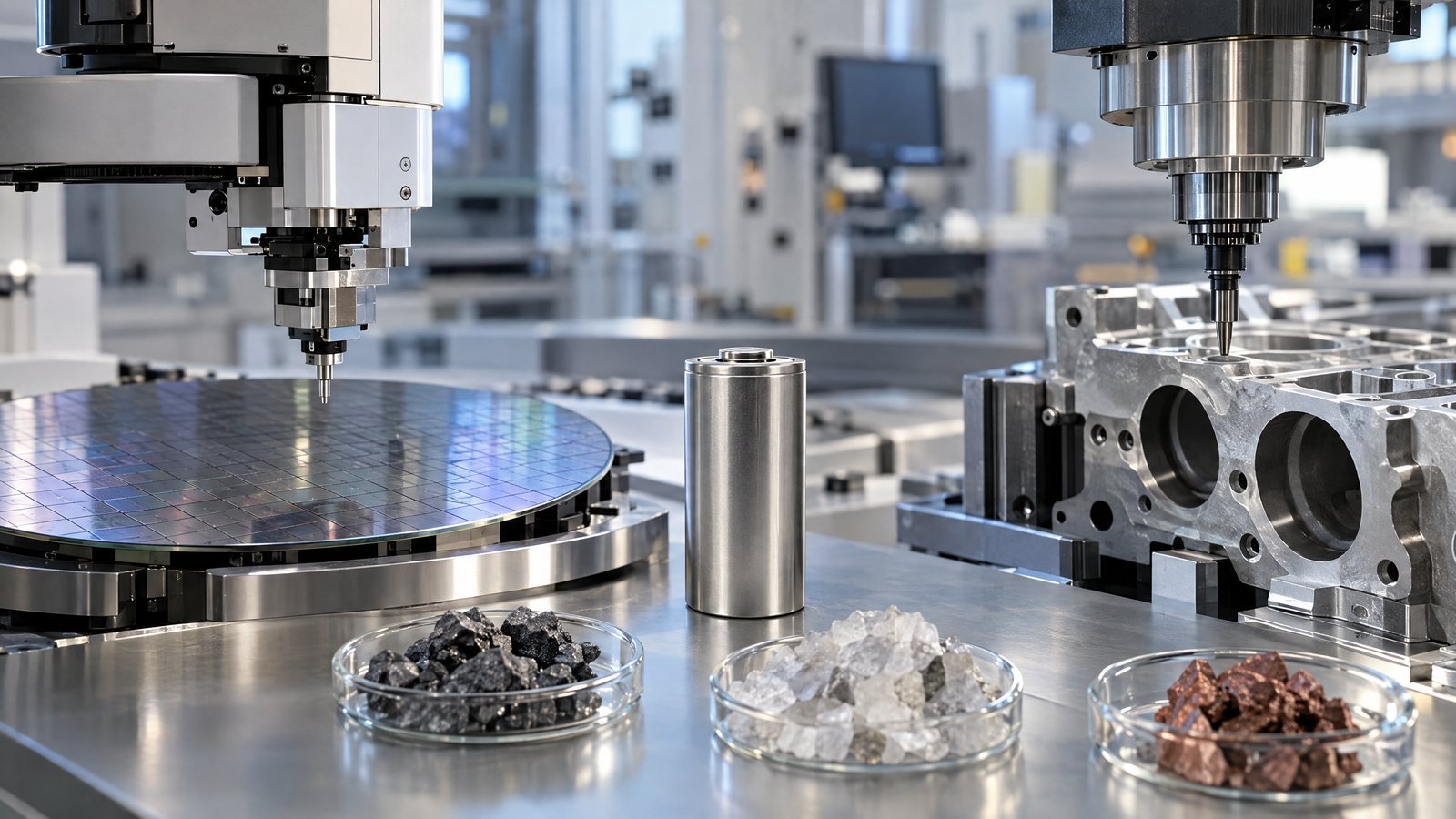

South Korea and Germany have signed a joint declaration of intent establishing a framework for economic and high-tech cooperation. The agreement brings critical minerals, semiconductor ecosystems, industrial artificial intelligence, batteries and technology protection into a partnership between the two countries.
Signed in Seoul by the South Korean trade ministry and the German economic ministry, the declaration sets out areas for cooperation rather than completed commercial projects. Its scope covers both the supply of materials and the technologies used in advanced manufacturing, with information sharing among the proposed activities.
The framework sits within a wider upgrade of bilateral relations to an Enhanced Strategic Partnership. Alongside the economic declaration, the governments have recorded plans for a semiconductor ecosystem partnership and a joint AI working group focused on transparency. Those initiatives remain planned work, not evidence of systems or facilities already in operation.
Critical minerals and technology protection
Critical-mineral supply chains are a central part of the framework. The intended cooperation includes sharing information and developing early-warning arrangements. These are provisions for cooperation on supply-chain information; the signing does not itself establish that an early-warning system has been implemented or that any supply has been secured.
The minerals agenda also covers refining, smelting and recycling, as well as resource development in third countries. This gives the framework a scope beyond information exchange, extending to several stages of mineral processing and resource activity. No completed development project follows from the declaration alone.
Protection of critical technologies is another named priority. It appears alongside cooperation in semiconductors, mobility, batteries and manufacturing AI, placing technology protection within the same economic framework as industrial collaboration. The declaration identifies that field for joint work without establishing a completed protection programme or a new legal outcome.
The distinction between an agreed framework and its execution is important across all these areas. The two sides have signed an expression of intent and defined subjects for cooperation. That is a government-level step, but it should not be read as confirmation that the industrial activities covered by it have already taken place.
Semiconductors, batteries and industrial AI
Semiconductor cooperation features both in the high-tech framework and in the planned ecosystem partnership. The latter is a stated direction for future bilateral work. It is not, on the available evidence, a financed project, a completed manufacturing investment or a commitment to a particular facility.
Batteries and mobility are also included in the cooperation agenda, together with AI for manufacturing. Their inclusion identifies areas in which the two countries intend to work together. It does not demonstrate that a battery venture, mobility programme or industrial AI deployment has been delivered under the new arrangement.
The planned joint AI working group has a specific focus on transparency. That planned group and the manufacturing AI cooperation are separate elements of the wider agenda: one concerns transparency, while the other places AI within industrial cooperation. Neither should be presented as an already completed initiative.
Commercial agreements remain a separate step
Nine memoranda of understanding between companies and institutions were also signed in Seoul. These sit alongside the government framework, but their signing is not evidence that nine funded projects are under way. Their terms and execution would need to be published before they could be described as financed commercial activity.
The immediate development is therefore the establishment of a cooperation framework and the wider strengthening of bilateral ties. Its priorities are clear, from critical-mineral supply chains to semiconductor ecosystems and AI transparency. The practical outcomes remain distinct from the intentions now agreed by the two sides.