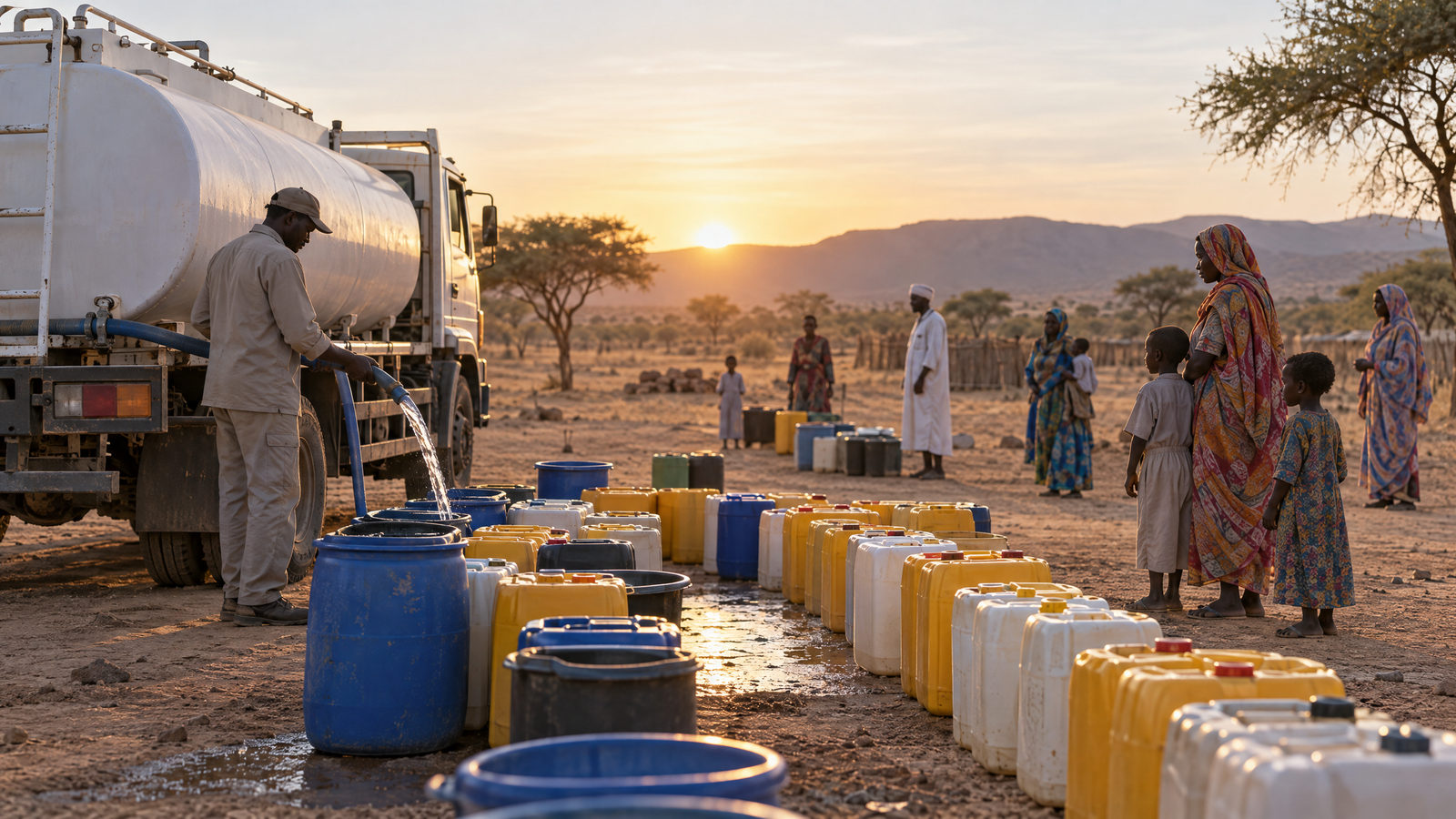

Water deliveries to displaced people in two Sudanese locations could contract as fuel costs rise and humanitarian funding remains short, according to a new warning issued on 29 September. The immediate concern is not a confirmed stoppage of supplies. It is that a service on which large displaced populations rely may become harder to sustain just as conflict and insecurity continue to disrupt civilian life.
In El Obeid, the warning says water trucking at the Mina Al Bari displacement site is at risk because of higher fuel prices and funding shortages. The site is said to host more than 9,000 families. In Tawila, North Darfur, the warning says deliveries are expected to decline sharply in the coming months unless additional funds are received.
The Tawila figures underline the scale of what is at stake. The town is currently said to be hosting 625,000 displaced people. Water trucks are reported to provide up to 2,500 cubic metres each day for 150,000 people. That does not mean every displaced resident receives trucked water, nor does it establish how much any individual receives. But it shows that any reduction could affect a substantial number of people who are already living away from home.
A warning, not a confirmed stoppage
The language of the update matters. It says the El Obeid operation is at risk, while Tawila deliveries are expected to fall if more funding is not secured. Neither statement confirms that trucks have stopped running or gives a date on which a reduction would begin. Both are conditional warnings about the ability to maintain a service whose cost is exposed to fuel prices.
At the stated maximum Tawila volume, 2,500 cubic metres is equivalent to about 17 litres per person per day if it were divided evenly among the 150,000 people named in the warning. That is an illustrative calculation from the reported total, rather than evidence that every person receives that amount. In practice, deliveries, household size, storage and access can all affect what reaches an individual family.
Funding gap extends beyond trucks
The water warning sits inside a much wider shortage. The 2026 humanitarian response plan is seeking $2.9 billion to reach more than 20 million people. The latest update says $1.2 billion has been received, leaving the plan less than 43 per cent funded. Separate funding data dated 29 September puts water, sanitation and hygiene coverage at 22.6 per cent: $85 million recorded against $375.9 million in requirements.
Those plan-wide figures do not specify the budget of either trucking operation, and they cannot by themselves show whether a particular route will be preserved. They do, however, provide context for the warning: essential water services are competing for resources within a response that still has a large unmet requirement. A shortfall in one part of the response can also make it harder for agencies to shift money quickly when fuel, access or needs change.
Security pressure in El Obeid
There is also a security dimension. The 29 September update said drone attacks had been reported in El Obeid for a second consecutive day. It reported that at least one civilian had been killed and that a university and a sports stadium had been damaged. Those are reported accounts from the update, not an assessment of responsibility for the attacks.
The warning does not say that the reported attacks directly caused the water-trucking risk. Its stated reasons are rising fuel prices and funding shortages. Still, violence and damage to civilian infrastructure are a material backdrop for a service that depends on vehicles, fuel, staff and safe access. The distinction is important: the immediate operational concern is financial, while the wider environment remains insecure.
What happens next
The near-term question is whether additional funding can arrive before planned deliveries are reduced. For Mina Al Bari, the update identifies the pressure but does not set out a public contingency timetable. For Tawila, it warns of a sharp decline in coming months rather than announcing a reduction already under way.
For displaced families, the issue is unusually concrete. Water trucking is not a long-term policy target or a proposed capital project; it is a daily service. The latest warning therefore places the focus on continuity: whether the funding and fuel needed to keep trucks moving can be secured before a conditional risk turns into a cut in supply.