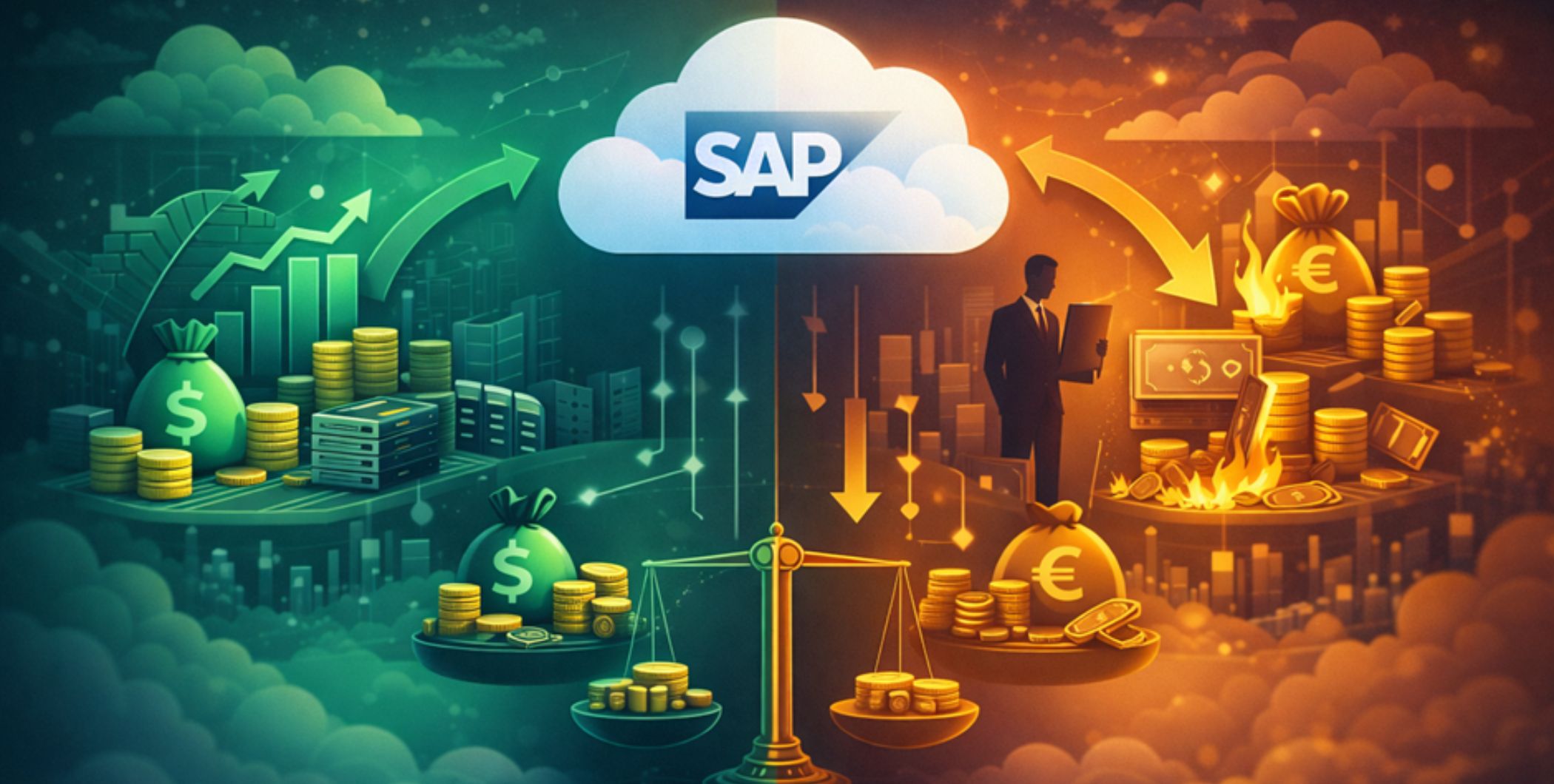

The process of moving SAP to the cloud is triggered by a very simple argument in the case of the majority of businesses: to reduce infrastructure costs, to be flexible, and to avoid using old hardware. The pitch is real. In 2025, the money spent by enterprises across the world on public cloud services is 723 billion, which is 21.5 per cent higher than the money spent last year ¹. There is no sense in such money flowing without purpose. Businesses are fed up with the turtle pace of upgrades, data and capital budget fragmentation that expands without any value generation. In Cloud, SAP systems can be implemented in hours as opposed to months, provide on-demand access to centralised information, and scale without extra hardware. Technology is not simply replaced, since migration to the cloud is more of a paradigm shift in terms of investment and value creation in organisations, and there are also latent trade-offs in migration.
The Gains That Are Easy to See
The victories in the short term are tangible. A Forrester Total Economic Impact SAP S/4HANA analysis to determine ROI and payback showed a payback period of 13 months and an ROI of 134 percent over three years ². Among the 110 surveyed customers, 37% indicated that S/4HANA directly facilitated revenue gains of an average of 3.2%, and 30% claimed it created entirely new revenues of an additional 2.6%. Customer retention also improved, as there was a 4.1% reduction in annual customer churn, which was worth $8.4 million over three years ².
There is also a change in operational dynamics beyond revenue. IT costs have been lowered by 15 percent over the last five years by SAP clients ³. It resulted in end-user productivity gains of 2.1 million, and one-half of the companies reported reduced run time that saved staff an average of 100 minutes per week ². It reduces the time to deployment, costs are less uncertain as CAPEX is replaced by OPEX, and compliance becomes an element of day-to-day operations rather than a fire drill. The five-year savings for organisations moving SAP workloads to the cloud average 25–30 percent in hardware and staffing savings in TCO ⁴.
The Less Visible Cost of Staying Behind
The accrued costs are usually hidden and start to build up before the migration process begins, especially for organisations that put it off. ECC will cease to be supported in the mainstream in 2027 ⁵. Its maintenance costs until 2030 are at a premium, and the rate at which consultants who deal with old systems are declining is high. Industry observers suggest that the rates of SAP migration consulting per day are going to increase by up to 50% in 2026–2027 in comparison with 2024 ⁵. As it stands, 61 percent of ECC customers were not licensed to S/4HANA by the deadline of 2024 ⁶, which is a significant figure considering the deadline. ISG notes that firms that wait are likely to pay a premium, since ERP resources are increasingly becoming scarce ⁷. Meanwhile, companies that are already on S/4HANA are exploiting SAP Business AI, real-time reporting, and automated procurement. The actual price is the fact that one is not fast enough.
Where Enterprises Quietly Lose Value
By default, a system is not simplified with cloud migration, and the biggest cause of unseen expense in such a transformation is custom code. Migration work has been estimated to account for approximately 40 percent of custom ABAP code, and each line needs to be scoped, cleaned, and aligned to S/4HANA ⁶. Generations of custom logic have accrued in most SAP deployments over decades, and this causes long-term issues: increasingly complex migrations, sluggish upgrades, and fragile integrations with new technology.
This is reflected in the figures. In a 200-executive survey conducted by Horváth Partners across six countries, 60 percent of S/4HANA transformations were over budget and schedule, and the average project was 30 percent behind schedule ⁸. Only 8% of companies finished on time ⁹. Two-thirds claimed that at go-live there were severe quality deficiencies ⁸. In a different study, researchers discovered that over half of the migrated firms overshot their schedules, and 65 percent of the migrated firms exceeded their budgets without meeting quality expectations ¹⁰. The most typical causes were scope creep, absence of testing and data migration processes, and process loops ⁸. Another issue is the dependency problem, as critical processes are based on specialised logic known only to a few individuals, and every change carries risk. A system that should have empowered the business gradually becomes a constraint.
The Shift from Infrastructure to Architecture Discipline
When the hardware problem has been addressed, we arrive at the actual problem of architecture. What remains in the core? What gets extended? What can be integrated externally? The clean core approach of SAP is specifically designed to ensure that the core ERP is not compromised by customisations but instead drives extensions to SAP BTP or other sidecar platforms¹¹. A clean core makes the system more productive, improves data quality, enhances stability during upgrades, and allows organisations to embrace new possibilities, such as AI, without decades of workarounds ¹¹. Through appropriate governance, organisations will be able to adopt advanced analytics, intelligent automation, and generative AI on a platform that does not become unstable each time the core is updated.
The Real Economic Trade-Off
The Forrester study quantifies the trade-off: total benefits of 38.2 million and costs of 16.3 million, giving a net present value of 21.9 million after 3 years ². However, such ROI does not come on a silver platter. It is achieved by organisations that consider migration to be a technical and architectural change, rather than a lift-and-shift process. Those companies that believe that migration is a normal upgrade will tend to fall into the 60 percent that exceed budgets and timelines. The clean core principles and disciplined change management, along with investment in early data archiving, enable organisations to experience the full benefits. Complexity is not eradicated by the cloud; it is redistributed to where it must be managed in a more strategic manner. Those companies that recognise this difference are the ones laying the groundwork for expansion, not just a faster server.
Sources
[1] Gartner, “Forecast: Public Cloud Services, Worldwide, 2022–2028,” November 2024. https://www.ciodive.com/news/cloud-spend-growth-forecast-2025-gartner/733401/
[2] Forrester Consulting, “The Total Economic Impact of SAP S/4HANA,” commissioned by SAP. https://www.altivate.com/wp-content/uploads/2020/04/The-Total-Economic-Impact-Of-SAP-S4-HANA.pdf
[3] Fingent, “Cost-Benefit Analysis of SAP S/4HANA Migration,” 2024. https://www.fingent.com/blog/cost-benefit-analysis-of-sap-s-4hana-migration/
[4] TForce, “SAP Cloud Migration USA: Save Costs & Boost Agility in 2025.” https://www.tforce.com.sa/how-sap-cloud-migration-helps-u-s-enterprises-cut-costs-in-2025/
[5] MyBusinessFuture, “SAP S/4HANA Migration: 60% Over Budget,” 2026. https://mybusinessfuture.com/en/sap-s4hana-migration-60-over-budget-what-midsize-companies-must-know-before-2027/
[6] Panaya, “Automatic Code Corrections: A Game Changer for SAP Development,” 2025. https://www.panaya.com/blog/sap/automatic-code-corrections-a-game-changer-for-sap-development/
[7] ISG, “Still on ECC? Why Delaying S/4HANA Migration Could Hurt Your Bottom Line,” 2024. https://isg-one.com/articles/still-on-ecc–why-delaying-s-4hana-migration-could-hurt-your-bottom-line
[8] Horváth Partners, “Business Transformation Unlocked – Maximizing the Benefits of SAP S/4HANA,” 2025. https://www.horvath-partners.com/en/press/detail/study-shows-sap-s-4hana-transformations-rarely-go-as-planned-60-percent-exceed-budget-and-schedule-two-thirds-dissatisfied-with-result-quality
[9] SoftwareSeni, “Why SAP Migrations Fail at a Rate That Should Concern Every Decision Maker,” 2026. https://www.softwareseni.com/why-sap-migrations-fail-at-a-rate-that-should-concern-every-decision-maker/
[10] Datalark, “Top 7 SAP S/4HANA Migration Challenges and How to Overcome Them,” 2025. https://datalark.com/blog/sap-s4hana-migration-challenges
[11] SAP Learning, “Analyzing the Benefits of Clean Core for Users,” 2024. https://learning.sap.com/courses/managing-clean-core-for-sap-s-4hana-cloud/