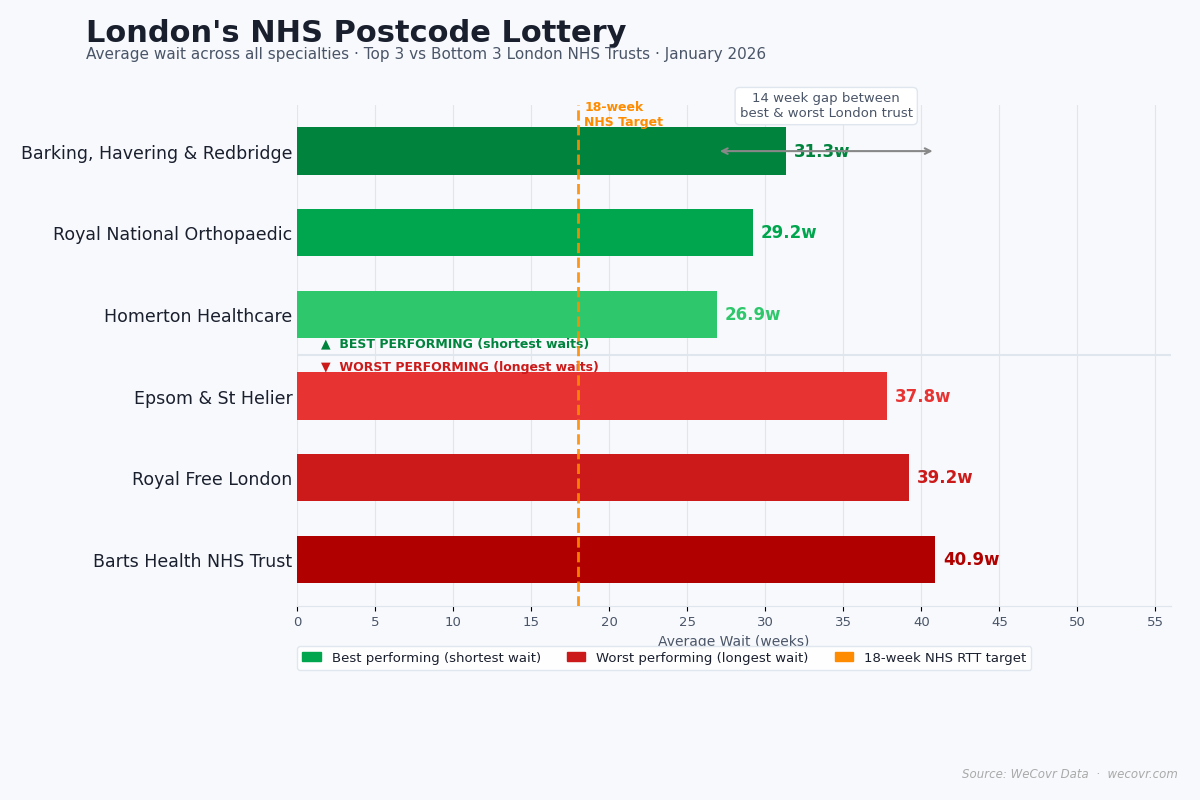

London is a city of micro-economies and stark contrasts, but perhaps the most severe divide currently facing the capital is largely invisible: the healthcare postcode lottery.
When national policymakers and health economists discuss the current NHS backlog, the conversation is frequently dominated by broad, national averages and central funding debates. However, a closer analysis of the latest official Referral to Treatment (RTT) data reveals that for Londoners, the speed of access to routine medical care depends heavily on which borough they call home.
Across the capital’s complex network of NHS trusts—from Barts Health in the east to Imperial College Healthcare in the west—waiting times for the exact same procedures vary drastically. The official NHS target states that patients should wait no longer than 18 weeks from referral to treatment. Yet, current data indicates that zero out of 23 medical specialties are meeting this standard nationally.
Inside the M25, this systemic strain manifests as a deeply localised postcode lottery. A patient referred for routine orthopaedic surgery or gynaecological care in one London borough may find themselves waiting months longer than a patient requiring the exact same procedure just a few miles away under a different Integrated Care Board (ICB). This extreme geographic disparity proves that the “national” backlog is, in reality, a collection of highly localised bottlenecks driven by trust-level capacity, staffing, and management.
The economic implications for London’s workforce are profound. The capital’s economy relies heavily on self-employed professionals, freelancers, and small business owners. For these workers, a delayed diagnosis or a postponed joint replacement does not merely result in prolonged physical discomfort; it translates directly into lost income and business disruption. When a routine wait stretches toward the 52-week mark, individuals are effectively forced out of the active labour market.
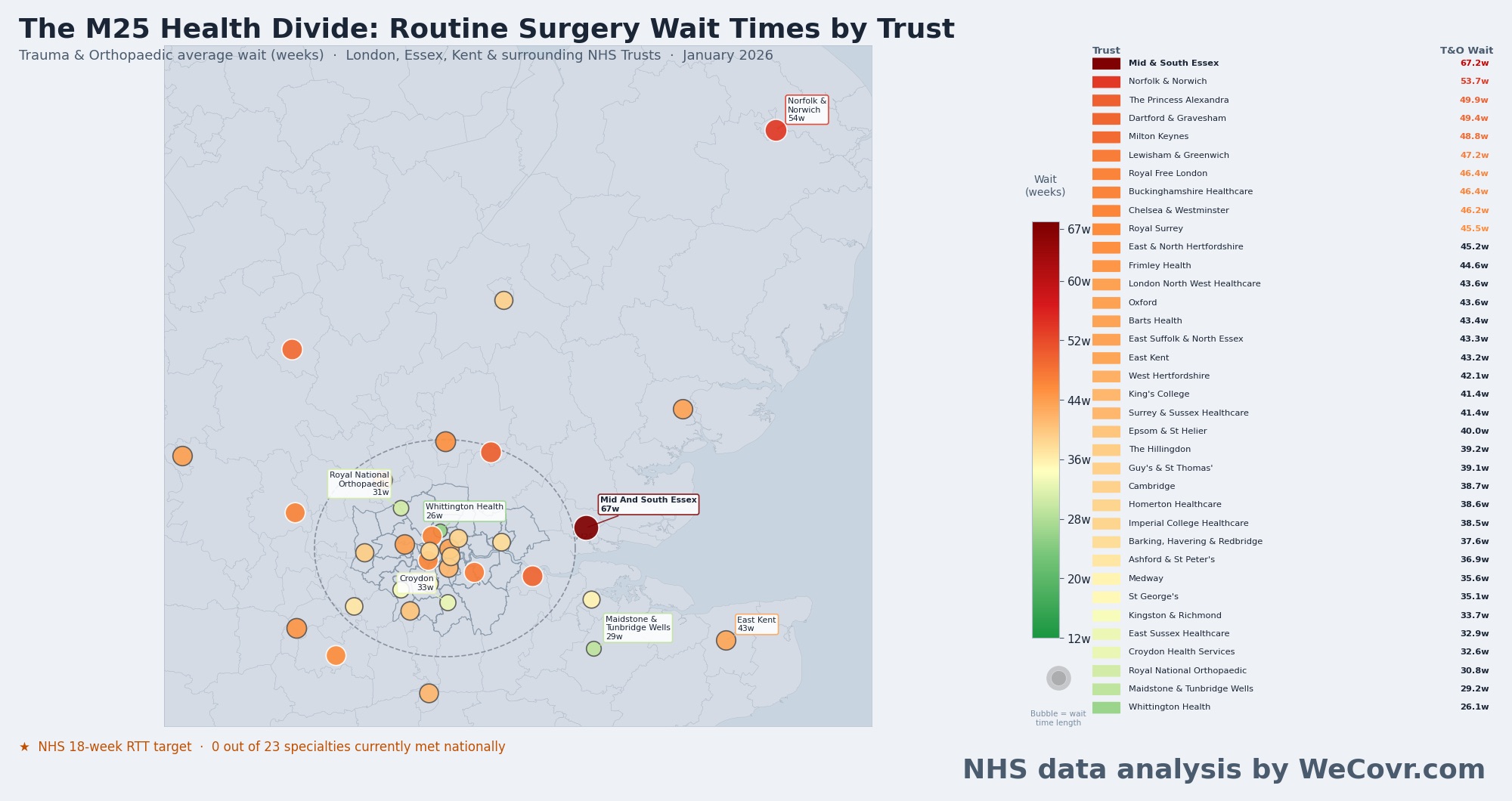
As a result of these local delays, broader healthcare industry trends are shifting rapidly. There is a well-documented, significant rise in UK patients opting for “self-pay” private medical treatments or purchasing private medical insurance to bypass struggling local trusts. For many working Londoners, this shift is no longer viewed as a luxury, but rather as an economic necessity. Patients are increasingly calculating that the upfront cost of private healthcare is ultimately lower than the long-term financial devastation of missing a year of work.
Navigating this fractured system requires a high degree of data transparency. Independent research platforms and data aggregators have stepped in to help map these trust-by-trust disparities. For example, healthinsurtech firm WeCovr recently processed the official NHS datasets to build interactive tools that track these specific geographical wait-time gaps. By translating millions of rows of raw RTT data into accessible formats, these platforms allow the public to see exactly how their local hospital is performing against national benchmarks.
Understanding exactly where local bottlenecks exist empowers patients to have more informed conversations with their GPs about alternative referral pathways or the viability of transferring to the independent sector.
Ultimately, resolving the healthcare crisis in London will require more than top-down funding announcements from Westminster. It demands granular, trust-level accountability. Until the extreme variance between neighbouring London boroughs is addressed, the postcode lottery will remain a hidden tax on the capital’s residents, fundamentally altering how Londoners live, work, and access their care.